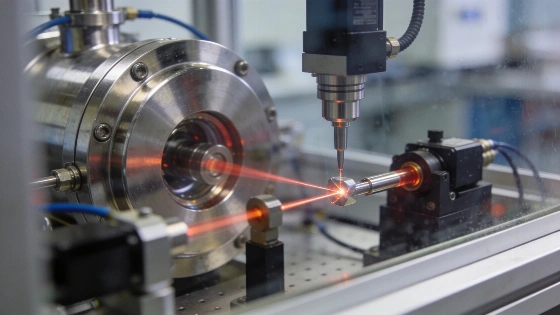
Taiyi Quantum says it integrated its first ytterbium-171 neutral-atom QPU within six months of founding. Its financing update reports a sub-10-microsecond control loop but leaves key processor performance measures unreported
In less than a year, Taiyi Quantum says it integrated its first physical quantum processing unit (QPU), bringing vacuum hardware, narrow-linewidth lasers, optical tweezers and imaging into one system. The integrated platform also combines optical and atomic subsystems, measurement electronics, real-time control and software. That engineering milestone matters for assembling a neutral-atom machine, but the company has not provided the performance data needed to judge how well it computes.
The Shanghai developer was founded in January 2026 and says full-machine integration was completed within six months. On October 10, Taiyi announced a new financing round that took cumulative funding beyond ¥1 billion RMB. The round's amount was not disclosed. The company said the funding would support research hiring, quantum-error-correction and systems-engineering capabilities, industry collaboration and open-source ecosystem development, as GMT EIGHT reported.
From components to a QPU
A neutral-atom processor uses individual atoms as physical qubits. Optical tweezers-tightly focused laser beams-can trap and reposition atoms, while imaging is used to determine their locations. Taiyi says it brought those subsystems together with vacuum and laser equipment in its first prototype. Integration is a necessary engineering step; by itself, it does not establish how many qubits can be controlled reliably or what calculations the system can perform.
The company focuses on ytterbium-171 (171Yb) arrays. Its platform description identifies nuclear-spin clock states as a route to extended coherence and points to multi-qubit entangling gates and physical erasure-error detection. Those are relevant design features, but the announcement supplies no measured coherence time, gate fidelity or error-detection result. It therefore does not show how those properties perform in the integrated machine.
Taiyi was co-founded by CEO Fang Zhenghao and CTO Dr. Liu Hongbin. A report by Shanghai outlet 上观新闻 identifies Liu as a former Chief Architect of Microsoft Quantum. The company says its team has grown to nearly 100 researchers recruited from MIT, Cambridge, UPenn, LMU Munich, Tsinghua and CQT Singapore. It has also open-sourced LUOSHU, a compiler designed for neutral-atom movement, changing connectivity and entangling-gate scheduling. The compiler is intended as a software layer between quantum algorithms and neutral-atom hardware.
Control is not fidelity
Taiyi reports reducing real-time control latency to under 10 microseconds. The figure describes the feedback loop from optical-camera input through FPGA/GPU processing to dynamic rearrangement of atoms with optical tweezers. The Chinese report describes a roughly 10-microsecond feedback interval that includes image acquisition, data processing and atom rearrangement. Fast feedback can help a system respond to measured atom positions, but latency is not a measure of gate accuracy or of the probability that a full calculation returns the right answer.
The announcement gives no physical-qubit count for the prototype, gate or readout fidelity, circuit depth, or results from repeated operation. It also does not specify the conditions under which the latency was measured. Without those details, the reported control speed cannot be compared with another processor's performance or used to estimate computational capability.
A separate neutral-atom report addressed atom-array features used in toxicity classification. That is a different kind of result from Taiyi's hardware-integration claim, and it does not provide evidence about this prototype's gate performance.
A target still ahead
The company says its hardware and real-time error-decoding pipelines are being designed around fault-tolerant error correction, with a target of 100 logical qubits. That is a design target, not a report that 100 logical qubits have been built. The announcement gives no code, physical-qubit overhead, logical error rate or error-correction-cycle results with which to assess progress toward it.
In this announcement, the clearest numerical engineering result is the reported control latency: below 10 microseconds. The other headline figures describe scale and financing rather than processor performance: nearly 100 team members, a 100-logical-qubit target, and more than ¥1 billion RMB in cumulative funding. Taiyi's announcement put the total at about $149.6 million USD. New investors in the October round included Jinqiu Fund, Yunbai Capital, Hongruida Investment, Chengdu High-Tech Zone Vision Fund and Lingang Frontier Investment; existing investors Huakong Fund, Hengxu Capital, Boyuan Capital, Gaomai Capital and Yaru Capital also increased their investments. The announcement described the transaction as giving Taiyi unicorn valuation status, without stating a valuation figure.
Funding and evidence
The financing follows a ¥300 million RMB ($44 million USD) Pre-A round in June 2026. Taiyi said that funding established a 1,000-square-meter cleanroom in Shanghai's Xuhui District and began its full-stack ytterbium hardware manufacturing strategy. Those are company-reported business and infrastructure milestones; they do not establish manufacturing yield or repeatable processor performance.
The material available for this announcement does not identify a peer-reviewed technical paper or independent replication of the prototype results. The distinction matters: assembling a working machine and closing a fast control loop are meaningful engineering achievements, while claims about high-fidelity gates or fault tolerance require measurements of errors and their behavior across repeated operations. For now, the reported milestone is integration, not a demonstrated fault-tolerant computer.
A physical qubit is an individual quantum system used to encode information; a logical qubit stores information across multiple physical qubits so errors can be detected or corrected. The number of logical qubits depends on the encoding and the measured error rates, not simply on a design target. A system's latency can describe how quickly it reacts, but only operation-level data can show whether its quantum states and gates remain reliable enough for error correction.