A search for material from the 1939 German invasion uncovered four bronze arrowheads and personal ornaments near Wierzbica. Their tentative Scythian association adds a new site to evidence for steppe contacts in eastern Poland
The searchers had permission to look for traces of fighting during the 1939 German invasion of Poland. Instead, outside the boundaries of any previously registered archaeological site, they found a concentration of prehistoric metal objects near Wierzbica. Members of an association from Lubycza Królewska made the discovery while searching for remains connected with the September 1939 fighting.
Reporting on 29 October 2026, the Polish regional newspaper Dziennik Wschodni described the assemblage as roughly 2,500 to 3,000 years old, dating it broadly to the Late Bronze Age or the beginning of the Iron Age. The findspot is in Lubycza Królewska municipality, Tomaszów County, close to Poland's present-day border with Ukraine.
The finds are preliminarily associated with Scythian activity, but they do not establish who deposited them or whether Scythians lived at the location. The objects were handed to the Voivodeship Office for the Protection of Monuments in Lublin, Zamość Delegation, for heritage assessment. They are expected to be transferred to the museum in Tomaszów Lubelski for preservation and documentation.
Arrowheads and ornaments
Four three-edged bronze arrowheads form the clearest evidence for a Scythian connection. The largest is about 4 centimeters long and 1.4 centimeters wide; traces of casting seams remain along its edges. Two smaller examples measure around 2.5 centimeters by 0.9 centimeters and have no sockets. The fourth has a socket and measures about 3.3 centimeters long and 0.8 centimeters wide.
Three-edged cast-bronze arrowheads are characteristic of weaponry associated with the Scythians, who were known as mounted warriors using composite bows. Historical accounts place Scythian groups across parts of the Eurasian steppe during the first half of the first millennium BC and describe contacts, including raids between the eighth and fifth centuries BC, with communities of the Lusatian culture. Such arrowheads are associated with this steppe military tradition, but their presence alone does not identify the people who deposited the Wierzbica objects.
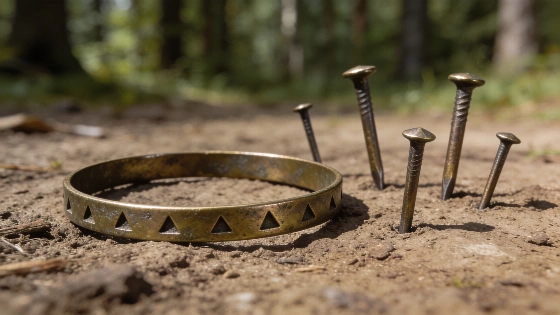
The Wierzbica assemblage also includes personal ornaments. One bronze bracelet was made from a thin sheet about 1 centimeter wide and no more than 0.5 millimeters thick. Punched dots form alternating triangular patterns across its surface. The surviving bracelet is semicircular, with a radius of about 10 centimeters, and its ends turn outward into hooks.
Other finds include fragments of twisted-wire bracelets and nail-shaped temple ornaments. One ornament is nearly complete: its convex head is 1.6 centimeters across and its pin is about 6 centimeters long. Fragments from five more were found together, with surviving heads measuring about 1.2 to 2 centimeters across.
Context and uncertainty
A cast bronze ring measures 3.4 centimeters in diameter. It may have been sewn onto clothing as decoration; researchers have also suggested it could have served as an exchange object. A bent length of bronze wire, with a pointed end and flattened top, may be a fibula pin or another kind of dress pin.
The searchers recorded the metal finds with GPS coordinates. That information could help archaeologists assess how objects are distributed if formal excavation takes place. The search was conducted under permission from the Lublin Voivodeship Conservator of Monuments, after members of the Association for the Remembrance of the 1st Infantry Regiment of the Border Protection Corps began looking for material connected with the 1939 campaign.
The discovery began with a different kind of search from the organized fieldwork described in a Serengeti field report, which covered human remains at a Neolithic pastoralist settlement and a Pleistocene giraffe skull.
A bronze dagger found near Kornie, also in Lubycza Królewska municipality, may belong to roughly the same period. It is about 15 centimeters long, but extensive damage affects its blade and tang. Its dating to the Late Bronze Age or beginning of the Iron Age is provisional, as is its association with Scythian activity; the regional report treats it as a separate nearby find rather than as part of the Wierzbica assemblage.
Scythian-related archaeological evidence is also known from Chotyniec in southeastern Poland, where researchers investigated a fortified settlement associated with the Scythian cultural world. At Wierzbica, the preliminary assessment places the objects in the Late Bronze Age or the beginning of the Iron Age. The arrowheads and ornaments add to the record of prehistoric objects in eastern Poland associated with contacts between steppe peoples and local communities. The objects' depositional history remains unresolved, and the assemblage does not by itself establish a settlement, burial, battlefield or hoard.