Chicago researchers gain dedicated on-site quantum hardware for work spanning molecular modeling and grid optimization. The IBM system will anchor the National Quantum Algorithm Center before a planned move to the Illinois Quantum and Microelectronics Park
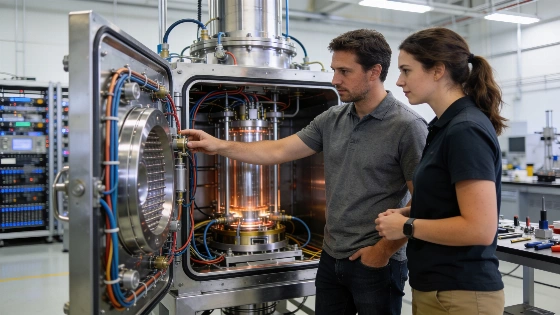
Until this installation, Chicago researchers accessed quantum hardware remotely through the cloud. On November 6, 2026, IBM, the University of Chicago, the State of Illinois and the Illinois Quantum and Microelectronics Park (IQMP) unveiled an IBM Quantum System Two at Hyde Park Labs. IBM said the system was operational and hosted by the University of Chicago, making it the company's first quantum computer installed in Illinois.
Local execution
IBM unveiled the system with the University of Chicago, with the State of Illinois and IQMP as partners. The computer is initially operating at Hyde Park Labs and is expected to move to IQMP when the permanent campus is complete. The campus is being developed on the former U.S. Steel South Works site on Chicago's Southeast Side.
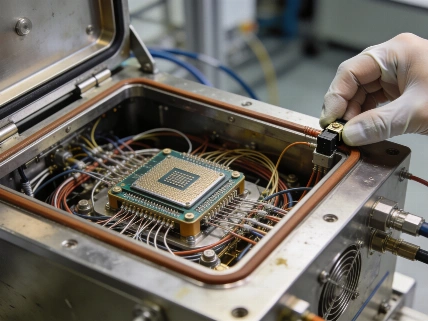
The system uses IBM's Quantum Nighthawk processor architecture. IBM describes Nighthawk as designed for quantum-advantage workloads, with square-lattice connectivity, high circuit throughput and real-time pulse control. IBM's technical materials say these features let researchers test error-correction techniques. IBM identified the Nighthawk r2 as a 120-qubit processor and announced in November 2025 that Nighthawk was intended to support circuits with 30 percent more complexity. Those are architecture and product-development specifications; IBM has not reported Chicago-specific benchmark results or measured error rates. The company's description of Nighthawk is available in its technical overview.
Projects on the system
The installation anchors ongoing National Quantum Algorithm Center (NQAC) Grand Challenges projects. One effort applies molecular modeling to drug discovery, with Deloitte and AbbVie among the collaborators. IBM and Northwestern University are also involved. Another project develops power-grid optimization workflows with EPRI and the University of Illinois Urbana-Champaign.
Optimization research also appears in a separate maritime algorithms study, which describes a planned comparison of hybrid methods with classical heuristics. The Chicago projects named in the announcement focus on molecular modeling and grid workflows.
Fermilab's work on distributed quantum computing architectures and high-energy physics simulations is another part of the system's research context.
Established in 2024 through an Illinois initiative led by Governor JB Pritzker, the NQAC includes IBM as a leading member and is focused on advancing quantum algorithms and applications. IBM says organizations across Illinois are working with the Chicago system to explore computationally difficult problems. On November 6, 2026, IBM described the installation as an operational research resource and said it would become a prominent fixture of IQMP after the campus is completed. The company's announcement of the Chicago installation describes the collaboration.
Training and relocation
IBM also announced the integration of the FutureNow Chicago center at IQMP in partnership with City Colleges of Chicago. The initiative aims to train local practitioners and support 750 regional technology jobs. Its stated fields include quantum computing and cybersecurity, with data science also in scope.
IQMP is being developed as a campus for quantum computing and microelectronics innovation. It is intended to house the quantum computer and the NQAC after construction is complete; IBM has not announced a relocation date. Harley T. Johnson, IQMP's chief executive, called the installation "probably the most publicly visible quantum computer in the world."