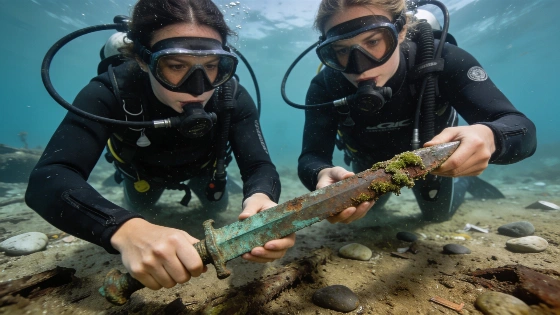
A 3,000-year-old Bronze Age sword has been recovered by volunteer divers from the Salcombe Cannon and Moor Sand sites off south Devon, offering new evidence for prehistoric maritime activity and trade in the region
An exceptionally well-preserved Bronze Age sword has been recovered from the seabed off the south Devon coast, adding to the archaeological record of prehistoric maritime activity in the region. The find was made by experienced volunteer divers from the South West Maritime Archaeological Group during a survey of the Salcombe Cannon and Moor Sand Protected Wreck Sites, with support from Historic England. The sword was located in a context that has previously yielded a significant assemblage of Bronze Age material, including weapons, ornaments, and gold objects.
Context of the Discovery
The Salcombe area has produced one of the richest collections of prehistoric maritime artifacts in Britain. Over recent decades, more than 400 gold objects, bronze swords, axe heads, and a gold bracelet have been recovered from the protected wreck sites. These finds are believed to originate from one or possibly two Bronze Age shipwrecks, although the precise circumstances of deposition remain uncertain. The newly recovered sword was found in association with other Bronze Age material, reinforcing the interpretation that this stretch of coastline was a focal point for trade and exchange during the Middle to Late Bronze Age, approximately 1300-800 BCE.
Archaeologists have emphasized the importance of the sword's preservation, noting that while some blade material has been lost to centuries of submersion, the artifact remains a rare and informative example of Bronze Age weaponry. The sword's typology and context support its dating to the later second millennium BCE, a period marked by increased maritime connectivity around the British Isles and across the Channel.
Material Evidence and Analytical Plans
The sword was recovered by divers Becky Gill and Catherine Gill, who described the find as a highlight of their fieldwork. Following recovery, the artifact was transferred for specialist conservation to stabilize the metal and prevent further deterioration. Once conservation is complete, the sword will be accessioned into the British Museum's national archaeological collection, where it will undergo detailed scientific analysis. This process is expected to include metallurgical examination, typological comparison, and potentially residue or use-wear analysis to clarify its manufacture and use-life.
The Salcombe site's cumulative assemblage provides a rare opportunity to study Bronze Age maritime networks. Previous research has suggested that the concentration of high-value objects, including gold ingots and weapons, may reflect either shipwreck events or deliberate deposition. The presence of multiple swords and other prestige items supports the interpretation of the area as a node in long-distance exchange systems. For comparison, discoveries such as the Iron Age child burial with a sword at Bois Médor in France, discussed in this related report, highlight the diversity of weapon deposition practices across prehistoric Europe.
Interpretation and Limitations
While the sword's recovery adds to the evidence for Bronze Age seafaring and trade, several interpretive challenges remain. The precise circumstances of deposition-whether the result of shipwreck, ritual offering, or loss during transport-cannot be established with certainty from the available context. The lack of associated human remains or clear stratigraphic association limits the ability to reconstruct the original event. Nevertheless, the repeated recovery of similar artifacts from the Salcombe area strengthens the case for sustained maritime activity and exchange during the later Bronze Age.
Specialists caution that while the sword is a significant addition to the archaeological record, it represents only one data point within a broader pattern of finds. Ongoing underwater survey and conservation work are essential for building a more complete picture of prehistoric maritime networks and the movement of people and goods along Britain's southern coast.
Conservation and Future Research
The sword is currently undergoing conservation to halt corrosion and stabilize its structure after centuries underwater. Once conserved, it will be subject to scientific analysis at the British Museum, including metallurgical testing and typological study. The results are expected to contribute to broader research on Bronze Age metalworking, trade, and seafaring in northwestern Europe. The Salcombe site remains a focus for ongoing archaeological investigation, with further underwater surveys planned to document and protect additional material.
Understanding the significance of underwater finds like the Salcombe sword depends on careful conservation and contextual analysis. The integration of artifact typology, metallurgical study, and site survey data is essential for reconstructing the scale and nature of prehistoric maritime activity in the region.
Archaeological provenance refers to the documented origin and context of an artifact or feature within a site. Secure provenance is critical for interpreting the meaning and significance of finds, as it establishes their relationship to other material and to the broader archaeological record. In underwater archaeology, provenance can be especially challenging to establish due to disturbance, movement of objects, and limited stratigraphic control. The value of discoveries like the Salcombe sword depends not only on their preservation but also on the quality of contextual information available to researchers.