
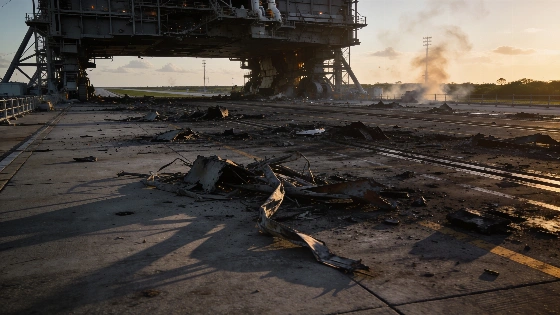
A Blue Origin New Glenn rocket explosion at Cape Canaveral produced infrasound waves detected more than 1600 kilometers away. Researchers used specialized sensors to estimate the blast's energy and assess its impact on launch operations and future missions.
When Blue Origin's New Glenn rocket exploded during a ground test at Cape Canaveral in May 2026, the event was not just a setback for commercial launch ambitions-it was a physical phenomenon on a continental scale. Infrasound sensors across the United States registered the blast's signature, with the most distant detection coming from northeast Texas, over 1,600 kilometers from the launch site. The scale of the explosion, now quantified in a peer-reviewed study, places it among the most energetic prelaunch failures ever recorded at a U.S. space facility.
Infrasound evidence and measurement
The new analysis, published in The Seismic Record, draws on data from 36 infrasound monitoring stations distributed across the country. Infrasound refers to acoustic waves at frequencies below the threshold of human hearing, which can travel vast distances through the atmosphere. These sensors, originally designed for nuclear test monitoring and meteor detection, captured the pressure waves generated by the New Glenn explosion. The farthest confirmed signal was recorded in Texas, more than 1,000 miles (1,684 kilometers) from Cape Canaveral.
By comparing the amplitude and timing of the infrasound arrivals at multiple stations, researchers estimated the explosion's energy yield at approximately 0.131 kilotons of TNT equivalent-about 144 metric tons. This figure is slightly higher than some estimates for the initial blast at the Chornobyl nuclear reactor in 1986, though the physical mechanisms differ. The study also inferred that between 3% and 6% of the rocket's cryogenic propellant was consumed in the initial detonation, with the remainder burning off more gradually in the resulting fireball and plume.
Technical context and mission impact
The New Glenn rocket, Blue Origin's largest vehicle, stands 98 meters tall and is designed to compete with SpaceX's Starship and NASA's Space Launch System. Prior to the explosion, New Glenn had completed three launches, including a Mars-bound NASA payload and a partially successful communications satellite deployment. The May 2026 incident occurred during a static hotfire test, not an actual launch, and was later traced to a faulty oxygen valve in the booster stage.
Damage to the Cape Canaveral launchpad was extensive, with repairs expected to take at least a year. This disruption affects not only Blue Origin's commercial schedule but also NASA's planned lunar infrastructure, which relies on New Glenn for key cargo deliveries. No injuries were reported, but the shockwave was felt up to 217 kilometers from the site, and thousands of local residents reported a thunderous boom. The operational consequences echo those seen in other high-profile launch failures, such as the Pallas-1 incident in China reported earlier.
Scientific value of infrasound monitoring
While the explosion itself was a setback, the infrasound data provided a rare opportunity to study a large-scale energetic event in real time. The research team, led by physicist Elizabeth Silber at Sandia National Laboratories, emphasized that infrasound monitoring is an underutilized tool for reconstructing the dynamics of rocket accidents and other atmospheric explosions. The same techniques have previously been used to track meteors and spacecraft reentries, including the OSIRIS-REx sample return capsule in 2023.
Infrasound analysis offers independent constraints on explosion energy, fuel consumption, and event timing, supplementing visual and seismic records. The method is particularly valuable when direct measurements are unavailable or when debris clouds obscure optical observations. The study's findings highlight the potential for global infrasound networks to support planetary defense, launch safety, and forensic investigation of spaceflight anomalies.
Limits and uncertainties
Despite the precision of the infrasound measurements, several uncertainties remain. The exact amount of propellant in the New Glenn booster at the time of the explosion is not publicly known, and the energy estimate depends on assumptions about fuel-oxidizer mixing and combustion efficiency. The comparison to Chornobyl's initial blast is illustrative but not physically equivalent, as the underlying processes differ between chemical and nuclear explosions.
It is also unclear how the incident will affect Blue Origin's long-term launch cadence or NASA's lunar program. The company has not attempted another New Glenn launch since the accident, and the timeline for pad reconstruction remains uncertain. The event underscores the technical and operational risks inherent in large-scale rocket development, especially as commercial providers take on more ambitious missions.
Infrasound is a form of low-frequency sound below the range of human hearing, typically defined as frequencies below 20 hertz. Because these waves can travel thousands of kilometers through the atmosphere with little attenuation, they are used to monitor natural and artificial explosions, meteor entries, and rocket launches. Infrasound sensors convert pressure fluctuations into electrical signals, which are then analyzed for amplitude, frequency, and arrival time. By triangulating signals from multiple stations, researchers can estimate the location, energy, and timing of distant events-even when those events are invisible or inaudible to people on the ground.