NASA's Artemis II crew discussed their 10-day lunar flyby, Orion spacecraft performance, and upcoming mission challenges at a public event in Colorado, highlighting both technical lessons and international collaboration
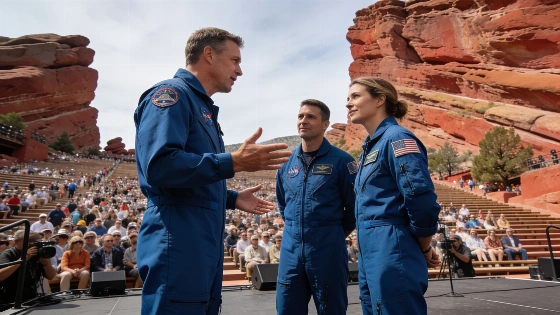
Months after completing the first crewed lunar flyby in over half a century, the Artemis II astronauts gathered at Red Rocks Amphitheatre in Colorado to share insights from their mission and outline the technical and operational lessons shaping NASA's next steps toward the Moon's surface. The event, attended by more than 8,000 people, brought together the four-person crew, mission engineers, and regional aerospace partners to discuss the realities of deep space flight and the evolving architecture of the Artemis program.
Mission Performance and Crew Experience
Artemis II launched on April 1, 2026, sending astronauts Reid Wiseman, Victor Glover, Christina Koch, and Jeremy Hansen on a 10-day journey around the Moon and back, with splashdown in the Pacific Ocean on April 10. This marked the first time since Apollo 17 in 1972 that humans traveled beyond low Earth orbit. The crew's Orion spacecraft, named Integrity, was tasked with validating life support, navigation, and proximity operations in a real mission environment. According to the crew, the spacecraft's habitability and systems performance provided critical data for future missions, especially regarding how four astronauts live and work in the confined volume of Orion during extended flight.
One of the most technically significant demonstrations involved manual proximity operations. The crew piloted Orion by hand during approach and retreat maneuvers relative to the spent upper stage, relying solely on visual cues rather than radar or automated ranging. This exercise tested both the spacecraft's handling and the astronauts' ability to judge distance and orientation in deep space, with Glover emphasizing the trust placed in the crew to execute these tasks without digital aids.
Technical Lessons and Forward Planning
Artemis II's mission objectives included evaluating the spacecraft's heat shield, life support, and overall systems integration under crewed conditions. The astronauts reported that while Artemis I had already demonstrated Orion's technical capability to reach lunar orbit, Artemis II exposed new challenges in crewed operations, such as managing consumables, optimizing sleep and work schedules, and troubleshooting minor system anomalies in real time. These findings are being incorporated into the planning and design for Artemis III, which aims to deliver astronauts to lunar orbit and, for the first time in the Artemis program, attempt a docking with a lunar lander.
NASA officials at the event confirmed that Artemis III is currently targeted for mid-2027, with the mission's primary goal to demonstrate docking with either the Blue Origin or SpaceX lunar lander. Both lander providers are preparing demonstration vehicles to validate docking systems and operational procedures. NASA's leadership acknowledged that these tests are essential for reducing risk ahead of any human landing attempt, and that lessons from Artemis II's proximity operations will directly inform Artemis III's approach to rendezvous and docking.
International Collaboration and Public Engagement
The Artemis II mission underscored the international nature of NASA's lunar ambitions, with Canadian astronaut Jeremy Hansen highlighting the importance of global cooperation in space exploration. The event at Red Rocks also recognized the contributions of hundreds of suppliers and more than 10,000 employees across the Rocky Mountain region, reflecting the distributed industrial base supporting Artemis hardware and operations. Colorado's role as a hub for aerospace engineering was emphasized by state officials, who noted the region's proximity to both the space industry and the physical altitude advantage for testing and development.
Public engagement was a central feature of the gathering, with the crew fielding over 1,300 questions from attendees, including students participating in a STEM festival. The astronauts described the psychological impact of seeing Earth from lunar distance, using simple visual analogies to convey the scale and isolation of deep space travel. Personal items carried on the mission, such as family letters and symbolic objects, were shared as examples of the human dimension of exploration.
Risks, Uncertainties, and the Path to the Lunar Surface
While NASA remains focused on landing near the Moon's south pole, agency officials acknowledged ongoing debate about the optimal site for the first Artemis landing. Some mission planners, including Artemis II pilot Victor Glover, have suggested a gradual approach to the south pole, citing the technical and operational risks of targeting this challenging region on the initial attempt. NASA's leadership stated that both lander designs are being tailored for south polar operations, but that demonstration missions will be used to validate docking and surface access before committing to a crewed landing.
As the Artemis program advances, technical milestones such as the deployment of new lunar surface instruments remain critical. For example, NASA's recent completion of the Lunar Environment Monitoring Station (LEMS) for Artemis surface deployment, as reported in Science Report's coverage of lunar seismic monitoring, illustrates the layered approach to risk reduction and scientific return. The Artemis II crew's experience with manual spacecraft control and real-time problem-solving will inform both operational protocols and astronaut training for future missions.
NASA's current schedule anticipates Artemis III in 2027, but the agency has emphasized that technical readiness, not calendar targets, will determine when astronauts attempt the next major step: docking with a lunar lander and, eventually, returning humans to the Moon's surface.
Proximity operations in space refer to the controlled movement of one spacecraft relative to another, often for the purpose of docking, inspection, or rendezvous. Unlike automated systems that use radar or lidar for precise ranging, manual proximity operations rely on the crew's ability to interpret visual cues and instrument displays to judge distance, orientation, and approach speed. This skill is especially critical in deep space, where communication delays and limited sensor data can complicate real-time decision-making. The Artemis II demonstration of manual control provided NASA with valuable data on human performance and spacecraft handling, informing both future mission design and astronaut training for complex maneuvers near the Moon.