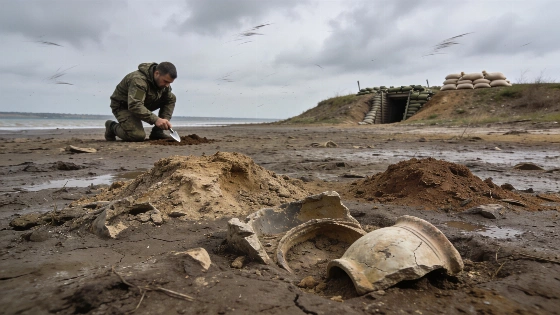
As the Kakhovka Reservoir in Ukraine recedes, archaeologists warn that prehistoric and Cossack-era sites are being revealed-but ongoing conflict and looting threaten their preservation and study.
The draining of the Kakhovka Reservoir in southern Ukraine has uncovered a landscape that was underwater for seventy years, exposing archaeological sites from the Late Palaeolithic through the Cossack era. But the chance to study these remains is slipping away. Ongoing war and looting have halted any systematic research. Ukrainian archaeologist and military officer Serhiy Nemtsev says that fieldwork on the reservoir bed is currently impossible due to the conflict, and all research has stopped. He notes that while access might return in the future, for now, the archaeological record is at risk of being lost for good.
Sites at risk
Nemtsev describes the former reservoir bed as a potential archive of settlements, burial grounds, and fortifications. The area, once covered by 200,000 hectares of water, includes the remains of the Golden Horde city Mamai-Sarai and the Velykyi Luh, a region important to Zaporizhian Cossack history. Before the 1950s flooding, surveys documented sites like Babino III, a Middle Bronze Age settlement from around 2100-1600 BCE, and Kamyanske, linked to the Early Bronze Age Yamnaya culture. These early investigations found distinctive pottery and stone construction, but much of the region was never explored before it was flooded. Expeditions before the Kakhovka Hydroelectric Station was built managed only rapid surveys and excavations. The territory is considered an archaeologically continuous zone, with sites ranging from the Late Palaeolithic to the Cossack Siches, including Babino, Ushkalku, and Kamyanske.
Now, as the water recedes, archaeologists face a new problem: the destruction of context. Defensive trenches and fortifications built by both Ukrainian and Russian forces have cut through archaeological layers. Illegal metal detecting and looting have increased. Nemtsev reports that "black archaeologists"-illegal diggers-are already active, and the legal framework for protecting heritage is weak. Artifacts lose much of their scientific value when removed without documentation, and prosecutions are rare. This situation is similar to what has happened in other conflict zones, as noted in studies published by journals like Nature and Science.
Evidence and uncertainty
Before the reservoir was created, emergency excavations and surveys gave a glimpse of the region's archaeological depth. Babino III became a reference point for a major Bronze Age culture, with its pottery style found in burial mounds across the steppe. The lower Dnipro valley's resources attracted people from prehistoric foragers to Cossack communities. But the full extent of settlement is still unknown, since many sites were never investigated before being submerged. Nemtsev points out that the region is an unbroken archaeological zone, with evidence from the Late Palaeolithic to the Zaporizhian Siches, but systematic fieldwork has stopped since the war escalated.
Some of the most important remains may be in the lowest parts of the landscape, where settlements clustered near the old river and floodplain. These areas, previously underwater, could hold evidence of Mesolithic river communities and Cossack Siches-self-governing military centers-whose locations are only partly known. The fate of these sites now depends on the outcome of the war and whether the reservoir will be restored or the land left exposed. Regional reports from 2026 say that after the dam was destroyed on June 6, 2023, downstream areas flooded while upstream zones dried out quickly. Local experts do not expect the reservoir or its infrastructure to be restored to their previous state.
In the Kherson region, only two archaeologists were working locally before the 2022 invasion. With Nemtsev now serving in the military and his colleague Denys Sikoza focused on heritage protection and monitoring destruction for the regional monument protection inspectorate, no systematic fieldwork is happening. The lack of professional oversight has left the region's archaeological record exposed to both military activity and illegal digging. This mirrors concerns raised by international research centers such as the Max Planck Society about the impact of conflict on cultural heritage.
Looting and conservation challenges
The disappearance of the reservoir has led to a surge in illegal digging. Online marketplaces and social media now show metal-detected finds from the exposed landscape, encouraging more looting. The loss is not just the objects themselves; the context-essential for dating and interpretation-is often destroyed. Nemtsev points to the seizure of thousands of antiquities from a former Crimean official's Kyiv property as evidence of the scale of illicit collecting, but such cases rarely benefit museums or the public. The weak legal framework and rare prosecutions make the problem worse, as highlighted in recent Ukrainian ecological field reports.
Uncertainty over the reservoir's future complicates any conservation plan. Archaeologists cannot organize surveys or excavations without knowing if the area will stay accessible or be reflooded. The region's islands and former riverbanks, including sites like Bazavluk Island and the Kamyanska and Oleshky Siches, may hold more evidence of Cossack life, but these opportunities are fading as the landscape changes. By 2026, only about 12% of the former water volume remains in ponds, and a young willow-poplar forest now covers tens of thousands of hectares of the exposed reservoir bed, according to recent regional overviews.
Similar problems have been seen elsewhere, such as the case of a Turkic stone statue in Kyrgyzstan, where exposure and lack of protection have also threatened archaeological context.
Numbers and preservation
Before the flooding, archaeological teams surveyed and excavated some areas along the lower Dnipro, but the scale was limited. The Kakhovka Reservoir covered about 200,000 hectares, submerging settlements, burial mounds, and fortifications across a region inhabited for millennia. Babino III alone provided evidence for a Bronze Age culture that occupied most of present-day Ukraine outside the west for about two centuries. But the number of sites lost or now exposed is unknown, and with no systematic fieldwork, new discoveries risk being undocumented or destroyed. A new ecosystem is forming on the former reservoir bed, not a return to the historical landscape, making pre-flood conditions impossible to restore, as confirmed by 2026 Ukrainian field studies and international environmental research published by journals such as Science.
Nemtsev and his colleagues hope to return to sites like Skelka, an ancient Greek settlement first recorded in 1895 and partly excavated before the pandemic and invasion stopped work. For now, the region's archaeological future depends on the course of the war, policy decisions, and the actions of looters. The exposed landscape offers a rare research opportunity, but without immediate protection and coordination, much of its value could be lost. The lesson from Kakhovka is that archaeological potential alone is not enough-preservation depends on stability, resources, and the rule of law. These challenges are now being discussed by institutions such as Harvard and MIT, which have called for international cooperation to protect cultural heritage during crises.
Archaeological context means the physical and spatial relationship between artifacts, features, and their surroundings. When objects are removed without documentation, as happens with looting or unrecorded construction, information about their original position, association with other finds, and stratigraphic layer is lost. This makes it much harder to date artifacts, reconstruct past activities, or understand a site's broader significance. Controlled excavation and careful recording are essential for turning objects into meaningful evidence about the past.