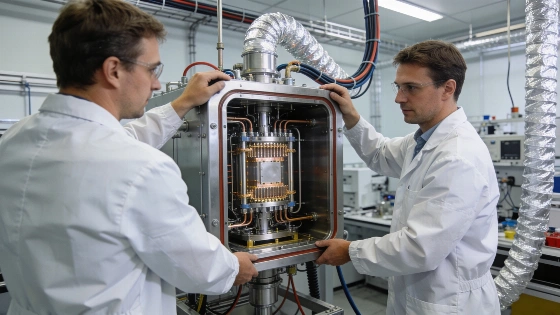
Anyon Systems has partnered with Matrix Group's KMT Technologies to distribute and integrate superconducting quantum processors with high-performance computing and AI infrastructure in select international markets
Anyon Systems, a Canadian developer of superconducting quantum hardware, has entered a strategic partnership with KMT Technologies Ltd., part of the Matrix Group, to expand the deployment of on-premises quantum computing systems internationally. Under the agreement, KMT will serve as the exclusive distributor and integration partner for Anyon's quantum processors in selected regions, focusing on installations that combine quantum hardware with high-performance computing (HPC) and artificial intelligence (AI) resources.
Superconducting Quantum Processors
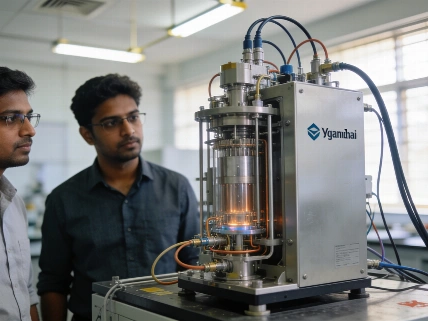
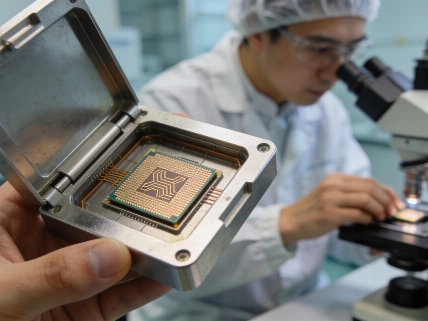
The physical platform at the center of this partnership is Anyon Systems' superconducting quantum processor, which is manufactured in-house and includes the quantum processing unit (QPU), cryogenic dilution refrigerator, control electronics, and the open-source Julia-based software suite, Snowflurry. The company's current hardware includes the MonarQ system, a 24-qubit device previously deployed at Calcul Québec and integrated into Canada's national academic HPC network. Anyon reports that its next-generation platform will feature 72 physical qubits, with a roadmap extending toward systems exceeding 100 qubits.
Integration with HPC and AI Infrastructure
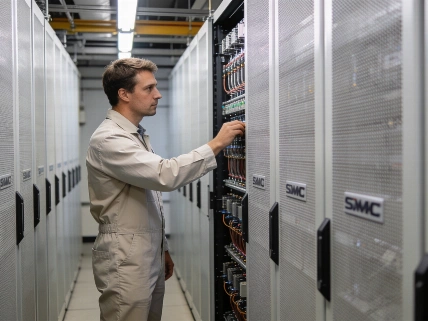
The collaboration aims to address the growing demand from governments, defense agencies, and research supercomputing centers for sovereign, on-premises quantum computing capabilities. A key technical focus is the development of fourth-generation quantum control electronics that enable direct, high-speed connectivity between the QPU and GPU-based AI clusters using Remote Direct Memory Access (RDMA). This architecture is intended to provide a low-latency, high-bandwidth data path between classical and quantum resources, supporting hybrid workloads where quantum processors act as specialized accelerators within larger HPC environments.
Deployment, Support, and Engineering Challenges
KMT Technologies will establish regional engineering teams, certified by Anyon Systems, to manage installation, commissioning, and ongoing maintenance of the quantum systems. The integration of quantum hardware into existing data centers presents significant engineering challenges, including cryogenic infrastructure, electromagnetic shielding, and the need for reliable, low-noise control and readout electronics. The company's approach emphasizes full lifecycle support, from initial deployment to long-term operation, in environments where uptime and system stability are critical.
Roadmap and Scalability Constraints
While Anyon's roadmap projects a path toward quantum processors with more than 100 physical qubits, the practical utility of such systems will depend on improvements in qubit coherence, gate fidelity, error rates, and system integration. The company has not yet reported the demonstration of logical qubits or fault-tolerant error correction, which remain essential milestones for scalable quantum computing. As with other superconducting platforms, scaling beyond tens of high-quality qubits requires advances in fabrication yield, calibration automation, and control electronics. For context, recent efforts to expand quantum hardware infrastructure-such as the opening of new engineering facilities for silicon spin-qubit processors-highlight the broader industry challenge of moving from laboratory prototypes to reproducible, deployable systems. One example is the expansion of Diraq's silicon spin-qubit engineering hub in Santa Monica, which illustrates the parallel push for scalable quantum device manufacturing (see coverage of Diraq's US facility).
Superconducting quantum processors operate at millikelvin temperatures, typically below 20 millikelvin, using dilution refrigerators to suppress thermal noise and maintain quantum coherence. Each physical qubit is controlled by microwave pulses delivered through carefully engineered wiring and filtered to minimize crosstalk and electromagnetic interference. Gate fidelities above 99% have been reported in leading laboratory systems, but maintaining this performance across larger arrays and over extended operation remains a central engineering challenge. The integration of quantum and classical hardware, especially for hybrid workloads, requires not only high-quality qubits but also robust software, control, and data-transfer infrastructure. The transition from physical to logical qubits-where error correction enables reliable computation-has not yet been demonstrated at scale in commercial superconducting systems, and remains a key benchmark for future progress.