

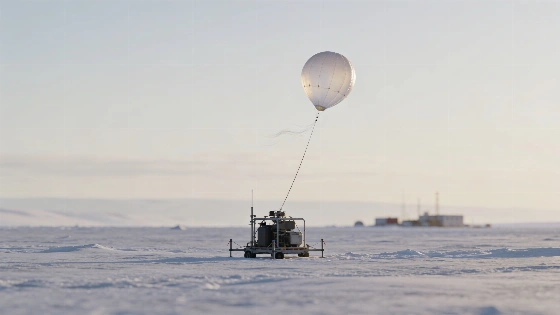
NASA and NOAA measured a 9.6 million-square-mile Antarctic ozone hole across the 2026 depletion season. Balloon readings show it was broad but less severe in ozone concentration than past record lows
An unusually powerful polar vortex kept ozone-depleting conditions over Antarctica in place longer during the 2026 season. NOAA and NASA said atypical weather conditions contributed to the hole's unusually large size.
In measurements reported Nov. 4, NASA and the National Oceanic and Atmospheric Administration (NOAA) ranked the ozone hole seventh largest by seasonal mean area across 48 years of monitoring. From Sept. 7 to Oct. 13, its average extent was about 9.6 million square miles (25 million square kilometers), more than twice the area of the United States. The footprint was large, while measurements showed less severe depletion than at past record lows.
Area and depth
The hole reached its largest one-day extent on Sept. 18, covering 10.5 million square miles (27.1 million square kilometers)-about 90% of the largest observed hole, recorded on Sept. 9, 2000. The seasonal mean and the one-day maximum describe the geographic area affected, not the ozone concentration at every location.
The largest ozone hole observed since monitoring began reached its maximum extent in September 2000. NASA ozone research team leader Paul Newman said ozone-depleting substances were less prevalent in the atmosphere in 2026 than at their peak in 2000; at peak levels, he estimated, the 2026 hole could have been 1 to 2 million square miles (3.5 million square kilometers) larger.
NASA's Aura satellite and the jointly operated NASA-NOAA Suomi National Polar-orbiting Partnership satellite, along with NOAA-20 and NOAA-21, contributed to the satellite measurements. NOAA and NASA also reported that balloon-borne observations at the South Pole Baseline Atmospheric Observatory recorded a 2026 low of 105 Dobson units on Oct. 17. A Dobson unit measures the total amount of ozone in an atmospheric column.
Vortex conditions
The Antarctic polar vortex helps create the cold stratospheric conditions in which chlorine and bromine from human-made compounds deplete ozone. In August and September, planetary-scale weather systems that often disrupt the vortex were especially weak, NOAA research scientist Amy Butler reported. She said the unusually large vortex was partly due to those weaker weather systems. Its strongest winds remained farther from the pole, expanding the area where ozone depletion could occur.
The extent of the depleted region and the concentration of ozone overhead measure different aspects of the event. The 105-Dobson-unit reading above the South Pole was less depleted than the historical low of 92 Dobson units, recorded there in October 2006. NOAA and NASA said the 2026 hole was not as deep as record ozone holes observed in previous decades.
Long recovery
Satellite records have helped track the ozone layer since 1979. NASA's Aura satellite contributed data, as did NOAA-20 and NOAA-21. The Suomi National Polar-orbiting Partnership satellite, jointly operated by NASA and NOAA, also contributed. NASA's broader work includes human-spaceflight operations at Houston's Johnson Space Center, covered in a center profile.
Monitoring shows that controls established by the Montreal Protocol in 1987 continue to drive the long-term recovery of stratospheric ozone. Countries agreed to replace ozone-depleting substances with less harmful alternatives. Stephen Montzka, senior scientist at the NOAA Global Monitoring Laboratory, said chlorine in the Antarctic stratosphere from those substances has declined by about a third relative to 1980s levels.
Chlorofluorocarbons and other ozone-depleting compounds were widely used in refrigerators and air conditioners. They can remain in the atmosphere or escape from old products and landfills for many decades. Scientists estimate that the ozone hole will recover by the 2070s. A 2022 United Nations assessment projected that ozone would return to 1980 levels around 2040 over most of the world, 2045 over the Arctic and 2066 over Antarctica, assuming existing policies remain in place.
Long-term measurements show a general decline in Antarctic ozone-hole size and depth since around 2000, alongside substantial year-to-year variation. A 2026 peer-reviewed analysis in Atmospheric Chemistry and Physics reported that newer results support the conclusion that the hole has generally diminished in size and depth since 2000. NOAA and NASA said the 2026 enlargement was driven primarily by atmospheric conditions and that the protective ozone layer remained on track for long-term recovery.
A Dobson unit is the standard measure used to express ozone concentration. The 105-unit reading describes ozone directly overhead at the South Pole, while the hole's area measures the extent of the region affected by depletion. NOAA and NASA's 2026 measurements combine satellite observations with ground-based and balloon-borne readings; continuing seasonal updates are available through NOAA's South Pole Ozone program and NASA's Ozone Watch.







