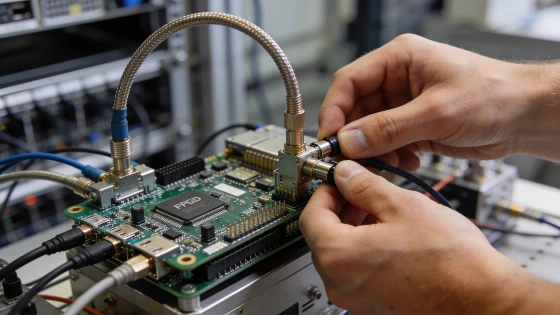
Altera and Riverlane have integrated an open source quantum error correction interface on Agilex 7 FPGAs, aiming to standardize real time data movement and control for multi qubit quantum processors across several hardware platforms
Altera and Riverlane have moved to address one of the most persistent bottlenecks in quantum computing hardware: the challenge of moving quantum error correction (QEC) data between control electronics and decoders with microsecond-level latency. Their joint announcement confirms that Riverlane's open-source QEC Interface (QECi) protocol has been validated on Altera's Agilex 7 field-programmable gate arrays (FPGAs), establishing a hardware-tested reference for real-time syndrome data routing in quantum processors.
Hardware integration and protocol validation
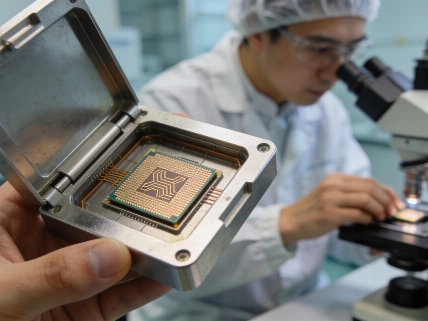
The technical core of the collaboration is the deployment of QECi on Agilex 7 FPGAs, leveraging the platform's F-Tile transceivers to achieve deterministic, low-latency data transfer between quantum control stacks and physical decoder chips. The open-source reference design, now available on GitHub, is intended to serve as a starting point for quantum processing unit (QPU) developers working with superconducting, trapped-ion, or silicon spin-qubit systems. By standardizing the data interchange between control electronics and QEC decoders, the protocol aims to reduce integration friction and enable parallel multi-qubit processing at the hardware level.
Altera's Agilex 9 Direct RF FPGAs are also included in the partnership, offering integrated digital-to-analog and analog-to-digital converters operating up to 64 gigasamples per second across a 36 gigahertz radio-frequency range. This specification is designed to support high-throughput readout and control for advanced quantum hardware, but the practical impact will depend on the ability of QPU developers to adapt the reference design to their specific device architectures and error-correction codes.
Quantum security and device management
This QEC hardware integration follows Altera's earlier rollout of post-quantum cryptography (PQC) support in its entry-level Agilex 3 and mid-range Agilex 5 FPGAs and system-on-chips. The PQC-enabled Secure Device Manager (SDM), combined with the Quartus Prime Pro Edition 26.1.1 tool flow, is designed to protect long-lifetime infrastructure against future quantum decryption threats. The architecture supports secure boot, bitstream encryption, key management, anti-tamper features, and platform attestation, all implemented at the hardware level. These measures are intended to address the risk of 'harvest-now-decrypt-later' attacks, where encrypted data is stored for future decryption by a large-scale quantum computer.
Altera's dual-track strategy now positions Agilex 3 and 5 devices as quantum-resistant for classical infrastructure, while Agilex 7 and 9 FPGAs are targeted at real-time quantum control and error correction. The company's approach reflects a recognition that quantum computing's most immediate impact may be on cryptographic security, even as the hardware for fault-tolerant quantum computation remains under active development.
Technical evidence and open source release
The QECi protocol's open-source release is a notable step for the quantum hardware community, as it provides a hardware-validated, publicly accessible reference for integrating real-time error correction into QPU control stacks. The protocol is designed to support high-bandwidth, parallel syndrome extraction and decoding, which are essential for scaling beyond a handful of physical qubits. However, the actual performance and scalability will depend on the implementation details of each quantum hardware platform, the efficiency of the decoder algorithms, and the ability to maintain low-latency operation as system complexity increases.
While the protocol validation on Agilex 7 FPGAs demonstrates feasibility, it does not by itself establish a complete fault-tolerant quantum computing stack. The open-source reference is a foundation for further engineering, not a turnkey solution. Developers will need to adapt the design to their own hardware, error-correction codes, and system architectures. The partnership's focus on open standards and reproducible hardware integration is a pragmatic response to the fragmented landscape of quantum control electronics, but the path to scalable, error-corrected quantum computation remains technically demanding.
Industry context and remaining challenges
Quantum error correction is widely recognized as the central engineering challenge for building useful quantum computers. The need for real-time, low-latency data movement between qubit control and decoding hardware is a bottleneck that has limited the practical demonstration of logical qubits and multi-qubit error correction cycles. The Altera-Riverlane collaboration is one of several recent efforts to standardize and accelerate this interface, but the field remains in early stages. As reported earlier, resource estimates for quantum attacks on cryptographic systems highlight the scale of hardware and error-correction required for practical threats, underscoring the gap between current prototypes and operational quantum computers.
Altera's decision to release the QECi protocol as open source, rather than as a proprietary standard, is a calculated move to attract QPU developers and foster interoperability across hardware platforms. However, the effectiveness of this approach will depend on adoption by the broader quantum hardware community, the ability to maintain deterministic timing under real experimental conditions, and the integration of efficient decoder algorithms capable of keeping pace with syndrome extraction rates. The technical evidence so far supports the feasibility of the interface, but not yet its scalability or universal applicability.
Quantum error correction is a set of techniques that protect quantum information from errors caused by decoherence, control imperfections, and environmental noise. Unlike classical error correction, which can copy and check bits, quantum error correction must preserve fragile quantum states without direct measurement. This is achieved by encoding logical qubits across multiple physical qubits and extracting error syndromes-signals that indicate the presence and type of error-without collapsing the quantum state. Real-time decoding and correction are essential for fault-tolerant quantum computing, but require fast, reliable data movement and processing at the hardware level. The integration of open-source QEC protocols with FPGA-based control electronics is a step toward addressing these challenges, but the transition from laboratory demonstration to scalable, useful quantum computers will require further advances in device yield, error rates, and system integration.