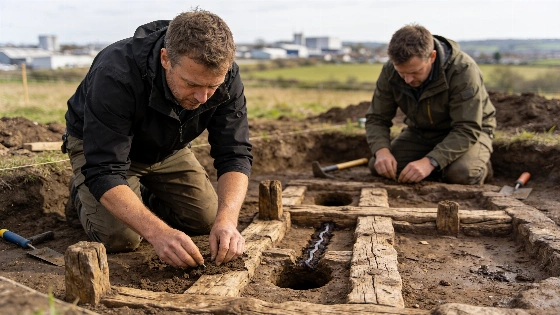
Archaeologists in Saxony-Anhalt have uncovered the remains of a deserted medieval settlement, revealing sunken buildings, wells, and a complex ditch system, but remarkably few artifacts, suggesting an organized abandonment
Archaeological excavations on the eastern edge of Halberstadt, Saxony-Anhalt, have revealed the remains of a medieval settlement that was ultimately deserted by its inhabitants. The site, known as "Am Frevelgraben," was investigated ahead of planned industrial development, providing a rare opportunity to document a community that left behind substantial architectural traces but few personal belongings.
Settlement Structure and Features
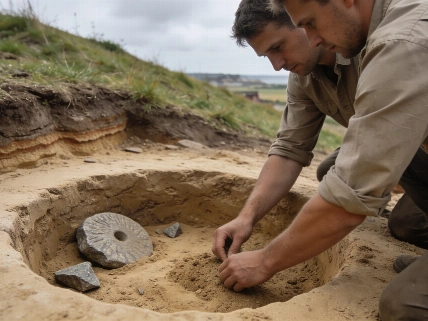
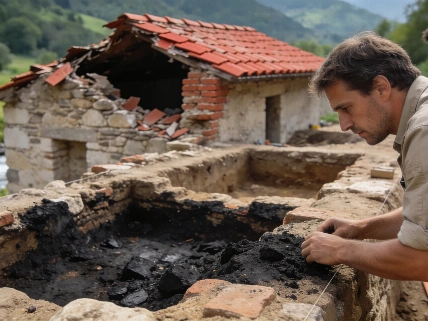
Researchers identified rows of sunken-featured buildings, or pit houses, arranged in distinct plots, along with storage pits and two wells. These structures, characterized by floors dug below ground level and timber superstructures, are typical of medieval rural settlements in central Europe. The site also preserves an elaborate system of ditches, some of which were repeatedly altered and extended, indicating that the boundaries and organization of the settlement changed over time.
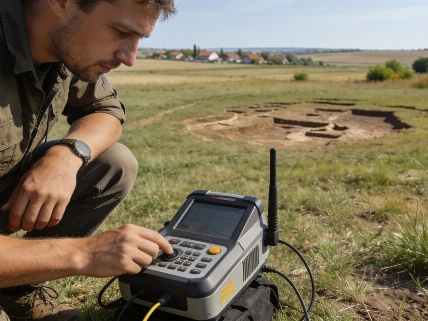
Geophysical surveys conducted before excavation revealed a multi-part ditch enclosure and numerous subsurface features. Excavations, which began in March, have allowed archaeologists to document the spatial organization of the settlement in detail. Notably, the northern part of the site, near the former Frevelgraben watercourse, lacked evidence of houses but contained pits and occupation layers, suggesting intensive use of the waterside zone.
Evidence for Organized Abandonment
Despite the well-preserved architectural remains, the site has yielded only a small number of ceramic fragments and metal objects. This scarcity of everyday items is unusual for deserted medieval settlements, which often contain large quantities of discarded pottery, tools, and fittings. The limited material suggests that the inhabitants left in a deliberate and organized manner, taking most of their possessions with them rather than abandoning them on site.
The recovered artifacts include scattered medieval pottery sherds and a handful of metal items such as belt buckles, fittings, and a bronze tap. These finds represent only a fraction of the material culture that would have been present during the settlement's occupation. The absence of more substantial refuse deposits complicates efforts to reconstruct daily life and social organization, but the architectural layout provides valuable information about household structure and community planning.
Settlement Development and Chronology
Analysis of overlapping features and the arrangement of pit houses indicates that the settlement underwent at least two major phases of occupation. As new buildings were constructed, the focus of the community appears to have shifted, and the ditch system was modified to accommodate changing needs. The site's location near a former watercourse would have influenced both its initial establishment and its eventual abandonment, though the precise reasons for desertion remain uncertain.
While the exact population size is unknown, the number of documented buildings and associated features suggests a modest rural community. The ongoing excavation is expected to clarify the settlement's chronological range and may provide further evidence about the circumstances of its abandonment. Comparable research at other deserted medieval sites, such as the recently investigated stronghold above the Gironde Estuary in France (see analysis of medieval defensive earthworks in southwestern France), highlights the diversity of settlement trajectories and abandonment processes across Europe.
Material Evidence and Interpretation
The site's most significant contribution lies in its preservation of settlement layout and infrastructure rather than artifact assemblages. The clear division into individual plots and the arrangement of pit houses in rows offer insights into medieval land use and household organization. However, the lack of substantial refuse or personal items limits the ability to reconstruct aspects of diet, craft production, or social differentiation within the community.
Archaeologists emphasize that the evidence supports an interpretation of organized departure rather than sudden catastrophe or violent displacement. The reasons for abandonment-whether economic, environmental, or social-remain open to investigation. As excavation continues, further analysis of the ditch system, wells, and occupation layers may yield additional clues about the settlement's development and decline.
Understanding deserted medieval settlements requires careful attention to both what is present and what is missing in the archaeological record. In this case, the absence of material culture is itself a significant finding, pointing to the varied ways in which communities managed their departure from established sites.
In settlement archaeology, the concept of a "deserted medieval village" refers to a community that was abandoned and not subsequently reoccupied. Such sites are often identified through a combination of earthworks, subsurface features, and artifact scatters. The preservation of architectural elements like pit houses and ditches can reveal much about spatial organization, but the absence of artifacts complicates efforts to reconstruct daily life. Archaeologists must balance architectural evidence with the limitations imposed by selective preservation and post-abandonment processes, recognizing that the reasons for desertion are rarely preserved in the material record itself.