At Site 29 near Poland's eastern border, excavation has identified a deep ditch whose purpose and date remain unknown, alongside a stored Neolithic flint deposit and an unexpected cremation burial from the Early Iron Age
For years, aerial imagery of Site 29 near Gródek showed a linear mark whose function researchers could not explain. Excavation has now identified it as part of a defensive system, adding a major feature to a site whose history was already known to span several periods. The investigation is part of the project "At the Crossroads of Goths and Slavs: Non-invasive Investigation of Multicultural Site No. 29 at Gródek," in Hrubieszów Municipality.
Earlier interpretations included a transport route associated with Gothic settlement or an older route shown on an 18th-century map. Researchers also considered whether it might relate to Bolesław I the Brave's campaign before the 1018 battle on the River Bug. Trenches from the First World War survive across the surrounding hills, but the feature's shape and dimensions did not fit those fortifications. The museum's account, reported by Kronika Tygodnia, describes the excavated feature as a large defensive system rather than a road.
A defensive boundary
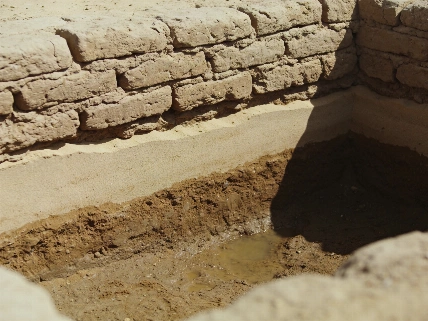
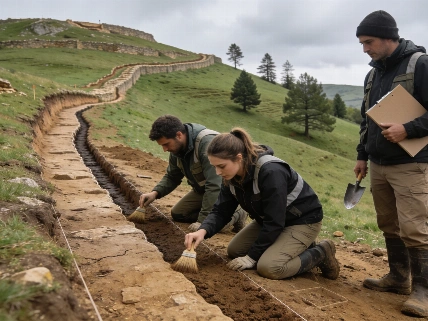
The broad, deep ditch appears to have enclosed an elevated area covering more than a dozen hectares. The ditch's builders and date remain uncertain. Earlier hypotheses ranged from a route to a feature connected with historical military activity; excavation identified a ditch with a defensive function, but did not establish its chronology or cultural attribution.
The feature adds to the evidence recovered at Site 29 through excavation and non-invasive surveys. At another archaeological site, pottery helped researchers date defensive construction; the investigation of the Cyprus fortifications offers a separate example of how associated material can help constrain a structure's chronology.
Researchers began magnetometer work in August, identifying a prominent linear anomaly for testing. The non-invasive survey covered more than 11 hectares-reported in the project account as 11.5 hectares-and the team opened three evaluation trenches, covering several dozen square metres in total. Excavation was carried out alongside surface survey and further geophysical measurements. The Lublin112.pl report describes the wider survey and the ditch enclosing an elevated area.
Flint stored underground
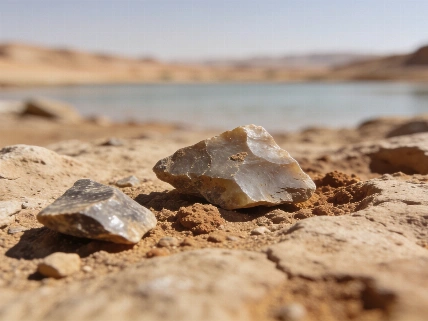
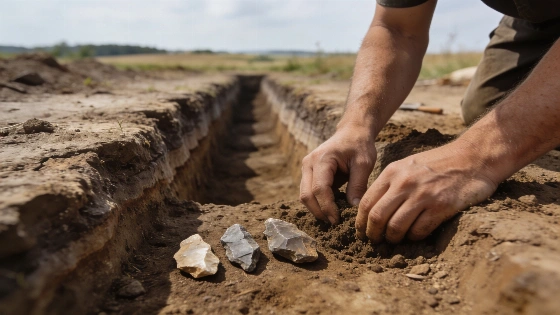
A separate discovery pushes evidence of human activity at Gródek back to the Neolithic. About one metre below ground, archaeologists found a deposit of flint material dating to around 6,000 years ago.
The pieces were selected, partly worked blanks rather than finished tools. Their concentration in one place indicates deliberate collection and deposition. Researchers suggested they may once have been kept in a leather or textile bag, which has since decomposed. The find records activity at the site millennia before the Gothic and medieval Slavic periods with which Gródek is more commonly associated.
Pottery and animal bones are relatively common finds from the Neolithic, while a concentrated cache of prepared flint blanks is more unusual. The deposit was found in an area where archaeologists had expected evidence connected with Gothic settlement. Its contents document the collection and storage of workable flint, but do not identify the people who gathered it or what they intended to make.
Burials and overlapping periods
Researchers also found an Early Iron Age cremation burial dating to about 2,500 years ago. It contained surviving human bone fragments and a ceramic vessel placed upside down over the burial. The remains are limited, but archaeologists identify the context as funerary and associate the community with the Pomeranian culture.
Other finds illustrate how material from very different periods occurs close together. An early medieval refuse pit contained hundreds of pottery fragments. Animal bones and lost glass beads were recovered there as well, near a storage pit dating from several thousand years earlier.
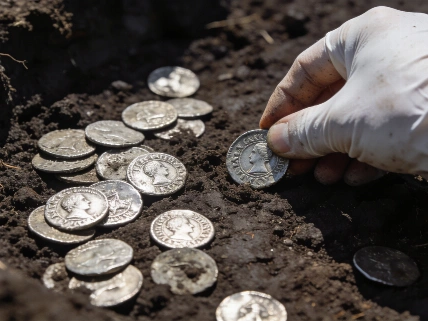
Evidence of the Gothic period also appeared in the same small trench: archaeologists recovered a Roman coin and a fragment of a Gothic comb. Elsewhere at the site, investigations in the western section found dozens of Roman denarii, along with pottery fragments and animal bones. Elements of clothing or personal adornment were also recovered.
In the eastern part of Site 29, agricultural activity has disturbed burials from an extensive early medieval cemetery. Part of the cemetery has been excavated, and researchers describe its inhumations as the oldest known Slavic burials of their kind in Poland.
Survey and excavation
Researchers chose excavation locations using aerial photography and magnetometer survey results, then opened three evaluation trenches covering several dozen square metres to test detected anomalies. The project combines non-invasive investigation with excavation and surface survey, rather than relying solely on visible surface remains.
Dr Michał Jakubczak and Robert Ryndziewicz of the Laboratory of Bio- and Archaeometry at the Institute of Archaeology and Ethnology of the Polish Academy of Sciences conducted the geophysical work. The project account reports that non-invasive archaeological methods surveyed 11.5 hectares of the site. Excavation, surface survey and geophysical measurements were continuing when the findings were reported.