A research team at KAIST has built a 3D-printed soft robotic hand that can cradle fragile objects and lift heavy ones, using AI to optimize the material's stretchability and durability for advanced manipulation tasks
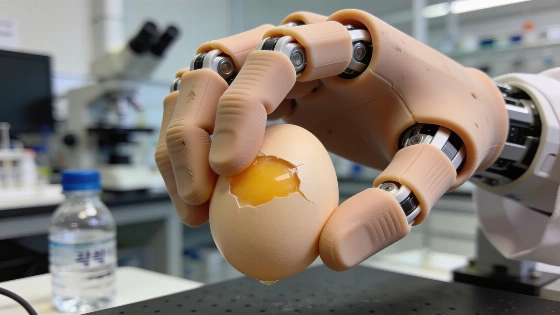
A soft robotic hand, engineered by researchers at the Korea Advanced Institute of Science and Technology (KAIST), has demonstrated the ability to grip both a raw egg and a full one-liter water bottle-without cracking the former or dropping the latter. This dual capability, achieved in controlled laboratory conditions, marks a technical advance in robotic manipulation, where balancing force and delicacy remains a persistent challenge for automation.
Unlike rigid industrial grippers, the KAIST prototype relies on a new 3D-printable material whose formulation was discovered using machine learning. The research team, collaborating with KIST and SEOULTECH, trained an AI model on a dataset of chemical recipes, including failed attempts that produced brittle or unprintable resins. The resulting material stretches to more than six times its original length before tearing, according to the published results in Nature Communications.
Digital Light Processing (DLP) 3D printing, the method used to fabricate the hand, typically struggles with highly elastic materials. Polymers that provide stretchability often make the resin too viscous for precise layer-by-layer printing. The team's AI-driven approach identified a chemical balance that allowed the resin to flow smoothly during printing while curing into a robust, flexible network. This eliminated the need for years of manual trial and error, accelerating the development of soft actuators for robotics.
To evaluate the system, the researchers printed pneumatic actuators-hollow structures that bend when pressurized with air. When assembled into a robotic hand, these actuators enabled the device to conform to objects of varying shapes and fragility. In laboratory demonstrations, the hand successfully manipulated computer mice, glass bottles, egg cartons, and raw eggs, adapting its grip in real time. The tests were conducted under supervised conditions, with no evidence yet of unsupervised or autonomous operation outside the lab.
Measured performance figures show the new material can stretch to over 600% of its original length before failure, a property that supports both gentle and forceful manipulation. The hand lifted a one-liter water bottle-approximately 1 kilogram-without slippage, and handled a raw egg without visible damage. However, the published data does not include long-term durability testing, repeated stress cycles, or performance in uncontrolled environments.
Soft robotics has seen rapid progress in recent years, with research groups worldwide seeking to replicate the adaptability of biological hands. Previous efforts have often relied on manual tuning of materials or complex multi-material assemblies. The KAIST team's use of AI to optimize a single printable resin represents a shift toward data-driven materials engineering. This approach could reduce development time for custom medical implants, wearable sensors, and collaborative robots designed to operate safely alongside humans.
While the laboratory demonstration is promising, the system remains a research prototype. The hand's performance has not been independently replicated, and its reliability in real-world settings-where objects may be wet, dirty, or irregularly shaped-remains untested. The absence of autonomous sensing or adaptive control also limits immediate deployment in unstructured environments. For comparison, other recent advances in robotic manipulation, such as those reported earlier, have focused on integrating vision and speech for home-care robots, but often rely on rigid grippers or require extensive human supervision.
Peer-reviewed publication in Nature Communications lends credibility to the reported results, but the evidence is limited to laboratory-scale demonstrations. The research highlights the potential of AI-guided materials discovery for robotics, but does not establish commercial readiness or general-purpose dexterity. Until the system is tested in diverse, real-world conditions, claims about its transformative impact should be treated with caution. The field of soft robotics continues to advance, but the gap between laboratory prototypes and robust, deployable systems remains significant.
Soft robotic actuators are devices made from flexible materials that deform in response to air pressure, electrical signals, or other stimuli. Unlike rigid motors and gears, soft actuators can conform to irregular shapes and absorb impacts, making them attractive for tasks that require safe interaction with humans or delicate objects. However, designing materials that are both printable and durable has proven difficult. Machine learning can accelerate this process by predicting which chemical formulations will yield the desired combination of flow, curing speed, and mechanical strength, reducing the need for manual experimentation. The resulting materials may enable new classes of robots that are safer, more adaptable, and easier to manufacture, but their real-world reliability must be established through systematic testing beyond the laboratory.