Unitree has introduced UnifoLM-OminiA-0.3, a unified AI model for humanoid robots designed to coordinate speech, vision, and manipulation for autonomous home-care tasks, with demonstrations showing real-time adaptation to user interruptions
Chinese robotics developer Unitree has announced UnifoLM-OminiA-0.3, a unified artificial intelligence model intended to coordinate speech, vision, reasoning, and physical manipulation in humanoid robots for home-care and wellness environments. The company demonstrated the model's capabilities through a series of controlled tasks, including tidying rooms, retrieving objects, and assisting around hospital beds, with the robot responding to spoken, visual, and environmental cues. According to Unitree, the system is designed to allow a single robot to interpret instructions, perceive its surroundings, plan actions, and execute multi-step tasks without switching between separate AI modules for each function.
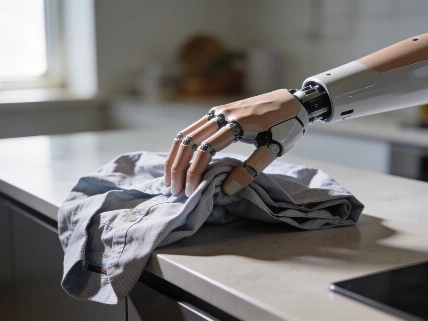
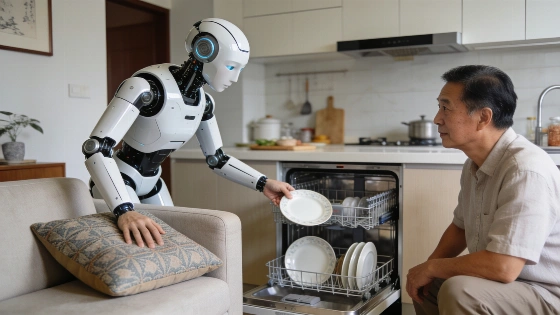
In the demonstration, a humanoid robot performed activities such as placing a cushion on a sofa, identifying colors, counting medicine boxes, retrieving specific items from shelves, and sorting laundry. The robot also loaded a plate into a dishwasher and adjusted a hospital-style bed. Notably, the system was shown responding to mid-task interruptions: when a user instructed the robot to stop while it was adjusting the bed, the robot halted the operation immediately. This behavior is intended to illustrate the model's capacity for continuous human-robot interaction and dynamic adaptation during task execution.
Unified Model Architecture
UnifoLM-OminiA-0.3 is positioned by Unitree as an embodied AI model that integrates language understanding, visual perception, object recognition, decision-making, navigation, and full-body motion control within a single framework. The company claims this unified approach enables robots to process multiple input modalities simultaneously, reducing the need for separate task-specific models and potentially improving responsiveness in complex, real-world environments. The model is aimed at home-care and wellness applications, where robots may need to handle unpredictable instructions, moving objects, and ongoing human interaction.
While many of the individual tasks demonstrated have been performed by other humanoid robots, Unitree emphasizes that the significance of UnifoLM-OminiA-0.3 lies in its ability to coordinate the entire workflow through a single AI model. The demonstration videos released by the company do not provide detailed information on the number of trials, failure rates, or the extent of human supervision during testing. As with many robotics demonstrations, it remains unclear how the system performs outside controlled environments or under sustained, uncurated use.
Evidence and Limitations
Unitree's demonstration of UnifoLM-OminiA-0.3 was conducted in a laboratory setting, with the robot performing a sequence of household and care-related tasks. The company has not disclosed quantitative performance metrics such as success rates, error rates, or the number of human interventions required during testing. The robot's ability to respond to interruptions was highlighted, but the robustness of this feature under varied conditions has not been independently verified. The model's architecture and training data have not been fully detailed, and it is not clear whether the system relies on pre-mapped environments or can generalize to new settings without additional configuration.
Unitree has previously released a low-cost upper-body humanoid robot, priced from 26,900 yuan (approximately $4,290), as part of its effort to make humanoid robotics more accessible. The company's broader UnifoLM embodied intelligence program includes earlier models such as UnifoLM-WMA-0, an open-source world-model-action framework introduced in 2025, and UnifoLM-VLA-0, a vision-language-action model released in early 2026. These models have been accompanied by open-source training code, model weights, and teleoperation datasets, with many of the same household tasks featured in the latest demonstration.
Context and Industry Trends
The integration of vision-language models with robot control reflects a wider trend in embodied AI, where developers seek to generalize robot behavior across diverse environments and tasks. Rather than programming separate routines for each object or activity, unified models like UnifoLM-OminiA-0.3 aim to enable robots to adapt to changing instructions and environments. This approach is considered particularly relevant for home-care and hospital settings, where unpredictability and ongoing human interaction are common. However, the absence of independent evaluation and detailed performance data limits the ability to assess the system's reliability and safety in real-world deployment.
Efforts to benchmark and evaluate general-purpose robot policies have become increasingly important as more companies pursue unified control architectures. For example, platforms such as NVIDIA's RoboLab have been developed to address persistent gaps in evaluating robotic models before real-world deployment, highlighting the need for transparent, repeatable testing standards in the field.
UnifoLM-OminiA-0.3 is currently presented as a company demonstration rather than a commercial product or independently validated research system. The extent to which the model can maintain stable performance, recover from failure, and operate safely in unstructured environments remains to be established through further testing and external review.
Unified AI models for robotics attempt to combine multiple perception and control functions-such as speech recognition, visual processing, and manipulation-within a single system. This approach contrasts with traditional robotics architectures, which often rely on separate modules for each function. While unified models can improve efficiency and responsiveness, they also introduce new challenges in training, evaluation, and safety assurance. The ability to generalize across tasks and environments depends on the diversity and quality of training data, as well as the robustness of the model's architecture. Independent benchmarking and transparent reporting are essential for assessing whether such systems can meet the reliability and safety requirements of real-world deployment, especially in sensitive settings like home care and healthcare.