Researchers have emulated quantum algorithms with over 200 logical qubits using the iQCC method on standard server hardware, benchmarking performance and accuracy for OLED materials design without relying on supercomputers
Researchers from OTI Lumionics and the Samsung Advanced Institute of Technology (SAIT) have reported the classical emulation of quantum algorithms involving more than 200 logical qubits, using their proprietary Iterative Qubit Coupled Cluster (iQCC) approach. The results, published in the Journal of the American Chemical Society, focus on simulating the electronic structure of phosphorescent transition-metal complexes relevant to organic light-emitting diode (OLED) displays. The study demonstrates that large-scale quantum chemistry calculations, typically considered intractable for classical computers, can be emulated on accessible server hardware when algorithmic and hardware optimizations are combined.
Emulation Method and Hardware
The iQCC algorithm was benchmarked against established classical quantum chemistry methods, including Density Functional Theory (DFT), Time-Dependent DFT (TD-DFT), Coupled-Cluster Singles and Doubles (CCSD), and Completely Renormalized Coupled-Cluster (CR-CC(2,3)). The team evaluated 14 transition-metal organometallic complexes, focusing on triplet excited states where classical single-reference methods often fail due to spin contamination and multireference character. The iQCC approach maintained variational stability in these challenging regimes.
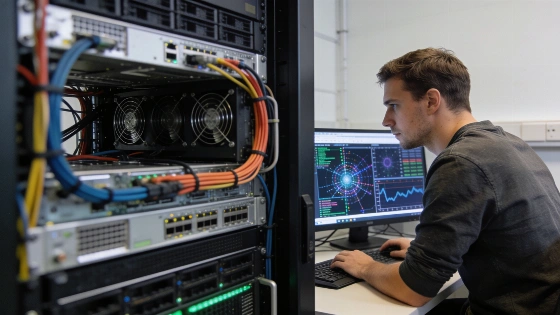
Emulations were executed on a single commercial 32-core AMD CPU with 800 GB of RAM, using an optimized C++ codebase. This setup enabled the simulation of quantum circuits with over 200 logical qubits without the need for high-performance computing clusters. When ported to NVIDIA Blackwell GPU architectures, the iQCC implementation achieved a reported 90-fold speedup, reducing the runtime for a 112-qubit ground-state calculation to about one hour.
Benchmark Results and Accuracy
In terms of predictive accuracy, the iQCC method achieved a mean absolute error (MAE) of 0.05 electronvolts (eV) and a correlation coefficient (R²) of 0.94 when compared to experimental photoluminescence spectra. This performance surpassed that of CR-CC(2,3), which yielded an MAE of 0.29 eV, as well as DFT-based approaches. The variational quantum circuits optimized in these emulations contained over 1.5 million parameters and more than 10 million two-qubit entangling gates, all without resorting to orbital partitioning schemes that can limit accuracy or scalability.
By establishing a rigorous application-level benchmark for quantum chemistry, the study sets a clear target for future physical quantum processors. Any claim of quantum advantage in molecular electronic-structure calculations will need to exceed the performance and accuracy demonstrated by these classical emulations under comparable conditions.
Classical Comparison and Scalability
The research highlights the importance of fair and current classical baselines when evaluating quantum computing claims. The ability to emulate large logical-qubit circuits on commercially available hardware challenges assumptions about the near-term inaccessibility of such calculations to classical methods. However, the approach remains computationally intensive, requiring substantial memory and processing resources, and does not eliminate the need for scalable quantum hardware for even larger or more complex systems.
For context, recent efforts in the field have also focused on benchmarking quantum hardware and algorithms against strong classical methods. For example, a collaboration between Quantinuum, NVIDIA, and Pfizer demonstrated AI-generated quantum circuits on a 98-qubit trapped-ion processor, as discussed in this related report. Such comparisons are essential for assessing the practical value and readiness of quantum computing technologies.
Limitations and Future Directions
While the iQCC emulation demonstrates that large-scale quantum algorithms can be simulated classically for specific chemistry problems, the method's computational demands remain significant. The study does not establish that all quantum chemistry tasks of industrial relevance are now accessible to classical hardware, nor does it demonstrate a general quantum advantage. Instead, it provides a transparent and reproducible benchmark for future quantum processors to surpass, particularly in the context of OLED materials discovery and design.
The research is peer reviewed and provides detailed technical data, but independent replication and broader application to other classes of molecules or materials will be necessary to assess the generality of the approach. The results underscore the need for careful benchmarking and transparent reporting as the field moves toward practical quantum computing for chemistry and materials science.
Understanding the distinction between physical and logical qubits is central to interpreting these results. A physical qubit is a single controllable quantum system, such as a superconducting circuit or trapped ion, while a logical qubit encodes information redundantly across multiple physical qubits to detect and correct errors. Logical qubits are essential for fault-tolerant quantum computing, but their emulation on classical hardware is limited by exponential scaling in memory and computation. The reported emulations do not represent physical quantum processors but provide a reference point for evaluating when quantum hardware can deliver results beyond the reach of classical simulation.