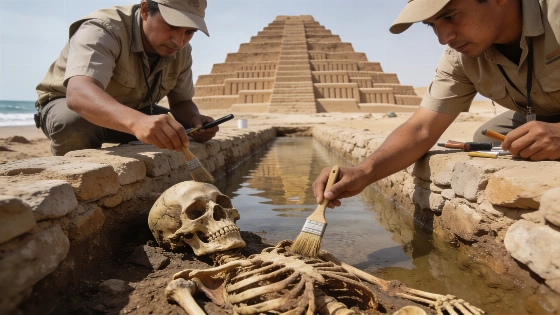
Archaeologists have uncovered a human skeleton in an underground water channel at Huaca Pucllana, Lima, Peru, dating to around 650 CE. The find may shed light on pre-Inca ritual practices and the use of water features in ceremonial contexts.
A recent excavation at the Huaca Pucllana archaeological site in central Lima, Peru, has revealed a human skeleton deposited in an underground water channel, offering new evidence for ritual activity in the region during the first millennium CE. The remains, provisionally dated to approximately 650 CE, were found near the site's prominent adobe platform pyramid, a structure associated with the Lima culture and later pre-Hispanic groups.
Excavation Context
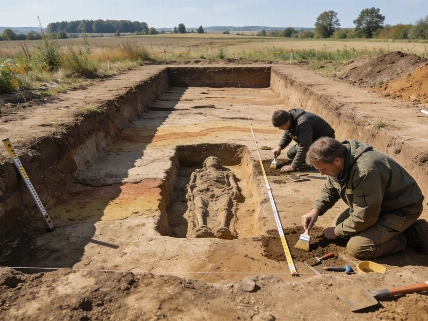
The skeleton was recovered from a stone-lined water channel leading to a ceremonial well, a feature constructed with river stones rather than the small adobe bricks typical of the Lima culture's architecture. The individual was positioned on the left side, with the skull oriented toward both the Pacific Ocean and the Huaca Pucllana pyramid. This deliberate placement suggests intentional deposition, possibly as part of a closing ritual for the water feature. The channel and well appear to have been sealed shortly after the burial, indicating a connection between the human remains and the termination of the structure's use.
Huaca Pucllana was established around 400 CE and remained occupied until the fifteenth century. The site is notable for its large ceremonial platform and evidence of complex ritual practices, including the destruction of large vessels, communal feasting, and the deposition of human remains. Previous excavations have identified other burials, including an adult male and female interred within the pyramid's foundations, interpreted as offerings related to construction or modification events.
Skeletal Evidence and Interpretation
Initial osteological analysis suggests the skeleton belonged to an adult male, based on pelvic and cranial morphology. However, further laboratory studies are required to confirm biological sex, estimate age at death, and assess for perimortem trauma or other indicators of cause of death. The preservation of the remains was sufficient for preliminary assessment, but detailed analysis will be necessary to determine whether the individual experienced injuries consistent with ritual killing or other forms of violence.
The association of the burial with a water channel and ceremonial well is unusual for the Lima culture, whose ritual deposits more commonly involved foundation burials within architectural features. The use of river stones in the construction of the water infrastructure also marks a departure from local building traditions, raising questions about the significance of water management and ritual closure in the site's ceremonial life. Comparable cases of ritual burial in wells or water features have been documented elsewhere, such as the Roman-era well in Croatia that yielded multiple skeletons, as discussed in a recent Science Report analysis.
Chronology and Cultural Context
The burial has been dated to around 650 CE based on stratigraphic association and the construction sequence of the water channel and well. While radiocarbon dating results have not yet been published, the context suggests the individual was interred during a period of significant architectural and ritual activity at Huaca Pucllana. The Lima culture is known for its distinctive ceremonial practices, but the specific role of water features in mortuary or ritual closure events remains poorly understood.
Archaeologists emphasize that the interpretation of the burial as a ritual sacrifice remains provisional. The absence of clear trauma or associated grave goods limits the ability to determine the precise circumstances of death. Ongoing analysis of the skeleton and the surrounding infrastructure may clarify whether the deposition was part of a broader pattern of ritual closure or represents an isolated event.
Future Research and Limitations
Further study will focus on detailed osteological examination, including age estimation, trauma analysis, and potential isotopic or genetic testing, provided preservation allows. The results may contribute to broader debates about the diversity of mortuary practices in pre-Inca coastal Peru and the relationship between water management and ritual activity. The find also highlights the importance of contextually secure excavation and multidisciplinary analysis in interpreting complex archaeological deposits.
As with many discoveries involving human remains, ethical considerations regarding the treatment, analysis, and eventual disposition of the skeleton are central to ongoing research. Collaboration with local heritage authorities and descendant communities will be necessary to ensure respectful and responsible handling of the remains.
Estimating biological sex from skeletal remains typically relies on morphological features of the pelvis and skull, which show population-level differences between males and females. However, preservation, age, and individual variation can complicate assessment, and results are probabilistic rather than absolute. DNA analysis, when possible, can provide additional confirmation, but is dependent on the survival of ancient genetic material. In archaeological contexts, sex estimation is a tool for understanding population structure and mortuary practices, but should not be conflated with social gender or identity in the past.