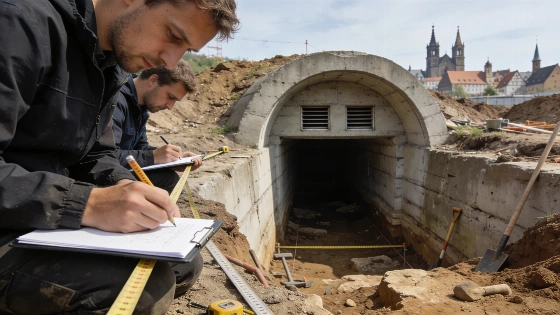
Archaeologists in Quedlinburg, Germany, have documented a rare World War II-era air raid shelter trench, exposed during construction work and offering new evidence for civilian defensive measures in the final years of the conflict
Construction work on the outskirts of Quedlinburg, a town in Saxony-Anhalt, Germany, has revealed a remarkably well-preserved World War II air raid shelter trench. The structure, discovered during earthworks for a new residential building, was investigated by the State Office for Heritage Management and Archaeology (LDA) of Saxony-Anhalt. Its preservation offers a rare opportunity to examine the material evidence of civilian life and local defensive strategies during the closing years of the war.
Excavation and Structure
The shelter was found beneath the surface on a ridge overlooking the Bode Valley, approximately 600 meters west of Quedlinburg's medieval center. Archaeologists identified the main feature as a semi-subterranean protective trench, measuring about 20 meters in length and 2.5 meters in width, with a concrete vaulted roof. The complex covers an area of roughly 20 by 14 meters and includes two entrance and exit passages of different lengths. The structure was constructed in stages using rammed concrete without steel reinforcement, with side walls approximately 45 centimeters thick and a semi-circular roof about 20 centimeters thick.
Distinct impressions from the wooden formwork used in construction remain visible on the interior walls, while the exterior roof was smoothed and coated with a protective layer. Five square ventilation shafts, each 25 by 25 centimeters, were built into the roof to provide airflow, and two sets of airlock-style double doors allowed the shelter to be sealed during air raids. The design reflects the need for rapid, cost-effective protection for civilians, as these trenches were intended to shield against shell fragments and debris but could not withstand a direct bomb strike.
Context and Preservation
The shelter's location and construction method are consistent with efforts across Germany to provide at least minimal protection for noncombatants as Allied bombing intensified. While military production was often moved underground, local authorities also built improvised civilian shelters like the Quedlinburg trench. The structure's survival beneath later development highlights the potential for recent historical features to remain undisturbed and underscores the importance of archaeological monitoring even for twentieth-century contexts.
Documentation of the trench will be completed before construction resumes, ensuring that the evidence is recorded for future research. The site's preservation allows for detailed study of construction techniques, ventilation systems, and the spatial organization of emergency shelters. Comparable discoveries, such as the investigation of Nazi-era structures built over earlier cemeteries in Poland's Wolf's Lair region, have also contributed to understanding the complex layering of recent and older historical remains-see the analysis of overlapping burial and military contexts in research on Göring's Wolf's Lair residence.
Material Evidence and Interpretation
The Quedlinburg shelter provides direct evidence for the scale and character of civilian defensive measures during World War II. The use of rammed concrete, the absence of steel reinforcement, and the presence of ventilation and airlock systems reflect both the urgency and the limitations of local construction efforts. While the shelter was not designed to withstand direct hits, its features demonstrate an attempt to mitigate the risks of aerial bombardment for residents. The archaeological context, including the shelter's position relative to the town and its concealment beneath later development, offers insight into how communities adapted to wartime threats.
Although the structure is well preserved, the absence of associated artifacts or personal remains limits interpretation of how the shelter was used in practice. No evidence has been reported for the number of occupants, the duration of use, or the specific events that may have prompted its construction. As with many twentieth-century archaeological sites, the challenge lies in integrating material evidence with incomplete written records and oral histories.
Recording Recent Past Archaeology
The documentation of the Quedlinburg air raid shelter trench highlights the growing role of archaeology in investigating the recent past. Features from the twentieth century, including wartime infrastructure, are increasingly recognized as important components of cultural heritage. Their study can illuminate aspects of daily life, risk, and adaptation that are often absent from official records. The careful recording of such sites ensures that the material traces of conflict and civilian experience are preserved for future analysis and public understanding.
Archaeological investigation of modern features requires the same attention to context, preservation, and ethical considerations as the study of older remains. The Quedlinburg shelter, like other wartime structures, raises questions about memory, commemoration, and the responsibilities of heritage management in documenting difficult or contested histories.
Understanding the archaeological context of recent historical features depends on careful stratigraphic analysis and documentation. Stratigraphy-the study of the sequence and relationship of soil layers and deposits-allows archaeologists to establish the relative timing of construction, use, and later disturbance. In the case of twentieth-century sites, stratigraphic evidence can clarify how wartime structures relate to earlier and later phases of occupation, and can help distinguish original features from subsequent modifications or destruction. This approach is essential for interpreting the complex layering of material evidence in urban and peri-urban environments.