

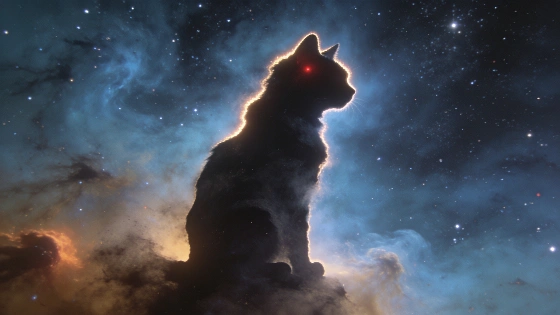
A mid-infrared view from NASA's James Webb Space Telescope shows a dust pillar in the Carina Nebula whose cat-like outline may have been shaped by radiation and stellar winds
A bluish-gray filament cuts through a red field, its irregular outline resembling a seated cat with a tail that widens near the bottom. The Cat's Head is a nickname for the pillar's animal-like silhouette within the Carina Nebula, a vast star-forming complex about 7,500 light-years from Earth.
A Pillar in Carina
The Cat's Head Nebula's head turns toward the right, where a bright feature stands out like an eye. Faint filaments form a dome nearby, while scattered stars punctuate the view. NASA identifies the region as NGC 3372 and associates it with HH 903. In the mid-infrared image, the bright source beside the pillar is described as probably an infant star embedded in dust; NASA notes that a narrow filament crossing it has no established physical relationship to the star.
The same dusty pillar appeared in an earlier comparison of Hubble's visible-light image with Webb's infrared observations of the Carina Nebula. ESA's three-telescope image set pairs Hubble's Wide Field Camera 3 view with Webb's Near-Infrared Camera and Mid-Infrared Instrument observations, showing the pillar at visible, near-infrared, and mid-infrared wavelengths.
Stellar Feedback
The distinctive shape was likely sculpted over time by intense ultraviolet radiation and winds from massive stars in the Carina Nebula.
That stellar feedback erodes surrounding gas and dust. Denser material within the cat-shaped pillar resists the erosion, at least for now. Infrared observations also reveal background pillars and fine structures obscured in visible light, including delicate strands and globules near the primary filament.
Webb's View
NASA released the mid-infrared view on Oct. 29, 2026. The image was captured with Webb's Mid-Infrared Instrument, or MIRI, using several filters to sample different wavelength ranges. Its colors map infrared emissions rather than showing the nebula as it would appear to human eyes: warm dust and carbon-based molecules, including polycyclic aromatic hydrocarbons, glow after being energized by starlight. NASA's asset metadata lists May 27, 2026, under "About the Data."
The image's background is mostly red, with dark space visible in the upper corners and Webb's eight-point diffraction spikes around some stars. NASA explains that variations in color and brightness reflect changing local conditions and chemical composition. The mid-infrared view also brings out the pillar's surrounding dust structures, while Webb's near-infrared observations reveal a dense stellar field through some of the dust.







