ETH Zurich's Attention-based Contact Planning policy guides a G1 humanoid through simulated obstacle courses and physical demonstrations. Its 92.5% simulation success rate is promising, but does not establish reliability outside the test environment
In simulation, Attention-based Contact Planning (ACP) completed eight composite obstacle courses with an average success rate of 92.5%, compared with 58.8% for the MGMT motion-generation-and-tracking baseline. The evaluation reported 1,000 episodes per method on each course, a difference of 33.7 percentage points. The gap is large in that test. It is not a measure of real-world reliability.
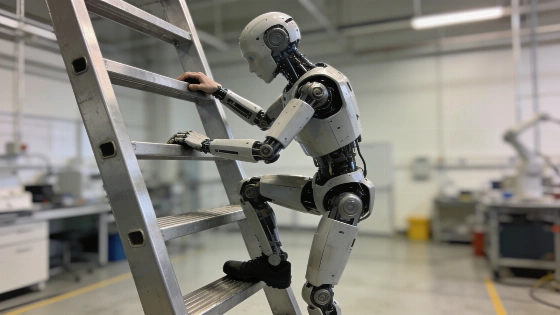
Researchers at ETH Zurich's Robotic Systems Lab and collaborators demonstrated ACP on Unitree's G1 humanoid robot. The G1 climbed ladders and stairs, crossed stepping stones, crawled through confined spaces, vaulted over obstacles, jumped down and sat, and recovered after falls. These physical demonstrations show the system performing varied movements; the reported success-rate comparison comes from simulation, not those demonstrations.
The research, Humanoid Mobility via Attention-based Contacts, was submitted to arXiv on October 22, 2026, and was listed as under review. ACP changes what the control system plans. Rather than prescribing a complete sequence of body motions, its contact planner selects points on the surrounding terrain for the robot to reach. A separate whole-body controller coordinates 23 joints to turn those targets into movement. On a ladder, for example, the planner must select usable rungs for the hands and feet as the robot moves.
The planner uses an attention-based neural network to process terrain information. At deployment, ACP combines a LiDAR-derived height map with the robot's internal state and a user-provided goal to predict contacts up to 1.5 seconds ahead. Contact plans can involve nine body parts: the hands, elbows, knees and feet, plus the pelvis. That gives the robot options for supporting itself when walking alone is insufficient.
For comparison, an earlier robot-planning approach from MIT predicts future positions to improve movement in manipulation tasks. ACP instead plans where a humanoid should make contact with terrain. The methods address different control problems, so their results are not directly comparable.
The perception system uses LiDAR measurements to build a local height map and estimate how reliable those measurements are. That matters for narrow surfaces such as ladder rungs, which a map could otherwise miss. On a Jetson Orin NX computer, the system processes a 20,000-point scan in 30 milliseconds and updates scans at 10 Hz.
Training began with a whole-body controller learning to execute contact plans from 13.2 minutes of human motion data adapted to the robot's body and physical limits. The demonstrations establish contact patterns as a training prior, not a fixed sequence for the robot to replay during operation. The researchers then trained the planner and controller together. In a later stage, reinforcement learning helped the system adapt to procedurally generated environments beyond the demonstrations; successful attempts supplied further training examples.
At deployment, ACP uses onboard observations and a specified goal rather than reference motions. The reported results do not provide a real-world success rate or details about human monitoring, intervention, or safety testing. Nor do they establish how consistently the robot would perform across unfamiliar physical environments.
The researchers identify a further boundary: ACP is designed for terrain-based contact and local movement toward a goal. Overhead contact, hanging and manipulation would require more advanced three-dimensional perception. The reported tests so support a specific claim about contact planning for varied movement, not a general claim of dependable humanoid autonomy.
Reinforcement learning trains a system through attempts and feedback tied to an objective. In ACP, that process helped adapt behavior to generated environments after the initial motion-based training. Simulation can broaden the situations used for training, but success there does not show that the same policy will cope with the full range of physical conditions.