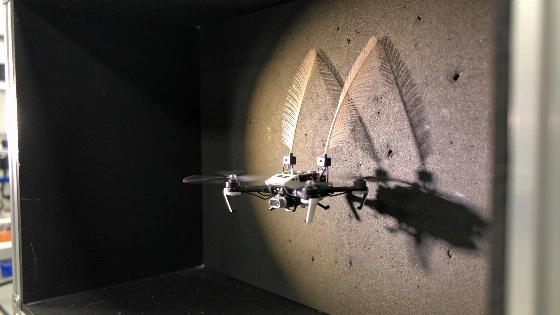
Researchers at Delft University of Technology demonstrated a tiny drone that uses pressure-sensitive artificial whiskers to navigate clear-wall test environments without relying on visual information.
A drone that cannot see has found a way through the dark: it can feel. In a research demonstration announced by Delft University of Technology on 18 September 2026, the tiny aircraft used two flexible artificial whiskers to detect nearby surfaces and navigate unfamiliar enclosures without visual information. The university's TU Delft release describes the system as bio-inspired tactile sensing for lightweight aerial robots.
That is a research demonstration rather than a ready-made rescue machine. The accompanying images and video show the drone traversing a controlled course made from clear walls, not operating in smoke, rubble or a disaster zone. The system shows that tactile sensing can support flight on a platform too small for many conventional perception systems, but the reported tests do not establish reliable operation in real emergencies or other uncontrolled environments.
Navigation by contact
Rodents provide the design precedent. Rats and mice use vibrissae to detect deflections and pressure changes as their whiskers brush against walls and obstacles. The Delft system adapts that principle to aerial robotics by placing a pair of flexible artificial whiskers at the front of a small drone. The approach is intended for situations in which cameras can fail, including darkness and other low-visibility conditions.
Each whisker has three miniature pressure sensors at its base. When a whisker bends against a surface, the sensors register changes that the onboard system uses to estimate where contact occurred and how deep it was in three dimensions. The drone is not seeing a map through a hidden camera; it is building navigational information from physical contact. TU Delft characterizes the interaction as gentle touch, allowing the aircraft to detect nearby boundaries and obstacles without carrying a large optical or ranging payload.
This matters because the research targets aerial platforms weighing less than 100 grams. Such drones have limited room and power for heavier perception hardware such as LiDAR, as well as for the computing systems needed to process it. Cameras can also become ineffective in smoke, dust or complete darkness. A tactile sensor does not restore ordinary vision, but it can provide a direct measurement of nearby boundaries when optical sensing fails.
Filtering the aircraft itself
The engineering difficulty was not simply detecting a wall. Propellers generate airflow, vibration and disturbances that can obscure the small pressure signals produced when a whisker touches a surface. The researchers therefore built a lightweight onboard processing pipeline to separate environmental contact from turbulence created by the drone.
The reported system runs with just 34 kilobytes of memory and filters the aircraft's self-generated noise while producing depth information described as precise to the millimeter. That figure describes the system's reported sensing output under the tested conditions; it is not a general guarantee of navigation accuracy across different surfaces, airflow patterns or damaged structures.
In flight tests, the drone navigated dark enclosures, traced surface contours, mapped unfamiliar room layouts and found exits without visual cues. The available material does not provide a trial count, a success rate, a comparison with a particular LiDAR or camera system, or a detailed account of failures and human intervention. Those omissions limit what can be concluded about reliability.
Prototype, not deployment
The distinction is important for search and rescue. A drone that can move through a dark test enclosure may eventually be useful in collapsed or smoke-filled buildings, but real incidents add unstable debris, changing airflow, irregular surfaces, communication problems and the possibility of physical damage. None of those conditions is established by the reported demonstration.
The same limitation applies to proposed industrial uses. Narrow pipelines, ventilation shafts, sewers and underground mines could benefit from a small machine that does not depend entirely on light, while dark lunar craters and Martian lava tubes present similarly difficult visibility conditions. These are plausible application areas rather than deployments reported in the study.
Human oversight is also not erased by tactile autonomy. The drone appears to have made local navigation decisions during the tests, but the available material does not specify its communication link, emergency behavior, recovery from contact errors or the role of operators during setup and flight. A system can automate obstacle-following without being independently capable of handling every failure in a dangerous environment.
What the evidence supports
The study published in Nature Communications supports a narrower and more useful claim: lightweight aerial robots can carry active tactile hardware and process contact data onboard despite the noise generated by their own propellers. That is an engineering result with clear value for robot perception, especially where cameras and heavier ranging sensors are constrained.
It does not show that whiskers are a universal replacement for vision, that the drone understands its environment in a human sense, or that it is ready for autonomous emergency deployment. Tactile navigation is inherently local: it reveals surfaces the whiskers reach, while unseen hazards and obstacles outside contact remain uncertain.
For robotics, the significance lies in moving perception closer to the physical world without adding a large sensor package. The Delft work is therefore a credible prototype-level advance, not a license to call tiny drones fully independent. Its next test should be less about a striking dark-room demonstration and more about repeatable performance, documented failures and clear human control in environments that do not cooperate.
Sensor fusion is the process of combining measurements from different sources to estimate a robot's surroundings. This drone instead places unusual weight on tactile contact, where pressure data must be interpreted alongside the aircraft's motion and airflow. That estimate is useful only within the limits of the sensor geometry and processing method. Better contact information can improve local control, but it cannot by itself establish complete environmental awareness or safe operation in every setting.
The appropriate evidentiary standard is the same one used in serious engineering reports from NASA and MIT or in peer-reviewed journals such as Nature and PNAS: distinguish a controlled laboratory result from demonstrated field capability. On that standard, the artificial-whisker drone is an intriguing example of bio-inspired sensing for sub-100-gram aircraft, while its performance in complex real-world environments remains an open research question.