The United States Air Force has received Anduril's YFQ-44A and General Atomics' YFQ-42A for experiments on how semi-autonomous aircraft can operate with crewed fighters in contested airspace
The United States Air Force has placed two Collaborative Combat Aircraft designs into experimental operations at Creech Air Force Base in Nevada. The move shifts the program from competing designs toward a harder test: determining how these semi-autonomous aircraft can be fielded, maintained, controlled and used alongside crewed fighters in contested airspace.
General Atomics confirmed that its FQ-42 Vengeance was delivered to Creech on September 18, 2026, for continued test and evaluation operations. The company describes the aircraft's role as regular testing, assessment and experimentation rather than combat deployment. The delivery was the first GA-ASI handover under the CCA program; Anduril's FQ-44 Fury was already operating at Creech with the Experimental Operations Unit.
This is not a declaration that the aircraft are ready for routine combat. It is a practical evaluation of the people, procedures and infrastructure needed to make human-supervised uncrewed aircraft useful without treating autonomy as a substitute for command responsibility. The Air Force's stated emphasis on putting CCA systems in the hands of Airmen reflects a shift from laboratory demonstration toward operational learning.
The distinction between experimentation and deployment is also important scientifically. A delivery creates an opportunity to collect flight, maintenance and human-factors data; it does not by itself establish reliability, safety or combat effectiveness. NASA's human-systems engineering practice similarly treats the vehicle, operators, software and operating environment as one integrated system that must be evaluated together.
Two aircraft enter testing
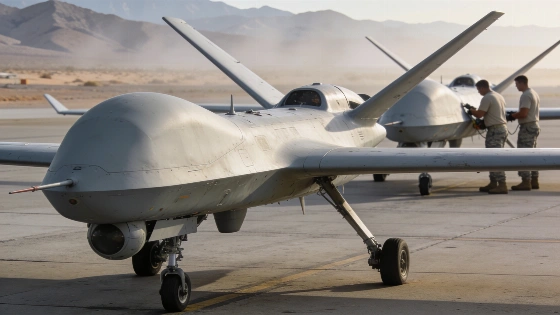
The aircraft are Anduril's YFQ-44A, known as Fury, and General Atomics' YFQ-42A, known as Vengeance. Fury arrived in August and is already undergoing operational experimentation. Vengeance was delivered on September 18, with plans to test it independently and in combination with Fury and crewed aircraft. Reports indicate that both prototypes are now available at Creech for work involving piloted fighters, including the study of collaborative operations.
Earlier Agile Combat Employment exercises with Fury were intended to rehearse procedures for integrating uncrewed wingmen into operational formations. These activities address a problem that is partly aerodynamic and partly organizational: a CCA must be able to fly its assigned profile, while units must also be able to launch, recover, service, communicate with and re-task it under realistic constraints.
The announcement identifies two designs and one experimental operational unit. It does not report a combat sortie, a benchmark score, a failure rate, a number of flight trials or an independent assessment of either aircraft. There are also no publicly supplied sample sizes, confidence intervals, p-values or peer-reviewed comparisons. That distinction matters: delivery enables evaluation, but it does not establish operational reliability.
The reported timeline is concise. Two CCA designs are now at Creech Air Force Base; one was delivered in August and the other on September 18. The available material gives no performance measurements beyond the start of operational experimentation. Any future assessment should specify the number and type of sorties, environmental conditions, communications disruptions, operator workload and predefined success criteria.
What the system does
CCAs are uncrewed fixed-wing aircraft designed to fly at speeds comparable to traditional aircraft and carry payloads for offensive or defensive roles. Their intended advantage is attritable mass: a lower-cost and more expendable force that can enter dangerous areas without placing a pilot inside every airframe. Whether that advantage is achieved will depend not only on procurement price, but also on maintenance hours, sortie generation, training demands, networking requirements and the cost of replacing aircraft.
In the proposed operating model, a crewed fighter acts as a hub while a human pilot directs several CCAs. The aircraft would receive a task such as flying a specified distance, searching an area and reporting back. It would then calculate a route, maintain formation, avoid hazards and execute the instruction without the pilot manually flying every movement. The key engineering question is how much authority can be delegated while preserving predictable behavior when sensors are incomplete, links are degraded or the mission changes.
That arrangement is better described as task-level autonomy under human supervision than as independent operation. The human remains the decision-maker, while the CCA supplies additional sensors, weapons capacity or physical presence. The system can automate navigation and formation behavior, but those functions do not demonstrate independent judgment or reliable performance in every environment. Research communities at MIT and Stanford have examined related questions of automation, supervision and human-machine coordination, but no such general research finding should be treated as a performance result for Fury or Vengeance.
Operational questions
The Air Force's immediate problem is logistical as much as computational. It must determine how many personnel are required to operate a given number of aircraft, how many CCAs one pilot can manage, where the aircraft can be based and how crews will refuel and rearm them. Those questions will shape whether the concept produces usable combat capacity or simply adds another layer of equipment and coordination.
Possible configurations include scouting, communications relay, electronic warfare, decoy and strike functions. A CCA could also carry additional AIM-120 AMRAAMs for an F-35 or F-47, allowing a crewed aircraft to employ weapons through the uncrewed platform rather than moving as close to a threat. The available material does not provide a tested configuration or evidence that any of these roles has been demonstrated in an operational scenario.
The Air Force says a CCA will fire only when instructed by a human. That condition establishes a formal approval point, but it does not by itself prove meaningful human control. Meaningful control would also depend on whether the pilot has adequate information, time, communication and a practical ability to intervene as events change. The current experiments are intended to expose those demands rather than assume they have already been solved.
In human-factors terms, the relevant measurements would include decision time, false alarms, missed detections, communication latency, task saturation and the frequency with which operators must override or correct the aircraft. None of those metrics has been publicly reported for the Creech experiments. The absence of published numbers is not evidence of failure; it means that conclusions should remain limited to the documented start of testing.
Evidence stops here
Senior Air Force officials have described the arrival of Fury and Vengeance as a way to build the program's operational future and deliver cost-effective combat power. Those statements explain the service's objective, not the aircraft's measured performance. No test results, independent verification, safety record or deployment status beyond experimental operations is supplied in the material available here. The GA-ASI announcement specifically frames the Vengeance handover as continued testing and evaluation.
The distinction between a crewed fighter and a CCA is therefore central. A pilot may delegate movement, sensing or other tasks, but the reported design still places weapon employment under human instruction. The aircraft are not presented as autonomous authorities able to select and attack targets without that instruction, and the announcement does not support such a claim.
For now, the strongest conclusion is also the most limited one: the United States Air Force has received the hardware needed to test whether Collaborative Combat Aircraft can be integrated into real military operations. That is a significant transition from design competition to operational experimentation, but it is not proof that the concept is affordable, dependable or controllable under pressure.
Human-in-the-loop systems place a person inside the decision chain, while the machine performs delegated tasks such as navigation or sensing. The quality of that control depends on workload, communications, system visibility and the time available to reject or change an instruction. The CCA program is valuable precisely because it is now testing those practical conditions; until those tests produce public evidence, Fury and Vengeance should be treated as experimental aircraft rather than validated replacements for crewed combat power.
As in aerospace programs at NASA and safety-critical autonomy research discussed in journals such as Nature, a credible claim about operational usefulness requires more than a successful demonstration. It requires repeatable trials, clearly defined endpoints, transparent accounting of failures and a comparison between human performance with and without the autonomous system. None of those complete datasets is yet available for the Creech CCA experiments.