I-care Group has acquired the assets of Amiral Technologies, including its DiagFit system, which detects abnormal machine behavior from normal operating data without requiring a library of past failures.
I-care Group has acquired the assets of Amiral Technologies and its DiagFit system to detect abnormal equipment behavior without depending on a catalog of previous breakdowns. The move gives the Belgian predictive-maintenance company a method aimed at complex assets in sectors such as defense and nuclear operations, where failures may be rare but their consequences can be serious.
The transaction concerns Amiral Technologies' assets rather than the entire company. I-care announced it on September 15, 2026, while the English-language PR material was dated September 17. The company says DiagFit will be integrated progressively into I-see(TM), its AI-based predictive-maintenance platform.
DiagFit is not a failure predictor in the narrow sense. It first uses historical operating data to establish how an asset behaves under normal conditions. Incoming data from multiple sensors and operating parameters is then compared with that baseline. When the system detects a departure from the expected pattern, it can flag the change for investigation.
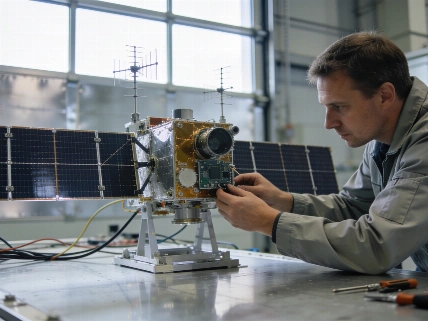
That distinction matters in industries where a conventional supervised model may lack enough examples of failure. A satellite or helicopter can generate extensive operational data while producing few failure events. In such cases, a system trained mainly on past breakdowns may have little direct evidence with which to recognize an unfamiliar fault. The same basic challenge appears in long-duration aerospace programs associated with organizations such as NASA and ESA, where avoiding failure is part of the design objective rather than a source of abundant training examples.
The technology came from Amiral Technologies, a Grenoble-based deep-tech company described by I-care as a CNRS spin-off. Its stated applications include complex assets such as satellites and helicopters. I-care founder and CEO Fabrice Brion said the integration should strengthen the company's ability to analyze complex industrial data across multiple sensors and operating parameters, particularly in defense and nuclear environments. The research lineage is relevant context, but it is not by itself evidence of field performance.
Those claims describe a capability being added to I-care's portfolio rather than a demonstrated guarantee of safer operations. The available official material does not report a transaction price, a failure-detection rate, a false-alarm rate, confidence intervals, sample sizes or an independent evaluation of DiagFit. It also does not establish how the system performs when sensors drift, operating conditions change sharply or an asset's normal behavior is poorly understood.
The numerical record is therefore limited but clear: the transaction was announced on September 15 on I-care's website, with September 17 given as the publication date in the English-language PR material; it involves the DiagFit and I-see(TM) technologies, and it concerns Amiral Technologies' assets. No trial count, benchmark score or measured improvement is reported, so the acquisition cannot be treated as evidence of a quantified performance gain.
DiagFit's on-premises deployment option is a practical part of the announced integration. Customers can process operational data inside their own networks instead of sending it to cloud infrastructure, where that architecture is appropriate. For defense programs and nuclear facilities, that may reduce a barrier to adopting machine monitoring because engineers retain more control over where sensitive equipment data is handled. I-care describes this capability in its official acquisition announcement.
Keeping data onsite does not by itself validate an anomaly detector or remove the need for human review. An alert indicates that observed behavior differs from a learned baseline; it does not identify the physical cause or prove that a component will fail. Engineers must still determine whether the deviation reflects damage, a legitimate change in operating conditions, a sensor problem or an incomplete baseline. This distinction is central to responsible industrial AI and is consistent with the cautious separation between model output and physical interpretation expected in high-consequence engineering.
The commercial logic is straightforward. Amiral Technologies' assets gain access to I-care's international sales operation, while I-care adds a system designed for assets where operational data is plentiful and failure examples are scarce. The acquisition is also presented as bringing relevant research and sales capabilities into I-care's broader offering, although the public materials do not provide a detailed organizational breakdown or financial terms.
The acquisition fits a wider reality of industrial AI: useful predictive maintenance cannot depend on spectacular quantities of labeled failures when the equipment being monitored is designed not to fail. But replacing failure examples with a normal-behavior baseline shifts the central engineering task rather than eliminating it. The quality of the result depends on whether the baseline covers the asset's real operating range, whether the sensors remain trustworthy and whether people can act on an alert without confusing statistical novelty with physical danger. Earlier robotics reporting likewise shows why technology claims need to be separated from what has actually been tested.
In practical terms, DiagFit gives I-care an additional route into predictive maintenance for difficult assets, especially where historical failure data is thin and data governance is strict. Its research background can be understood in the broader context of technology transfer from public laboratories, a process that also appears in fields ranging from CERN instrumentation to applied work reported in Nature. That comparison provides context, not a performance claim about DiagFit.
The system's eventual value will depend on validation across real operating conditions. Useful evaluation would need clearly defined normal-operation periods, documented anomaly cases, measurements of false positives and missed events, and testing across changes in load, environment and sensor quality. None of those results is disclosed in the available announcement, so the public evidence currently supports the existence and intended role of the technology, not a quantified safety or reliability improvement.
Anomaly detection means identifying behavior that departs from a reference pattern; it does not automatically explain the departure. A model may learn normal relationships among sensor readings during known operating conditions, but unusual behavior can result from maintenance, a changed workload, sensor error or genuine deterioration. That is why DiagFit's importance will depend less on the label AI than on validation across real operating conditions and on engineers retaining responsibility for interpreting its alerts.
The acquisition is therefore best understood as a strategic expansion of industrial anomaly detection rather than a proven safety breakthrough. I-care has confirmed the assets acquired, the planned on-premises capability and the progressive integration of DiagFit into I-see(TM), while the public record still lacks the accuracy, false-alarm and independent-validation data needed to judge how well the system performs in the field.