Kipu Quantum reports higher balanced accuracy and F1 scores when classical classifiers use features extracted from a 200-atom neutral-atom array. The benchmark tests toxicity classification, not a quantum computer's general advantage.
Each molecule in the UCI Molecular Toxicity dataset was represented by features generated using a 200-atom neutral-atom array. Kipu Quantum reports that classifiers using those features scored better on imbalanced toxicity benchmarks than models using traditional molecular descriptors. This is a measured improvement on a particular classification task; it does not establish a general quantum advantage or show that the processor discovered a drug.
Analog atom dynamics
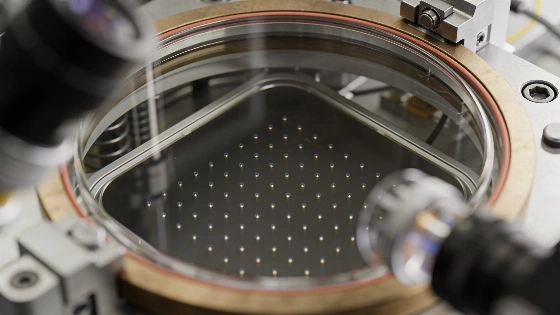
The experiment used QuEra Computing's 256-qubit Aquila neutral-atom quantum processor through the Kipu Quantum Hub platform. For each candidate molecule, the team arranged 200 neutral atoms on a 14×15 grid, with atoms spaced a few micrometers apart. Smooth driving pulses lasting under 4 microseconds let interactions between the atoms evolve continuously through Rydberg-state dynamics. The resulting measurements were converted into high-dimensional features for later analysis.
QuEra describes neutral-atom systems as using light to trap the atoms, an approach it says is well suited to scaling. In a company overview, QuEra cited a 3,000-qubit system it had demonstrated and set out a goal of a 10,000-qubit system in 2028. The company also describes Aquila as available through Amazon Braket, with reported availability of about 130 hours per week and 99% uptime. These are platform details, separate from the toxicity-classification benchmark. More information on QuEra's scaling approach appears in its discussion of neutral-atom scaling.
This is analog quantum feature extraction, not a deep gate-based circuit running a complete machine-learning algorithm. The quantum processor generated the representation; classical models then performed the classification. That division matters: the reported result concerns the usefulness of these extracted features within the tested process, not a fully quantum learning system.
Reported benchmark
The study reports about 1,000 quantum features per molecule, collected across 500 independent readout shots for each sample. The team evaluated the features over 100 random dataset splits using XGBoost, CatBoost, Random Forest, Support Vector Machines (SVM), and Google Research's zero-shot tabular foundation model (TabFM). Across the imbalanced-data metrics emphasized by the report, Balanced Accuracy rose from 0.55 to 0.70, while the F1-score increased from about 0.30 to about 0.60. An SVM classifier reached the highest reported AUC, about 0.81.
These measures capture different aspects of performance. Balanced Accuracy gives weight to correct classification in each class, so it is less easily inflated by predicting the majority class alone. F1 combines precision and recall, while AUC measures how well a classifier ranks examples across decision thresholds. The reported results summarize the benchmark across its random dataset splits.
That distinction is impressive for toxicity data, where a model can achieve seemingly strong raw accuracy by labeling most molecules as non-toxic. Kipu Quantum reports that the quantum features outperformed traditional descriptors on the imbalanced benchmarks. The scores describe this dataset and evaluation process; they are not, by themselves, a toxicology validation or a demonstration of performance on newly tested compounds.
What remains untested
The result concerns a feature-generation step followed by classical classification. The process's practical value depends on how consistently the features improve prediction against classical baselines, as well as the resources needed to generate and process them. The benchmark addresses toxicity classification on the UCI dataset; it does not report a drug discovery, clinical, or regulatory outcome.
The authors are Kipu Quantum engineers Antonio Ferrer Sánchez and Carlos Flores. Alejandro Gómez Cadavid also contributed to the study, titled "Reading Toxicity of Molecules with Neutral-Atom Quantum Processors". A separate three-qubit Grover test used a different quantum platform and task; its result does not independently confirm this toxicity benchmark.
The report describes an experimental use of QuEra hardware, with classification scores evaluated on dataset splits. A classifier score is distinct from toxicology validation, and the benchmark does not establish that the model was tested on new compounds outside those splits. The technical report is available through the Kipu Quantum Portal.
Quantum feature extraction uses a quantum system to map inputs into measurement-derived values that a classical model can then use. Here, the atoms' collective dynamics provide the representation, while the classifier remains classical. The study's reported gains concern that hybrid process on the tested molecular toxicity dataset.