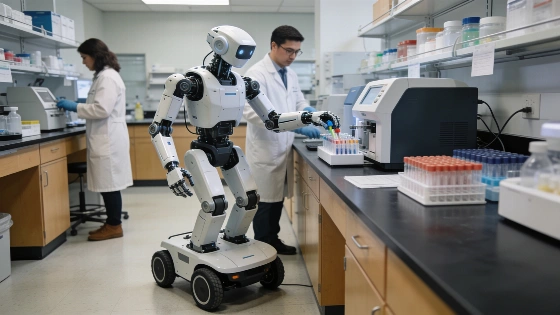
Tactus AI has introduced Elsie, a two-armed humanoid robot designed to automate hands-on clinical laboratory tasks using existing instruments and validated procedures, aiming to address staffing shortages without major infrastructure changes
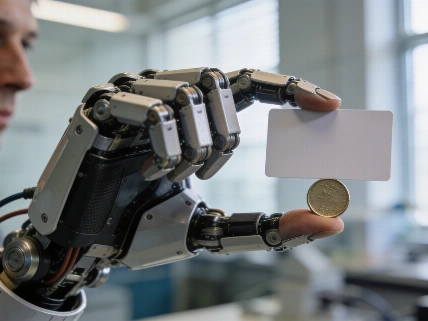
Tactus AI, a U.S.-based startup, has announced the development of Elsie, a two-armed humanoid robot intended to automate routine clinical laboratory work. Elsie was presented at the 2026 Association for Diagnostics & Laboratory Medicine (ADLM) Annual Scientific Meeting & Clinical Lab Expo. The system is designed to operate within existing laboratory environments, handling diagnostic instruments and tools already in use, and following validated standard operating procedures. According to the company, Elsie's core hardware combines wheeled mobility with dual-arm manipulation, and is equipped with touch, force, depth, and machine-vision sensors to support physical interaction with laboratory equipment.
Unlike many automation solutions that require new infrastructure or dedicated robotic workcells, Elsie is intended to work at human-scale laboratory benches and interact with instruments as they are currently configured. The robot's software stack includes a Lab Orchestration platform that coordinates multi-step procedures involving robots, instruments, and human staff, as well as a library of validated robotic skills for specific laboratory operations. These skills cover tasks such as transporting samples, monitoring instrument status, clearing first-line faults, changing consumables, and recording actions within the orchestration platform. Tactus AI reports that Elsie can be integrated into laboratory workflows without requiring replacement or major modification of existing equipment.
Deployment and Evaluation
The company plans to select three to five launch laboratories in 2026, beginning with U.S. academic medical centers. Each site undergoes a readiness review that assesses infrastructure, instrument compatibility, workflow integration, and data systems. This is followed by a 30-day assessment period, during which a pilot roadmap and success criteria are defined. Before deployment, Tactus AI constructs a digital twin of the customer's laboratory bench, using data on instrument configurations, standard operating procedures, error codes, and technical contacts. Elsie's control policies are then trained and stress-tested in a physics-based simulation environment, with hundreds of virtual runs before on-site validation alongside laboratory personnel. Individual robotic skills are not deployed on live workflows until approved by the customer's quality team.
According to the U.S. Bureau of Labor Statistics, there are projected to be approximately 22,600 annual openings for clinical laboratory technologists and technicians through 2034. The American Society for Clinical Pathology's 2024 survey reported a 28 percent vacancy rate in anatomic pathology and vacancy rates of 7 to 15 percent in most other laboratory departments. Tactus AI positions Elsie as a response to these staffing shortages, aiming to automate repetitive manual tasks while maintaining existing laboratory procedures and infrastructure.
Technical Capabilities and Limitations
Elsie's physical AI platform is designed to perceive and manipulate objects in real-world laboratory settings. The robot's sensor suite enables it to detect force, depth, and tactile feedback, supporting safe handling of laboratory equipment and consumables. The orchestration software coordinates Elsie's actions with those of human staff and other automated systems, aiming to minimize workflow disruption. However, the company has not disclosed detailed performance metrics, such as task success rates, error rates, or the frequency of human intervention required during pilot deployments. Independent evaluation of Elsie's reliability and safety in operational laboratories has not yet been reported.
Before live deployment, each laboratory's digital twin is used to simulate hundreds of task runs, allowing for stress-testing of control policies and identification of potential failure modes. On-site validation is conducted with laboratory staff, and only skills that meet the customer's acceptance criteria are approved for use. This staged approach is intended to reduce the risk of workflow disruption and ensure that automation is introduced in a controlled manner. The extent to which Elsie can generalize to new instruments or adapt to unexpected laboratory conditions remains to be demonstrated in broader deployments.
Context and Comparison
Elsie's approach to laboratory automation differs from traditional fixed automation systems, which often require dedicated workcells and significant reconfiguration of laboratory layouts. By focusing on human-scale manipulation and compatibility with existing instruments, Tactus AI aims to lower the barrier to robotic integration in clinical settings. This strategy is part of a broader trend in robotics, where humanoid and mobile robots are being developed to operate in environments originally designed for people. For example, recent research has explored machine-learning frameworks that enable humanoid robots to navigate unpredictable terrain, as seen in work on real-world locomotion for humanoid robots.
Despite these advances, the deployment of humanoid robots in safety-critical environments such as clinical laboratories raises questions about reliability, error recovery, and human oversight. Regulatory requirements for laboratory automation remain stringent, and the integration of autonomous systems must account for quality assurance, traceability, and liability in the event of failure. Tactus AI's staged deployment process, including simulation-based training and customer-specific validation, reflects an awareness of these challenges, but independent evidence of sustained operational performance will be necessary to assess the system's impact.
Sim-to-real transfer is a central concept in robotics, referring to the process of training and testing robot control policies in simulated environments before deploying them in the physical world. Simulation allows developers to expose robots to a wide range of scenarios, including rare or hazardous events, without risking equipment or disrupting real workflows. However, differences between simulation and reality-such as sensor noise, mechanical wear, and unpredictable human behavior-can limit the reliability of sim-to-real transfer. Effective deployment of robots like Elsie depends on minimizing this gap and ensuring that simulated training translates into robust real-world performance.