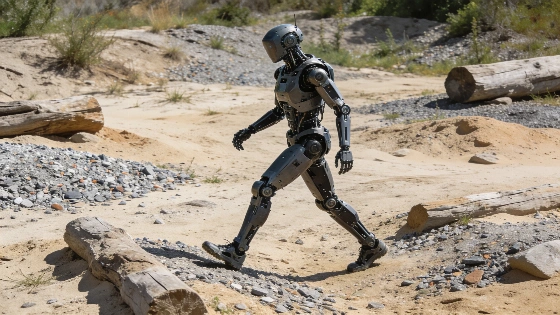
Georgia Tech researchers have introduced a machine-learning framework that enables a humanoid robot to walk across unpredictable real-world surfaces, reducing both training time and computational demands compared to previous methods
A research team at Georgia Tech has developed a machine-learning approach that enables a full-sized humanoid robot to walk across a variety of challenging real-world surfaces-including sand, gravel, wet grass, slopes, stairs, and slippery floors-while reducing the time and computational resources required for training. The system, presented at the IEEE International Conference on Robotics and Automation (ICRA), is based on a reinforcement learning framework called "Learn to Teach." Unlike conventional teacher-student reinforcement learning, which trains a teacher model in simulation before transferring knowledge to a student model that controls the physical robot, the new method trains both models simultaneously. This parallel training allows the student to benefit from the teacher's evolving expertise in real time, while the teacher also learns from the student's experiences in the physical world.
In laboratory and outdoor tests, the humanoid robot equipped with the new controller was able to traverse a range of surfaces without requiring separate controllers for each environment. The robot maintained balance and adapted its gait even when subjected to external disturbances such as pushes and pulls. According to the research team, the controller was not specifically trained for every terrain it encountered, yet it demonstrated robust performance across diverse conditions. The researchers reported that their approach reduced the overall training time and computational cost compared to sequential teacher-student methods, which typically require extensive simulation on high-performance GPU hardware.
Quantitative details from the study indicate that the simultaneous training framework significantly shortened the training process, though the exact reduction in hours and computational resources was not disclosed in the conference summary. The robot's ability to generalize to new, previously unseen terrains was demonstrated in a series of controlled experiments, but the number of trials, failure rates, and human interventions required during testing were not specified. The research was presented as a peer-reviewed conference paper, and independent replication of the results has not yet been reported.
The "Learn to Teach" framework is designed to address a common limitation in teacher-student reinforcement learning known as the imitation gap, where the student model encounters real-world situations that differ from the teacher's idealized simulation. By allowing both models to learn from each other's experiences, the framework aims to improve the transfer of skills from simulation to reality. The researchers suggest that this approach could be adapted to other robot designs and tasks that require reliable movement in unpredictable environments, though further validation will be needed to assess its generalizability and safety in broader applications.
Recent advances in robot policy evaluation have highlighted the persistent gap between simulation and real-world deployment. For example, NVIDIA's RoboLab platform was developed to benchmark and analyze general-purpose robot policies before field testing, as discussed in a recent Science Report article on simulation-based evaluation limits. The Georgia Tech team's work addresses a related challenge by focusing on efficient transfer of locomotion skills to physical robots operating in uncontrolled environments.
Reinforcement learning is a machine-learning technique in which an agent learns to make decisions by receiving feedback in the form of rewards or penalties. In robotics, reinforcement learning is often used to train controllers in simulation, where failures are safe and inexpensive. However, transferring these controllers to real robots can be difficult due to differences between simulated and physical environments-a problem known as the sim-to-real gap. Teacher-student frameworks attempt to bridge this gap by using a well-trained simulation model to guide a real-world controller, but sequential training can be slow and inefficient. The "Learn to Teach" approach seeks to accelerate this process by enabling continuous, bidirectional knowledge transfer between simulation and reality, potentially improving both training efficiency and real-world robustness.