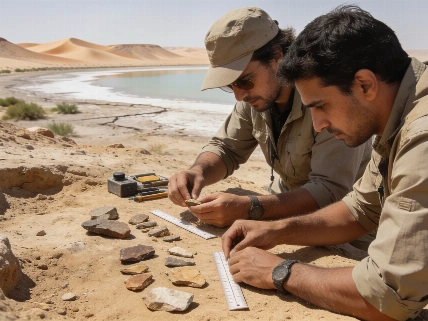
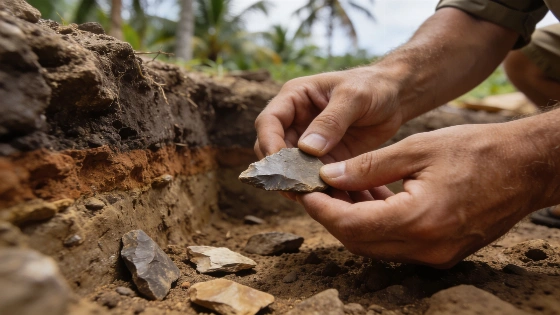
Archaeologists use the term lithics to describe stone artifacts found at ancient sites. Recent discoveries in Indonesia show that stone tool production predates Homo sapiens, challenging earlier assumptions about human technological origins
In archaeological research, the term lithics refers to artifacts made from stone, including tools, flakes, and cores produced by deliberate human action. These objects are among the most enduring forms of material culture, often surviving long after organic materials such as wood, textiles, or leather have decayed. Lithic analysis provides a crucial window into the technological abilities and behaviors of ancient populations, especially where other evidence is scarce or absent.
Evidence from Early Sites
For much of the twentieth century, it was widely believed that only Homo sapiens, our own species, created sophisticated stone tools. However, discoveries from sites across Africa and Eurasia have demonstrated that earlier hominins, including Homo erectus and other unidentified relatives, also produced and used stone implements. Notably, archaeological excavations in Indonesia have uncovered sharp-edged stone flakes and cores dating to approximately 1.5 million years ago-well before the emergence of Homo sapiens. These finds were recovered from stratified deposits, with dating supported by geological context and associated faunal remains.
The Indonesian assemblages include hundreds of stone artifacts, many showing evidence of intentional flaking and edge modification. The tools were found in association with animal bones, suggesting their use in processing food or other materials. The dating of these layers relies on a combination of stratigraphic analysis and radiometric techniques, providing a minimum age for the artifacts and their makers. While the precise hominin species responsible remains uncertain, the evidence demonstrates that stone tool production was not unique to Homo sapiens.
Preservation and Interpretation
Stone artifacts are highly resistant to decay, making them a dominant component of the archaeological record for early human sites. In contrast, organic materials such as plant fibers, hides, and wooden implements rarely survive over long timescales, especially in tropical or temperate environments. As a result, much of what is known about ancient technology and behavior is inferred from lithic evidence. This preservation bias means that the archaeological record may underrepresent the full range of materials used by past populations.
Interpreting lithic assemblages requires careful analysis of manufacturing techniques, use-wear patterns, and contextual associations. Archaeologists examine the size, shape, and flake scars on tools to reconstruct the methods used to produce them. Experimental archaeology and microscopic analysis can help identify traces of use, such as cutting, scraping, or pounding. However, the absence of organic tools and perishable materials limits the ability to reconstruct the complete technological repertoire of early hominins.
Reconsidering Human Evolution
The recognition that multiple hominin species produced stone tools has significant implications for understanding human evolution. It challenges the notion of a simple, linear progression of technological development and highlights the diversity of behaviors among ancient populations. The Indonesian finds, in particular, suggest that hominins dispersed across Asia much earlier than previously thought, carrying with them the knowledge and skills to produce lithic tools.
Despite advances in dating and analytical methods, important uncertainties remain. The identity of the toolmakers at early Indonesian sites is still debated, as no associated hominin fossils have been securely linked to the artifacts. Additionally, the function of many stone tools can only be inferred indirectly, and the absence of organic remains leaves gaps in the reconstruction of ancient lifeways. Ongoing research continues to refine the chronology and interpretation of these assemblages, contributing to a more nuanced understanding of early human technology.
In archaeological terminology, lithics encompass all artifacts made from stone, including tools, debitage (waste flakes), and cores. Lithic analysis involves studying the raw material, manufacturing techniques, and patterns of use and discard. Because stone is highly durable, lithic artifacts often form the backbone of archaeological interpretation for prehistoric periods. However, reliance on lithics alone can obscure the broader range of technologies and behaviors practiced by ancient populations, especially those involving perishable materials. Recognizing the limitations and strengths of lithic evidence is essential for reconstructing the complexity of early human societies.