Stoke Space has raised $1 billion to advance its Nova Pathfinder and Nova Block 2 rockets, both designed for full reusability and high payload capacity to low Earth orbit, with the first orbital launch targeted for early 2027
Stoke Space has positioned itself as a direct challenger to established launch providers by announcing a $1 billion Series E funding round dedicated to the development of its fully reusable Nova rocket family. The company's latest move signals a clear intent to compete for both commercial and national security payloads as the market for large satellite constellations intensifies and legacy vehicles approach retirement.
Nova Block 2 and Pathfinder Architecture
The Nova program consists of two main vehicles: the Nova Pathfinder, which is nearing its first orbital launch, and the newly revealed Nova Block 2, a larger variant designed to deliver payloads up to 15 metric tons to low Earth orbit (LEO). Both rockets are built around rapid, full reusability, with Pathfinder serving as the testbed for the technologies that will underpin Block 2's operational capability.
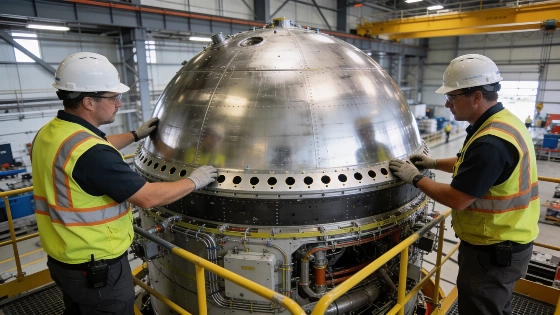
Pathfinder's first stage is powered by seven in-house Zenith engines using a full-flow staged combustion cycle and fueled by liquid oxygen and liquefied natural gas. Block 2 will double the engine count to fourteen, increasing thrust and supporting a wider payload fairing of five meters in diameter. The upper stage departs from conventional designs by integrating twelve small dual-thrust chambers around a metal heat shield, which is actively cooled by liquid hydrogen during atmospheric reentry. This approach is intended to minimize turnaround time between flights by reducing maintenance and eliminating the need for fragile ceramic tiles.
Funding and Infrastructure Expansion
The $1 billion investment brings Stoke Space's total funding to $2.3 billion, enabling the company to scale up manufacturing, testing, and launch operations. A significant portion of the new capital will be used to expand the Moses Lake Test Site in Washington from 75 to 475 acres, supporting propulsion and vehicle testing for both Pathfinder and Block 2 hardware. Stoke is also building a new payload processing facility at Cape Canaveral Space Force Station's Launch Complex-14, sized to accommodate both vehicles, and is developing an offshore recovery platform to complete its reusability system.
Stoke's infrastructure push comes as the company prepares for Pathfinder's first orbital launch, targeted for early 2027. If successful, multiple Pathfinder missions are planned for 2027 and 2028, while Block 2 development continues in parallel. The company intends to keep Pathfinder operational even after Block 2 enters service, citing mission flexibility and market demand for different payload classes.
Technical Milestones and Market Position
Stoke Space has already completed a low-altitude "hopper" test of Pathfinder's upper stage engine system, demonstrating controlled flight and landing. The company claims that scaling up to Block 2 will increase upper stage thrust by more than a factor of five, with independent systems for each of the twelve engines. The cylindrical tank design of Block 2 allows for greater propellant and payload volume, supporting the larger fairing and higher mass to orbit.
Nova Block 2 is positioned to compete directly with SpaceX's Falcon 9 and Rocket Lab's upcoming Neutron vehicle. With SpaceX planning to retire Falcon 9 as Starship becomes operational, Stoke aims to fill the gap for medium- to heavy-lift launches. The company's timeline for Block 2's first flight is set for 2029, with production and launch cadence expected to ramp up thereafter. For context, SpaceX's own expansion plans for Starship infrastructure were reported earlier as the company prepares for thousands of annual launches from new sites.
Remaining Challenges and Industry Implications
Despite the ambitious funding and technical roadmap, Stoke Space faces significant engineering and operational hurdles. Full-flow staged combustion engines are among the most complex propulsion systems in use, and achieving rapid, reliable reusability at scale remains unproven outside of SpaceX's Falcon 9. The company's approach to upper stage reentry and recovery is novel, but will require extensive testing to validate performance and durability under repeated flight conditions.
Stoke's entry into the heavy-lift market comes at a time of transition, as established vehicles are phased out and new architectures are still in development. The company's ability to deliver on its promises will depend on successful demonstration flights, robust ground infrastructure, and the capacity to meet customer requirements for cadence and reliability. If Stoke can achieve even a fraction of its stated goals, it will force a recalibration of expectations for commercial launch providers and could accelerate the shift toward fully reusable systems as the industry standard.
Full-flow staged combustion is a rocket engine cycle in which both the fuel and oxidizer are fully gasified and driven through separate preburners before entering the main combustion chamber. This approach increases efficiency and thrust while reducing engine wear, but it also introduces significant engineering complexity. Only a handful of organizations have successfully developed such engines, and their use is typically reserved for advanced launch vehicles where performance and reusability are critical. The cycle's technical demands make it a key differentiator for companies seeking to push the limits of rapid, repeatable access to orbit.