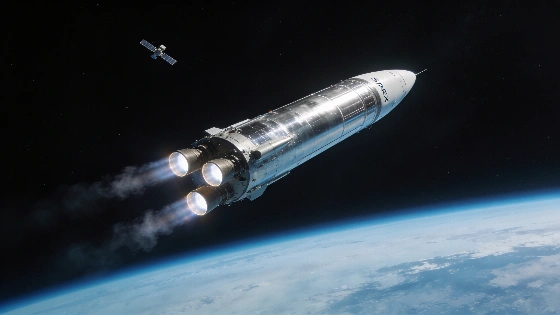
A camera-equipped Starlink V3 satellite recorded SpaceX's Starship upper stage after Flight 13, offering an unusual view of the vehicle's engines, thrusters and separation in space
A camera aboard one of SpaceX's next-generation Starlink V3 satellites has captured an unusual view of the company's Starship upper stage in space. The footage shows the vehicle after it deployed the satellites during Flight 13, documenting a moment that is normally visible only through telemetry and distant tracking.
The orbital view
Starship, the upper stage of SpaceX's fully reusable launch system, lifted off from South Texas on July 24, 2026. Flight 13 followed a suborbital path rather than placing its payload into a lasting orbit, but it carried 20 functional Starlink V3 satellites-the first spacecraft of that generation to reach space.
Six of the satellites were fitted with cameras intended to inspect Starship's heat shield. Their instruments also recorded the vehicle as it moved away after deployment. SpaceX released a 65-second composite on July 31, assembled from imagery gathered by four cameras on a single satellite. Because the sequence combines separate camera views, it is processed footage rather than a single conventional photograph.
The images begin at relatively close range, with the reflective 52-meter Ship occupying much of the frame. As the distance increases, more of the vehicle becomes visible. Near the end of the sequence, Ship appears as a complete vehicle, with three of its six Raptor engines firing. Brief white plumes are also visible as the craft uses reaction-control thrusters for small attitude adjustments.
What Flight 13 tested
The satellite footage is visual evidence of the vehicle's behavior, but it does not by itself establish the performance of every system. Other mission data are needed to determine engine output, propellant use, thermal conditions and the exact trajectory. The cameras were designed to observe the heat shield, so their images provide context for the flight rather than a complete engineering assessment.
Ship deployed the satellites and successfully reignited one Raptor engine in space before continuing toward its planned splashdown. About 65 minutes after liftoff, the upper stage came down in the Indian Ocean off Western Australia. It survived atmospheric reentry and remained afloat afterward; an earlier report on Ship remaining afloat after splashdown described the vehicle's condition several days later.
The first-stage booster, Super Heavy, had a less complete test. Its landing burn used five of the 13 Raptor engines planned for that maneuver, and the booster struck the Gulf of Mexico faster than intended. Super Heavy uses 33 Raptors during liftoff, illustrating the difference between a successful launch and a fully controlled recovery.
Why Starlink V3 matters
The V3 satellites deployed on Flight 13 were not placed into a permanent operational constellation. Because the mission was suborbital, the 20 spacecraft reentered roughly 20 minutes after deployment. Their immediate role was therefore both functional and experimental: they demonstrated deployment hardware while supplying imagery of the rocket during flight.
SpaceX has told the U.S. Federal Communications Commission that it wants to operate a much larger Starlink V3 constellation, potentially reaching 100,000 satellites. The proposed scale remains a regulatory and deployment plan, not an already completed network. V3 spacecraft are considerably larger than the company's existing V2 satellites, with an individual mass of about 2,000 kilograms, increasing the importance of a launch system capable of carrying many large payloads.
Starship is central to that architecture because SpaceX intends the rocket to be reusable. In practice, that goal depends on repeated demonstrations of controlled ascent, payload deployment, reentry and recovery. Flight 13 supplied evidence for several of those steps, but the booster's landing performance shows that the system is still under development.
Beyond the test flight
The company also sees Starship as part of NASA's future Artemis campaign. The vehicle is expected to support the Artemis III astronaut mission to low Earth orbit in the mid-2027 timeframe and is intended to land astronauts near the Moon's south pole on Artemis IV, currently targeted for late 2028. Those plans remain dependent on further testing, certification and mission readiness; a successful suborbital test is not equivalent to operational crew capability.
The satellite video is valuable because it reveals physical activity that ground cameras cannot easily resolve after separation. It shows engines firing and thrusters operating, but it does not prove that Starship has achieved routine reusability or that the proposed Starlink expansion is technically and legally complete. Those conclusions require repeated flights, detailed telemetry and successful recovery of both stages.
A spacecraft camera records reflected light and converts it into digital image data; the resulting sequence can then be aligned and combined with footage from other cameras. Perspective, exposure and processing affect how large or bright an object appears, so a composite view should not be treated as a direct measurement of distance, engine thrust or vehicle condition. In this case, the images complement engineering data by showing what the vehicle looked like during a specific phase of flight.