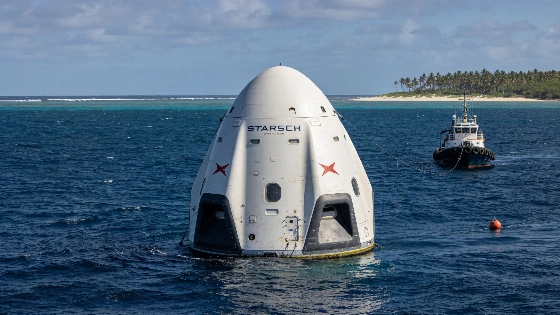
SpaceX's Starship Ship 40, which completed a controlled splashdown in the Indian Ocean after its July test flight, has been successfully towed to calmer waters near Christmas Island for engineering analysis
SpaceX has achieved a significant technical milestone by recovering the upper stage of its Starship launch system intact after a controlled splashdown in the Indian Ocean. The vehicle, known as Ship 40, was towed over 24 days through challenging sea conditions to a location just off the coast of Christmas Island, where it now awaits detailed inspection by SpaceX engineers. This recovery marks the first time a Starship upper stage has survived reentry and ocean landing in one piece, providing the company with a rare opportunity to examine the effects of flight and splashdown on the spacecraft's structure and systems.
Recovery Operation and Mission Context
Ship 40 launched from SpaceX's Starbase facility in South Texas on July 24, 2026, as part of the Starship Flight 13 test. The mission's primary objective was to demonstrate a controlled, intact splashdown of the upper stage in the Indian Ocean, a key step toward full vehicle reusability. After separation from its Super Heavy booster, Ship 40 executed a landing burn and entered the ocean as planned. The recovery team then faced nearly a month of rough seas and logistical challenges before reaching the calmer waters near Christmas Island, an Australian territory located about 1,900 kilometers northwest of Broome.
At 52 meters in length, Ship 40 is the largest spacecraft SpaceX has attempted to recover from the ocean. The intact return of the vehicle contrasts with the previous test, Flight 12, in which the upper stage (Ship 39) exploded after splashdown. The successful retrieval of Ship 40 allows SpaceX to directly assess the performance of its heat shield tiles, aerodynamic surfaces, and hydraulic systems following atmospheric reentry and ocean exposure.
Engineering Analysis and Reusability Goals
SpaceX engineers are now preparing to conduct a comprehensive analysis of Ship 40 while it remains offshore. The company's iterative design approach relies on post-flight examination to identify weaknesses and implement incremental improvements for future vehicles. Ship 40 is the first Starship upper stage to complete a spaceflight and return intact, offering a unique data set for evaluating the durability of thermal protection systems and structural components under real mission conditions.
The recovery operation is a critical step toward SpaceX's goal of developing a fully reusable super heavy-lift launch system. Future test flights are expected to build on these results, with plans to attempt a return of the upper stage to Starbase using the "Mechazilla" launch tower's catching arms. According to SpaceX, Ship 41 and its Super Heavy booster are already being prepared for Flight 14, which aims to further demonstrate orbital insertion and controlled recovery techniques.
Implications for NASA and Commercial Missions
The Starship program's progress is closely watched by NASA, which has contracted SpaceX to develop a lunar lander variant for the Artemis IV mission, scheduled for 2028. Before Starship can be certified for crewed missions, it must meet a series of technical milestones, including successful orbital flight, controlled reentry, and safe recovery. The intact retrieval of Ship 40 represents a step forward in meeting these requirements, but significant engineering and operational challenges remain.
SpaceX's efforts to develop reusable launch systems have broader implications for the commercial space sector. The ability to recover and reuse large spacecraft could reduce launch costs and enable more ambitious missions, including lunar and interplanetary exploration. The company's approach to rapid iteration and hardware recovery was also highlighted in its recent plans to deploy robotic manufacturing facilities on the Moon, as discussed in a recent Science Report article on lunar robotic factories.
Technical and Environmental Considerations
Christmas Island, where Ship 40 now floats offshore, is a remote location with limited port infrastructure. Most of the island is designated as a national park, and environmental considerations are likely to influence the logistics of moving the spacecraft for further analysis or transport. The recovery team must balance engineering needs with local regulations and the island's unique ecosystem, which is known for its annual red crab migration.
While the intact recovery of Ship 40 is a notable achievement, it does not guarantee that future Starship vehicles will survive splashdown or be suitable for rapid reuse. Each test flight provides new data on the limits of current designs and the operational risks involved in ocean recovery. The next phase of testing will focus on returning vehicles to land and demonstrating the reliability required for human spaceflight.
Spacecraft recovery is a complex process that involves both engineering and environmental challenges. When a vehicle like Starship's upper stage splashes down in the ocean, it is exposed to saltwater, dynamic loads, and potential impact damage. Engineers analyze recovered hardware to assess the condition of heat shield tiles, structural joints, and propulsion systems. This information is essential for refining reusability strategies and improving the safety and performance of future missions.