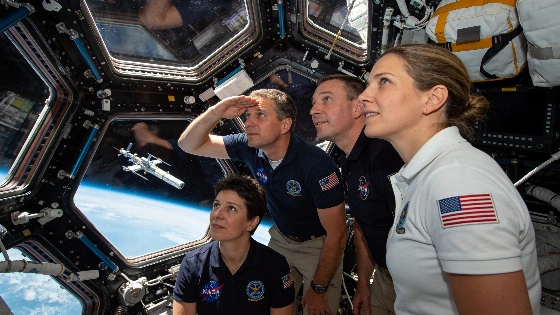
NASA's International Space Station experiments in 2026 are testing technologies and studying astronaut health to support future Artemis missions to the Moon and Mars, with new results informing spacecraft design and deep space exploration
Throughout 2026, the International Space Station (ISS) has remained a central platform for testing the technologies and biological responses essential for human exploration beyond low Earth orbit. As NASA's Artemis II mission completed its first crewed lunar flyby in over half a century, ongoing ISS research is providing the data and operational experience needed to prepare for longer and more distant missions, including those to Mars.
Technology Demonstrations in Orbit
ISS crews are evaluating compact exercise systems, medical fluid generation, and robotic automation to address the unique challenges of deep space travel. The European Enhanced Exploration Exercise Device (E4D), now in a two-year demonstration phase, is designed to help astronauts maintain bone and muscle health during extended missions. Unlike previous exercise equipment, E4D can simulate a range of gravity levels and supports multiple exercise types, potentially reducing the mass and volume required for future spacecraft.
Medical autonomy is another focus. The Intravenous Fluid Generation - Mini (IVGEN Mini) experiment is testing the production of intravenous fluids from the station's potable water. Since commercial IV fluids have a limited shelf life, the ability to generate them on demand could be critical for medical emergencies far from Earth. Meanwhile, the Test facility for lab-aUtomation System in Kibo (TUSK) is assessing how microgravity affects robotic precision, with the goal of automating routine laboratory tasks and freeing up crew time for mission-critical activities.
Human Health and Adaptation
ISS astronauts serve as both operators and research subjects, collecting biological samples and undergoing physiological monitoring to understand how the human body responds to microgravity. Previous studies have shown that astronauts can lose 1-1.5% of bone density per month in orbit, increasing the risk of fractures. Regular exercise and new countermeasures are being evaluated to mitigate these effects.
Blood flow and clotting are also under investigation. The Spaceflight Thrombosis and Risk Factors (Venous Haemostasis) experiment is examining changes in blood circulation that could elevate the risk of thrombosis. Cardiovascular and respiratory adaptations are tracked using the Bio-Monitor "smart shirt" as part of the CARDIOBREATH study, which records heart rate, blood pressure, and breathing during exercise. These data are informing risk assessments and countermeasures for long-duration missions.
Mental health remains a priority as well. The RelaxPro experiment is evaluating structured mind-body practices, such as meditation, to reduce stress and improve sleep quality during prolonged isolation and confinement in space.
Spacecraft Systems and Environmental Monitoring
Testing next-generation spacecraft systems on the ISS allows engineers to refine designs before deploying them on lunar or Martian missions. The Fiber-optic Active Dosimeter (Lumina) is providing real-time radiation monitoring using optical fibers that darken in response to ionizing radiation, a key hazard for deep space crews. Understanding radiation exposure is essential for mission planning and crew safety.
Cryogenic fuel management is another technical hurdle. The Zero Boil-Off Tank Noncondensables (ZBOT-NC) experiment is studying how non-condensable gases affect the pressure and evaporation rates in cryogenic propellant tanks. Results will help validate models and improve the efficiency of fuel storage for future spacecraft.
Microbial monitoring is also underway. The Genomic Enumeration of Antibiotic Resistance in Space (GEARS) investigation is surveying the ISS environment for antibiotic-resistant bacteria using DNA sequencing. This work aims to improve onboard diagnostic capabilities and inform protocols for maintaining a safe habitat during long-duration missions.
Linking ISS Research to Lunar and Martian Exploration
The integration of ISS research with Artemis and Moon Base programs is shaping the operational and scientific framework for sustained exploration beyond Earth. The Artemis II mission in April 2026 marked a significant milestone, but the lessons learned from ISS experiments are directly informing the design of life-support systems, medical protocols, and crew health strategies for future lunar and Martian expeditions. For context, the importance of lunar sample analysis in shaping mission priorities was highlighted by the Soviet Luna 24 mission, which returned soil from the Moon in 1976 and revealed traces of water-an event discussed in this historical overview.
As the ISS continues to operate through the remainder of 2026, its role as a testbed for spaceflight systems and human adaptation remains central to NASA's strategy for extending human presence deeper into the solar system.
Radiation exposure is a persistent concern for deep space missions. Unlike low Earth orbit, where Earth's magnetic field provides partial shielding, lunar and Martian missions expose crews to higher levels of cosmic and solar radiation. Dosimeters such as Lumina measure the accumulated dose in real time, allowing mission planners to assess risk and develop protective strategies. Understanding the limits of current shielding and the biological effects of radiation is essential for designing safe long-duration missions beyond Earth's protective environment.