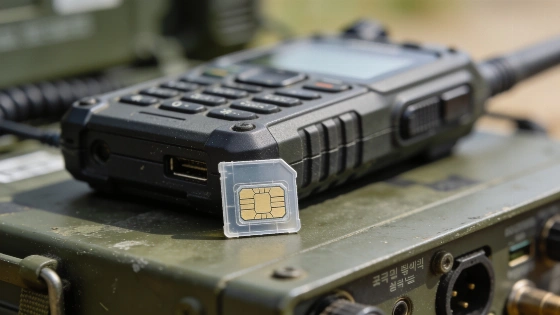
South Korea's MSIT/KISA pilot places domestic KpqC algorithms alongside NIST standards inside tamper-resistant SIM hardware. The stated goal is crypto-agility for military systems, though the announcement gives no performance measurements
A tactical communications device may be able to adopt new cryptography without replacing its entire hardware platform. That is the aim of a South Korean military pilot in which IDEMIA Secure Transactions (IST) and KT Corporation are testing post-quantum cryptographic functions inside SIM and eSIM secure elements.
Cryptography inside the SIM
The secure element is intended to perform cryptographic operations within a tamper-resistant module rather than relying on the host device to handle sensitive basic material. Information from the announcement, the SIM generates and stores session keys internally, then carries out the cryptographic work. The approach is meant to reduce the burden on host devices where processing capacity and memory are limited.
That matters because post-quantum cryptographic methods can require larger keys and signatures than older public-basic schemes such as RSA and ECC. On a low-power field terminal or tactical sensor, added computation may affect processing time and battery use. Moving those operations into a dedicated module is one proposed way to manage the burden; the announcement provides no measurements of any reduction in latency or power consumption.
The pilot is part of South Korea's 2026 Post-Quantum Cryptography Pilot Conversion Project, organized by the Ministry of Science and ICT (MSIT) and the Korea Internet & Security Agency (KISA). It is testing domestic Korean Post-Quantum Cryptography (KpqC) algorithms alongside international NIST standards within one secure element. The announcement describes this as the first reported deployment of both frameworks in a tamper-resistant SIM/eSIM platform.
Tests across defense systems
The program is being conducted on behalf of South Korea's Ministry of National Defense and the Army Information and Communication School. KT's pilot evaluates encryption and authentication under operational military conditions, rather than reporting a laboratory benchmark for the SIM alone.
One test area is uncrewed systems, where the pilot is intended to secure telemetry and flight commands between tactical UAVs and ground control stations. Another concerns authentication across private 5G military base stations and connected endpoints. The program also covers authenticated encryption for perimeter CCTV feeds and digital video evidence archives.
The announcement does not identify the specific algorithms, basic or signature sizes, processing times, power draw, number of tested devices, or measured error rates. It also gives no details about the test protocol or a comparison against existing cryptographic hardware. These are the parameters that would quantify performance, interoperability, and behavior during sustained field use.
What the pilot covers
IDEMIA and KT are testing an implementation intended to combine NIST and KpqC algorithms in SIM-based secure hardware. The work is a pilot, not a completed migration across military networks, and the announcement sets out no performance target.
Crypto-agility is the ability to change cryptographic standards without rewriting application software. A unified secure element could make switching standards easier, but compatibility still depends on how the module communicates with host devices and the surrounding network. The announcement presents interoperability with U.S. and NATO forces as an objective; it does not report interoperability test results.
The distinction between a pilot and a completed migration matters here. South Korea's broader plan is to move critical national infrastructure away from quantum-vulnerable public-basic algorithms over the next decade, but the supplied material does not specify milestones for this military project. A separate defense-network effort described in an earlier report focused on adding encryption through software on existing radios and edge devices; the SIM pilot tests a different hardware layer.
Post-quantum cryptography is designed to run on conventional computing hardware; it does not require a quantum computer or transmit quantum states. Its purpose is to use mathematical cryptographic methods intended to resist attacks from future quantum computers. A secure deployment still depends on correct implementation, protected keys, and testing across the systems that use the algorithms.