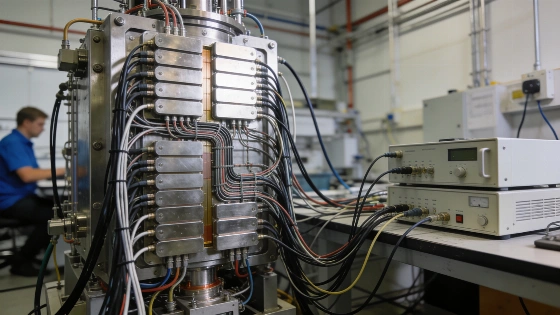
Quantum computers rely on classical software and control systems that can be attacked. Garrv Sipani's QHTM catalog organizes reported threats and labels their maturity rather than treating every risk as proven
Garrv Sipani's Quantum Hardware Threat Matrix (QHTM) organizes attacks on quantum computing systems into five tactics and twenty-six techniques. Each entry carries a maturity label: demonstrated on real hardware, shown in simulation, theoretical, or already mitigated in practice. The framework aims to give hardware vendors and security teams a shared way to describe what they are defending.
A classical control plane
Quantum processors depend on ordinary computing systems to run. A compiler and scheduler prepare jobs, while calibration data helps set the device's operating conditions. Control software directs the hardware, and classical decoders may process measurements in an error-correction loop. The qubits sit at the end of this chain; they do not make the surrounding systems immune to software or hardware attacks.
Cloud access makes that exposure concrete. The commercial model described by Sipani allows users to submit jobs remotely. IBM and Google are among the providers he names; AWS Braket and Azure Quantum are also part of the list, alongside IonQ and Quantinuum. A customer using shared hardware may be able to affect another tenant's work without crossing a network air gap.
Isolation still reduces some risks, but it does not remove threats from people with legitimate access or from compromised software dependencies. Sipani points to Stuxnet, which crossed an air gap into physically isolated centrifuges in 2010, as a reminder that isolation is not a guarantee. Quantum systems also need network connections for jobs and results, while their software toolchains can draw updates and dependencies into the control environment.
Where attacks can reach
The attack surface extends from device operation to the path a circuit takes through the system. Calibration data consists of files, and quantum operations are driven by microwave or laser pulses. In a fault-tolerant design, a classical decoder would read stabilizer measurements and calculate corrections. Sipani describes how tampered measurements could lead it to apply the wrong correction, creating logical errors that resemble noise.
Changes along the compilation or scheduling path could also alter what runs while leaving the submitted circuit unchanged. On multi-tenant devices, crosstalk may allow one user's activity to bias or corrupt another's results. Dynamic circuits use mid-circuit measurement and feed-forward; Sipani says they can also create a covert channel between registers that do not share a gate.
He points to published demonstrations of crosstalk side channels on multi-tenant NISQ devices, attacks that fool decoders, and silent edits to compiled circuits. The examples are not all at the same evidence level, which is why QHTM labels maturity instead of presenting every technique as an established practical threat.
A framework in progress
Sipani argues that quantum hardware security has lacked a common vocabulary because the field is young, hardware has been scarce, and expertise is split between security and quantum engineering. He also identifies an assumption that quantum errors are random consequences of noise rather than possible targets of deliberate interference. QHTM is intended as a vendor-neutral catalog, rather than a set of defenses or product claims.
That scope differs from post-quantum cryptography, which replaces vulnerable cryptographic algorithms on classical systems. An earlier IBM report covered software for mapping cryptographic exposure and supporting enterprise migration. QHTM instead focuses on attacks against quantum hardware and the classical systems around it.
That distinction also appears in vendor guidance issued jointly by the Cybersecurity and Infrastructure Security Agency, the U.S. National Security Agency, and the Australian Signals Directorate's Australian Cyber Security Centre on 5 November 2026. Their post-quantum cryptography (PQC) framework moves through five phases-locate, assess, triage, implement and communicate-and directs organizations to ask suppliers where cryptography is used, whether it is hardware-bound, and whether firmware and cryptographic implementations can be updated. The CISA vendor guidance is intended for supplier discussions, procurement, contract renewals and ongoing assurance, with vendors asked to set out product-specific migration plans early enough for customer deployment before the end of 2030.
Those questions apply to the cryptographic dependencies around quantum platforms-such as cloud services, control systems, firmware and communications-not to whether the quantum processor itself is resistant to the attacks cataloged in QHTM. The agencies advise organizations to track cryptographic inventories and distinguish temporary hybrid classical/PQC operation from a longer-term move to PQC-only implementations. Under Committee on National Security Systems Policy 15, new commercial national-security systems are required to support quantum-resistant algorithms beginning in 2027, while legacy systems that cannot support them are scheduled for phase-out by 2030.
Sipani says the matrix is open under CC BY 4.0 and welcomes additions or criticism. He has also filed related weaknesses and attack patterns with MITRE's CWE and CAPEC programs; the source describes these as filings, not as entries already accepted into either program.