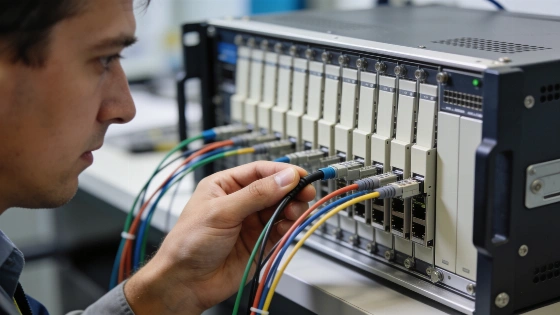
South Korea has begun a three-year effort to extend quantum communications testbeds beyond Seoul, Pangyo and Daejeon. Its 2028 network goal is a plan, not yet a reported performance result
A 15-kilometer free-space quantum basic distribution link is one of the targets in South Korea's new national testbed program. The government has begun a three-year expansion effort, but the stated range is a goal for a future hub, not a result reported from a completed test.
Three hubs by 2028
On October 21, 2026, the Ministry of Science and ICT (MSIT) and the National Information Society Agency (NIA) held a kickoff briefing at the Pangyo Business Support Hub in Seongnam, Gyeonggi Province, for the "Open Quantum Testbed Advancement and Expansion Project." The initiative runs from 2026 through 2028 and is intended to extend the existing Seoul-Pangyo-Daejeon testbed footprint into a nationwide quantum communications test infrastructure. The project follows a public call for proposals in May 2026 and a subsequent selection review.
KT Corporation (KRX: 030200) will lead the Commercial Hub, designated Section A, and the Future Hub, Section C. SK Broadband will lead Section B, the International / Overseas Hub, which is intended to test interoperability for cross-border quantum security. The assignments are part of a shared testbed program intended to support equipment testing, interoperability and commercialization; the kickoff marked the start of the expansion, not completion of a nationwide network.
The reported 2026 investment is 7.4 billion won: 3.75 billion won in government funding and 3.65 billion won from private-sector participants. South Korea's domestic expansion schedule calls for Daegu in 2026, Gwangju and Busan in 2027, and the Gangwon region in 2028. The project announcement describes the effort as an expansion of test infrastructure to support commercialization and overseas interoperability.
Fiber and free space
Section A centers on KT's Daejeon hub. The plan is to connect metropolitan regions across Chungcheong and Honam, with expansion into Yeongnam and Gangwon. A basic function will be an open, multi-vendor structure where domestic optical-network manufacturers can test quantum basic distribution (QKD) equipment. Basic management systems and encryptors are also included in the interoperability checks.
Section B combines different security methods along cross-border routes. The project assigns physical QKD to domestic and localized overseas segments, while post-quantum cryptography (PQC) is planned for longer-distance transit links. Research testbeds in Singapore are named as partners; sites in Poland and Bulgaria are included as well. The stated uses include scientific data transmission and communication security for Urban Air Mobility (UAM). The project description does not provide link distances, basic rates, or test results.
Section C addresses optical links through open air rather than relying only on fixed fiber. KT's target is to extend free-space QKD transmission from 4.8 km to 15 km, using modular transceivers and adaptive optics intended to counter atmospheric turbulence. The same hub is designated for multi-point quantum entanglement distribution, with physical routing layers planned for distributed quantum computing clusters and possible future quantum satellite uplinks. The 15-kilometer figure is a demonstration target; the expansion plan also includes research into wireless and satellite-related QKD and entanglement distribution.
Targets and evidence
The initial first-year investment is 7.4 billion won, reported as about $5.6 million. Government funding accounts for 3.75 billion won, or about $2.83 million, while private-sector contributions account for 3.65 billion won, or about $2.76 million. These figures describe the program's funding, not the cost or performance of an individual link. Yonhap reported the funding breakdown and planned expansion milestones, including the 2028 Gangwon target.
The project sets out responsibilities, intended tests and technical aims. It does not give device counts, QKD basic rates, entanglement rates, link-loss measurements, or results showing that the 15-kilometer target has been reached. Nor does it report an independent replication. A testbed provides a place to assess equipment and interoperability, while a deployment target alone does not establish that a network works at the intended range or under operating conditions.
This infrastructure program is also distinct from work on quantum-computing circuits. For comparison, a recent circuit analysis concerned classical verification of circuit rewrites, rather than communications links. Here, the announced work centers on testing network components and security arrangements across terrestrial, free-space and international connections.
QKD uses quantum states to support basic distribution, while PQC refers to cryptographic algorithms designed for conventional computing systems. They address security through different technical approaches, so combining them across parts of a route does not make the full system automatically secure. Interoperability tests can show whether components work together under specified conditions; performance and security claims still depend on the measurements and assumptions reported for those tests.