The Kaggle challenge tests whether AI agents can shrink fault-tolerant algorithm subroutines while a classical verifier checks candidate circuits at high speed. It is a software competition, not a quantum-hardware demonstration
Randomized classical tests can check candidate quantum-circuit rewrites without simulating arbitrary quantum dynamics. Google Quantum AI is putting that approach at the center of a Kaggle competition, where participants will try to compress subroutines used in fault-tolerant algorithms.
Why these circuits
Simulating arbitrary quantum circuits becomes intractable at relatively modest sizes because the number of amplitudes grows exponentially with the number of qubits. But many costly subroutines in fault-tolerant algorithms use a more restricted set of operations. The competition targets these kickmix circuits, rather than arbitrary quantum programs.
The kickmix gate family includes reversible classical logic and diagonal phase gates; it also covers measurement-based uncomputation, identified in the release as HMR gates. These operations map computational-basis states to computational-basis states while tracking a scalar phase. That structure lets a classical computer test candidate circuits without representing a general quantum state.
Testing on a CPU
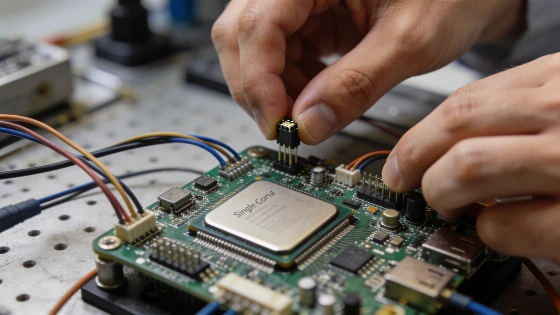
Google describes kickmix as an open-source C++20 and Python verification library integrated with Qualtran. It uses classical SIMD bit-packing, which processes multiple bits in parallel, alongside a Fiat-Shamir heuristic. The candidate circuit's salted SHA-256 digest seeds test inputs, creating an automated, non-interactive signal for AI coding agents and heuristic optimizers.
Randomized fuzz testing checks sampled inputs, rather than exhaustively checking every possible input. It can so provide rapid feedback during circuit improvement. The test signal guides search, while the competition's objective is to find compact circuit implementations under its rules.
The reported scale is large for this narrow task. Google's materials say the verifier can fuzz-test candidates with tens of millions of gates at rates up to 60 billion instructions per second on one CPU basic. The competition opened on October 22, 2026, with a $150,000 prize pool, and its final submission deadline is January 20, 2027.
What the contest measures
The result being pursued is a more compact compilation of algorithmic subroutines. That is a software-improvement objective, distinct from measuring qubit performance. The competition focuses on circuit improvement and classical verification.
The technical account appears in an arXiv preprint, with related posts from Google software engineers Tanuj Khattar and Ryan Babbush. Craig Gidney also commented on the work through Algassert. A related circuit-cost study used classical evaluation to rank LLM-written circuit programs by estimated resource use.
The new competition offers participants a way to test improvement ideas against a rapid classical verifier. Its outcome will show whether agents or other search methods find smaller implementations under the contest's rules. The contest concerns circuit representations and their classical verification, rather than demonstrating quantum-hardware operation.
How kickmix checking works
Kickmix works by restricting the circuit structures that need checking. In a general quantum circuit, amplitudes can interfere in ways that make classical simulation expensive. For the kickmix operations described here, a classical program can follow basis-state transformations and keep track of phase information. That makes large randomized checks practical while keeping the competition focused on software improvement and circuit behavior.
The verifier's speed is relevant because improvement depends on repeated evaluation. Fault-tolerant computing also involves physical devices executing compiled operations while controlling errors; the competition addresses circuit representation and checking.