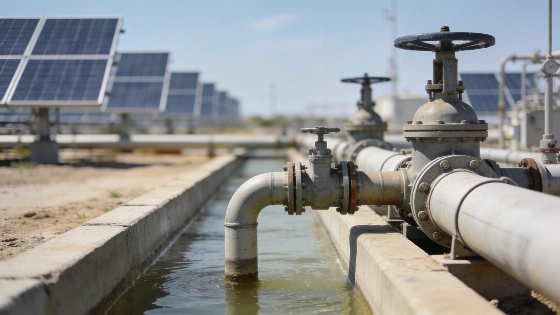
A new structure compares solar-powered treatment with disposal for brine from a Texas desalination plant and wastewater from the Permian Basin oilfields. The most cost-effective option depends on the waste stream.
Deep-well injection sends concentrated desalination waste underground, but it can be expensive. Researchers modelled whether solar-powered treatment could recover more water at lower cost than disposal in two cases: brine from the Kay Bailey Hutchison Desalination Plant in Texas and produced water from the Permian Basin.
The cost ranking shifts with the waste stream. For desalination brine, photovoltaic-powered reverse osmosis was the most cost-effective solar option. For highly saline oilfield wastewater, the model found that zero-liquid-discharge systems could make economic sense by reducing or eliminating costly disposal. The study is a techno-economic comparison of treatment and disposal routes, not a report on a commissioned solar-treatment facility.
Two waste streams
Brine is the concentrated, salt-rich stream left after desalination separates fresh water from the incoming water. Oil and gas production also generates highly saline wastewater, known as produced water. Both streams are often managed through deep-well injection, which pumps waste underground and incurs costs for transport and well operations, along with permits and monitoring.
The structure compares that disposal route with further treatment to recover water. Its two case studies represent different settings: the Kay Bailey Hutchison plant is a large inland desalination facility, while the Permian Basin is one of the most productive oil-producing regions in the United States. The analysis so tests its options against distinct wastewater sources rather than treating all concentrated waste as interchangeable.
Solar options compared
The model assessed reverse osmosis alongside thermal desalination. Reverse osmosis uses membranes to separate water from dissolved salts; thermal methods use heat to evaporate water and recover it. The energy source matters to the comparison: photovoltaic panels generate electricity for membrane processes, while solar-thermal systems supply heat for evaporation.
For the desalination-brine case, pairing photovoltaics with reverse osmosis was the most cost-effective solar-powered approach in the study. Solar-thermal desalination remained relatively expensive, with the cost of collectors and heat storage contributing to the result. The ranking applies to the options modelled for this particular stream, not to every desalination setting.
When recovery pays
The oilfield wastewater result points to a different treatment choice. Zero-liquid-discharge systems recover almost all the water and leave solid salts behind. For highly saline produced water, that degree of recovery could be economically attractive when it reduces or removes the expense of brine disposal.
The economics depend on the waste's chemistry and treatment requirements, as well as electricity and disposal costs. Handling residual salts also affects the calculation. Zero-liquid-discharge can reduce the liquid sent to disposal wells, but it also requires treatment equipment and leaves a concentrated solid residue. The model evaluates selected cases rather than establishing a universal price or describing an operating solar-treatment installation in the Permian Basin.
Deep injection in the Permian Basin is also subject to seismic-related oversight. The Railroad Commission of Texas established Seismic Response Areas and has restricted injection volumes or suspended some disposal operations in affected areas. S&P Global Ratings describes the regulatory focus on deep saltwater-disposal wells in its assessment of Select Water Solutions; it reports that about 99% of that company's disposal-well network consists of shallow wells.
The researchers' 2026 study, "Techno-economic analysis of solar-integrated desalination systems for zero liquid discharge of brackish desalination concentrate and produced water," by Kurban A. Sitterley and colleagues, was published in Progress in Energy, volume 8, article 045002. It compares the costs of recovering additional water with those of deep-well disposal for the Kay Bailey Hutchison plant and produced water from the Permian Basin.
More broadly, the researchers describe solar energy as a potential means of supporting water recovery and reuse in water-stressed regions. They also discuss recovering valuable minerals from waste streams as a possibility. Reverse osmosis uses pressure to move water through a membrane that holds back dissolved salts; thermal desalination instead relies on heating water so it evaporates and can be recovered. These processes need different forms of energy, which helps explain why photovoltaic electricity and solar heat produce different cost results in the model.