Plug-in solar panels for homes and apartments are now legal in many US states, but no panels meet new certification standards and key safety risks remain unresolved as regulators and utilities struggle to keep pace
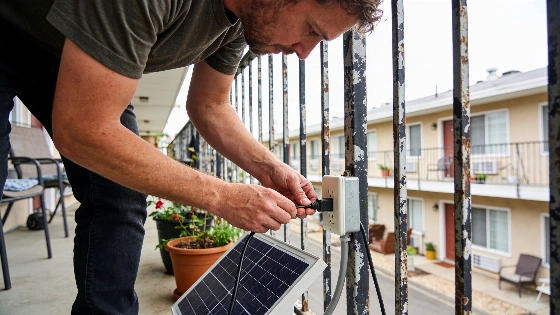
Plug-in solar panels, often called balcony solar, have rapidly gained legal approval across the United States since Utah enacted a law in March 2025 permitting their use. These compact photovoltaic systems are designed to connect directly to standard household outlets, allowing residents-including those in apartments-to generate some of their own electricity without major electrical work or utility approval. Following Utah's move, states such as Colorado and Virginia legalized similar systems, and by July 2026, legislative efforts were underway in New York, New Jersey, and California. However, the speed of adoption has outpaced the development of technical standards and safety regulations, leaving a regulatory gap that exposes users and the grid to unresolved risks.
Unlike traditional rooftop solar, which requires professional installation and utility coordination, balcony solar panels are marketed as plug-and-play appliances. This simplicity is central to their appeal, but it also introduces new hazards. Household wiring in the US was not designed for power to flow from an outlet back into the home's electrical system. Plug-in panels can create electrically live prongs when unplugged, increasing the risk of electric shock. They also inject power downstream of circuit breakers and overcurrent protection, potentially rendering these safety devices ineffective. In addition, standard ground fault circuit interrupters (GFCIs) may not reliably detect or interrupt current flowing in the reverse direction, raising the possibility of undetected faults or failures.
Certification and Technical Barriers
To address these risks, UL Solutions, a major US standards body, developed the UL 3700 standard for plug-in photovoltaic equipment. The standard sets requirements for insulation, wiring methods, overcurrent protection, and the ability to safely disconnect during a power outage-a critical feature to protect utility workers during grid failures. However, as of mid-2026, no commercially available balcony solar panels have achieved UL 3700 certification. Some requirements, such as bidirectional GFCI disconnects, are not yet supported by off-the-shelf components. As a result, systems currently on sale in states like Utah either lack certification or rely on unrelated electrical standards not designed for plug-in solar applications.
Germany, where balcony solar first became popular, offers a cautionary comparison. There, more than 2 gigawatts of plug-in panels have been deployed, and a national standard was finalized in December 2025. German law prohibits net metering for these systems to avoid grid management uncertainty, and renters have legal protections to install panels unless landlords have a valid technical objection. German authorities, including fire safety officials, have reviewed the technology and found it acceptable under the new standard. The US, by contrast, is still in the process of aligning technical requirements, certification, and enforcement.
Utility Oversight and User Compliance
US utilities have expressed support for customer access to plug-in solar but emphasize the need for notification and oversight. Without accurate records of installations, utilities cannot reliably track distributed generation or ensure that only certified equipment is connected to the grid. Research from the Electric Power Research Institute (EPRI) indicates that even in Germany, unregistered plug-in panels outnumber registered ones by a factor of two. In the US, the lack of a unified registration or enforcement mechanism increases the likelihood of "guerilla" solar-unregistered, potentially uncertified systems operating outside utility knowledge.
For utilities, the main operational concern is the risk that plug-in panels could feed electricity back onto the grid during an outage, endangering line workers. UL 3700 requires that systems automatically disconnect in the event of a blackout, but until certified products are available and widely adopted, this safeguard cannot be guaranteed. The absence of a robust certification regime also complicates liability and insurance for property owners, tenants, and manufacturers.
Deployment Scale and Regulatory Timeline
By July 2026, plug-in solar panels are legal in at least three US states, with legislative progress in several others. In Germany, over 2 gigawatts of balcony solar have been installed, with panels available through major retailers. In the US, no panels have yet met the UL 3700 standard, and the first certified products are not expected before late 2026. The regulatory lag means that thousands of systems may be operating without recognized safety certification, and the true number of installations is likely underreported due to voluntary or absent registration requirements.
While the technology offers a low-barrier entry to solar generation, the lack of harmonized standards and enforcement leaves significant gaps in safety assurance. Until certification catches up with deployment, users, utilities, and regulators face uncertainty about the reliability and safety of plug-in solar systems in real-world conditions.
Plug-in solar panels are classified as appliances rather than permanent electrical installations, which allows them to bypass many of the permitting and inspection requirements that apply to rooftop solar. However, this classification also means that safety depends heavily on the effectiveness of product standards and the willingness of users to follow notification and registration procedures. The current regulatory environment in the US is fragmented, with state laws, utility policies, and national standards evolving in parallel but not always in coordination.
Certification standards such as UL 3700 are intended to provide a baseline for safety and interoperability, but their effectiveness depends on both technical feasibility and market adoption. Until certified products are widely available and registration is enforced, the risks associated with plug-in solar-including electric shock, fire, and grid instability-remain incompletely addressed.
Certification in electrical and electronic systems is a process by which products are tested against defined safety and performance standards, often set by independent organizations such as UL Solutions. For plug-in solar panels, certification aims to ensure that devices can safely interact with household wiring, disconnect during outages, and prevent hazardous conditions such as electric shock or fire. However, certification is only effective if products are both technically capable of meeting the standard and subject to meaningful oversight. In rapidly evolving markets, regulatory and technical gaps can persist for years, leaving users and infrastructure exposed to risks that standards alone cannot eliminate.