Google's first Project Suncatcher hardware test is scheduled to fly next week on SpaceX's Transporter-18 rideshare mission. A prototype satellite carrying four Tensor Processing Units will measure how the chips withstand launch vibration, radiation, vacuum and extreme temperatures before any larger orbital computing cluster is attempted.
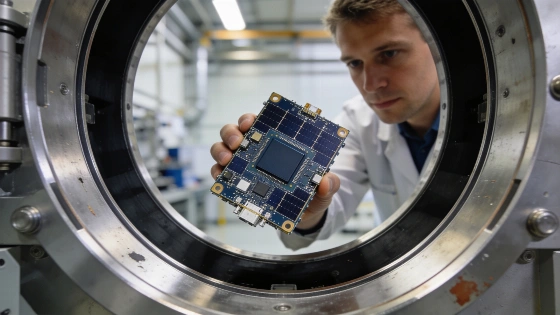
Google is preparing to put four Tensor Processing Units, or TPUs, into low Earth orbit for the first time. The chips will fly on SpaceX's Transporter-18 rideshare mission inside a prototype satellite built in partnership with Planet Labs. The experiment is designed to determine whether the processors and their supporting systems can survive launch and operate reliably in orbit, not to demonstrate a complete orbital data center.
The flight is the first orbital hardware test in Project Suncatcher, a research effort exploring whether future satellite clusters could host large-scale machine-learning infrastructure. Google's stated objective is to collect engineering data, identify failure points and establish which parts of the architecture require redesign. The mission is therefore a feasibility and durability study rather than a commercial deployment.
That distinction is important in space systems engineering. A processor may remain electrically functional while the wider platform fails because of power instability, thermal limits, radiation-induced errors, communications interruptions or mechanical damage. NASA and ESA have spent decades qualifying spacecraft electronics through combinations of vibration, vacuum, thermal cycling and radiation testing because reliability depends on interactions among these stresses rather than on a single laboratory measurement.
Survival before scale
The proposed attraction is power. Google's Suncatcher materials say low Earth orbit could provide near-continuous sunlight and potentially deliver up to eight times more solar power than comparable systems on Earth. That figure is a projected advantage of the orbital environment, not a result measured by the Transporter-18 mission. The immediate experiment is narrower: whether the satellite and its TPUs can withstand launch vibration, vacuum, radiation and severe thermal conditions.
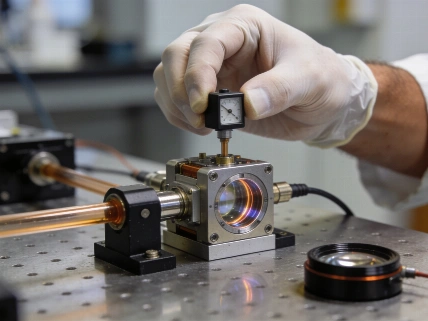
Launch imposes sustained acceleration and broadband vibration on spacecraft structures. Individual components can experience much higher short-duration loads than the vehicle as a whole, depending on their mounting and resonance characteristics. Google has subjected the hardware to vibration testing along all three axes to reproduce frequencies associated with rocket launch. A successful ground test supports resistance to the tested load profile, but it does not establish continuous in-orbit operation.
The four-TPU payload will provide a more informative test than an isolated chip because the satellite must also manage power delivery, control electronics, mechanical interfaces and thermal paths. Even so, the result will remain limited to a prototype. It cannot by itself demonstrate that a large constellation could run useful machine-learning workloads at scale or achieve a lower total cost than terrestrial facilities.
Radiation and errors
Radiation creates a different failure mode from mechanical shock. High-energy particles can deposit charge in semiconductor devices, causing single-event upsets, transient faults or, at higher accumulated doses, progressive degradation of materials and circuits. A bit flip in memory may be recoverable, while an error in control logic or an uncorrected numerical operation can interrupt a workload. Error detection, redundancy and checkpointing are therefore as important as the radiation tolerance of the silicon itself.
Google tested its Trillium TPUs with a proton beam at the University of California, Davis's Crocker Nuclear Laboratory while the processors ran machine-learning workloads. Google reported that initial results showed the chips could tolerate a total ionizing radiation dose greater than the level expected during a five-year space mission. That finding describes a laboratory exposure and does not constitute evidence that the processors have operated for five years in orbit or that a deployed cluster will maintain a particular error rate.
Radiation qualification is normally interpreted alongside particle energy, dose rate, shielding, operating state and the type of fault being measured. The relevant performance questions include whether errors are detected, whether corrupted calculations can be retried and whether the system can recover without human intervention. A proton-beam result therefore addresses one component of orbital reliability, not the full behavior of a spacecraft under changing solar and cosmic conditions.
The cooling problem
Heat may be as consequential as radiation. TPUs concentrate substantial power in a small area, while the vacuum of space prevents the convective airflow used by conventional data centers. A spacecraft must move heat through conductive paths, heat pipes and radiators before releasing it as infrared radiation. The radiative limit depends on radiator area, surface properties, orientation and the surrounding thermal environment.
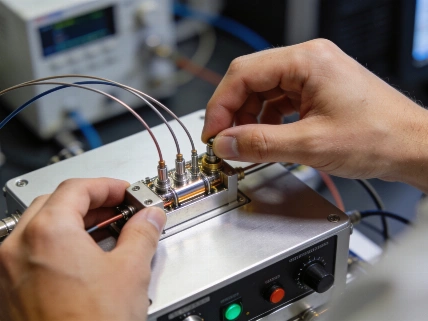
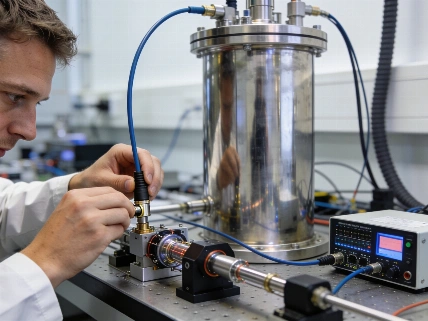
Google is testing heat pipes and radiators to carry thermal energy away from the processors. The cooling assembly has already been evaluated in a thermal-vacuum chamber intended to reproduce space conditions. Transporter-18 will be the first opportunity to observe how that system performs in orbit rather than inside a ground facility. A successful launch therefore begins another stage of testing rather than completing the qualification process.
These constraints distinguish orbital AI computing from placing a familiar server inside a satellite. Power generation and storage, heat rejection, radiation protection, fault management and communications must work together. Research published in journals such as Nature has repeatedly shown that system-level reliability cannot be inferred from the performance of one component in isolation; the same principle applies when computational hardware is integrated into a spacecraft.
Lasers between satellites
Project Suncatcher's longer-term design calls for clusters carrying dozens of TPU chips across multiple satellites. Such a cluster would need to divide workloads between spacecraft using very fast links. Google plans to use lasers for those connections because the proposed architecture requires high bandwidth between nearby satellites rather than only conventional long-distance communications.
Laser links must remain precisely aligned while both spacecraft move along their orbits. Pointing, acquisition and tracking systems must compensate for relative motion, vibration and small errors in position knowledge. In a distributed computing architecture, a brief communications interruption could affect workload scheduling, synchronization and recovery even if every processor remains healthy.
Google plans a separate orbital test in 2027 involving two satellites and an evaluation of the inter-satellite communication system. That mission would examine a different layer of the proposal. Transporter-18 is focused on whether the processing hardware can endure launch and the radiation, vacuum and thermal environment of low Earth orbit.
What the test can prove
The reported ground tests give Google evidence about vibration, radiation exposure and thermal-vacuum behavior. They do not yet demonstrate an orbital AI data center, a working satellite cluster or reliable large-scale machine-learning services in space. As Reuters reported, the prototype is intended to measure survivability and operating reliability rather than prove that a full data center can function in orbit.
The measurable facts are limited but significant: the payload will carry four TPUs; launch testing reproduced forces associated with rocket vibration along three axes; proton-beam experiments assessed Trillium processors; Google compared the reported radiation tolerance with a projected five-year mission dose; and the future cluster concept involves satellites carrying dozens of TPUs. These figures describe test conditions and design aims rather than operational performance.
Project Suncatcher is best understood as an engineering sequence. First comes component and spacecraft survival. Then comes validation of thermal control and fault management in orbit. A later mission is intended to test laser communication between two satellites. Only after those steps could the larger proposition of coordinated orbital AI computing be judged on evidence rather than architecture diagrams and power estimates.
In this context, compute in space means running machine-learning processing on hardware carried by satellites rather than sending all data to terrestrial facilities. It does not automatically mean that the system is autonomous or that satellites will behave like a self-managing data center. The relevant questions are whether the processors remain available, whether errors can be controlled, whether heat can be removed and whether the links can distribute work reliably.
Google's mission is important precisely because it is not yet a finished-product story. It is a controlled attempt to test whether a difficult premise survives contact with orbit. The evidence supports cautious interest in the hardware experiment, not the conclusion that satellite-based AI clusters are ready. Until the orbital tests and the planned communications trial produce results, Suncatcher remains a research program with a demanding engineering case still to prove.