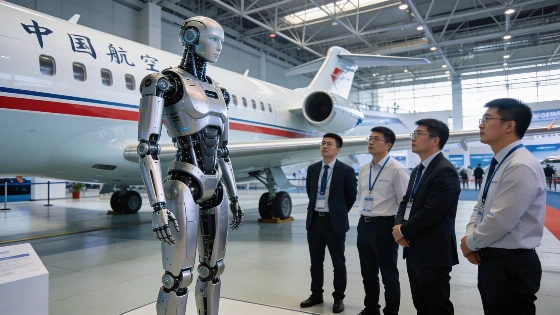
At the 2026 World Robot Conference in Beijing, Chinese companies are presenting humanoid and quadruped robots for aviation, security, and industrial roles, with demonstrations highlighting both technical progress and ongoing challenges in real-world deployment
Chinese robotics companies are using the 2026 World Robot Conference (WRC) in Beijing to showcase a new generation of humanoid and quadruped robots designed for specialized industrial, aviation, and security applications. The five-day event, which opened on Wednesday, features over 300 exhibitors and includes demonstrations of robots performing tasks such as industrial patrols, suspect restraint, and aircraft support. While many systems remain in the prototype or demonstration phase, the event reflects a growing emphasis on deploying robots in environments that demand both physical capability and reliable human oversight.
Humanoid Robots for Aviation
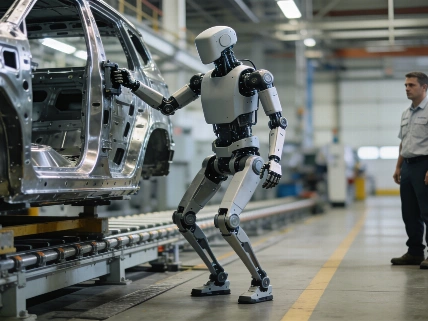
Among the most technically ambitious systems on display is Fengxing-001, a humanoid robot developed by the Aviation Industry Corporation of China (AVIC) for aviation-related operations. According to AVIC, Fengxing-001 is intended for tasks including intelligent manufacturing, aircraft maintenance, missile loading, and direct aircraft operation. The robot stands approximately 1.8 meters tall and weighs 80 kilograms. AVIC staff report that two or three Fengxing-001 units could perform missile-loading tasks typically requiring four to six human workers, with the robot's legs powered by compact motors derived from aero-engine technology to enhance load-bearing capacity. The system uses an electro-hydraulic hybrid-drive mechanism and incorporates aviation power-by-wire technology for high-output joint movement.
AVIC states that Fengxing-001 can jump up to 30 centimeters, jog at speeds up to 3 kilometers per hour, walk while carrying 20 kilograms, and handle loads of up to 15 kilograms. The robot has been under development since 2024 and has completed simulated trials in which it operated an aircraft in response to instructions. AVIC claims that a modified version of the humanoid, with its lower body removed, could be used to convert older aircraft into unmanned platforms at a fraction of the cost of traditional retrofitting. However, these demonstrations have not yet been independently verified, and the extent of human supervision required during operation remains unclear.
Security and Industrial Applications
Security robotics is another focus at the conference, with companies such as China North Industries Group Corporation, NEXWISE, and the China Electronics Technology Group Corporation's 21st Research Institute presenting quadruped robots and surveillance systems. Some robotic dogs are equipped with cameras and autonomous navigation, enabling them to patrol large industrial sites and make basic decisions, potentially reducing the need for human patrols. NEXWISE demonstrated a robotic dog fitted with an electromagnetic net launcher, designed to restrain targets from a distance of 5 to 10 meters. The company claims the system is quieter than conventional gunpowder-powered launchers and can be integrated with both robotic and human security teams, with the robot identifying a target before remote operation of the launcher. As with other demonstrations, the degree of autonomy and the reliability of target identification have not been independently assessed.
Beyond security, the conference highlights the broader commercialization of robotics in China. Unitree is presenting humanoid robots known for dance and martial-arts demonstrations, while UBTECH's Walker C1 is aimed at service and public-facing environments. Deep Robotics' quadrupeds are already in use for search, inspection, and emergency rescue. Other exhibitors are targeting logistics, manufacturing, and healthcare, with robots such as Galbot's G1-featuring wheels, a lifting torso, and two arms for shelf restocking and warehouse tasks-and Fourier Intelligence's GR-3, designed for companionship, education, and eldercare. These systems illustrate the sector's push toward more complex and specialized environments, but most remain in limited pilot deployments or demonstration settings.
Technical and Deployment Challenges
The WRC also hosts the second World Humanoid Robot Games, bringing 2,056 robots from 16 countries to compete in events such as long jump, weightlifting, and table tennis. While these competitions provide a platform for technical benchmarking, they do not necessarily reflect the reliability or safety required for real-world deployment. Many robots at the conference operate under controlled conditions, with human supervision or remote control remaining essential for safety and task completion. The transition from demonstration to routine industrial or security use will require further advances in perception, manipulation, and fail-safe operation, as well as regulatory oversight to address dual-use and safety risks.
For context, recent developments in cross-platform robot learning, such as the Fi0 model's ability to transfer task knowledge across different robot arms, highlight the technical complexity of adapting robotic systems to new environments and hardware. Readers interested in the challenges of generalizing robotic capabilities may find further detail in Science Report's coverage of cross-body robot task transfer research.
Fengxing-001's reported specifications-1.8 meters in height, 80 kilograms in weight, a 30-centimeter jump, and a 20-kilogram carrying capacity-are consistent with current research prototypes in the humanoid robotics field. The World Humanoid Robot Games' participation of over 2,000 robots from 16 countries underscores the scale of international interest, but most systems remain in the demonstration or pilot phase, with limited evidence of sustained, unsupervised operation in uncontrolled environments.
Understanding the distinction between automation and autonomy is central to interpreting these demonstrations. Automated robots can perform predefined tasks or follow instructions, often under human supervision or remote control. Autonomous robots, by contrast, must reliably perceive their environment, make decisions, and recover from unexpected events without direct human intervention. Most robots at the 2026 WRC, including those intended for aviation and security, remain automated or semi-autonomous, with meaningful human control required for safety and accountability. The gap between controlled demonstrations and robust, independent deployment remains a defining challenge for the field.