Quobly has demonstrated single-chip readout and quantum gate operations on its QSOI architecture, fabricated with industrial 300mm FD-SOI CMOS technology and enriched silicon-28, marking a step toward scalable silicon-based quantum processors
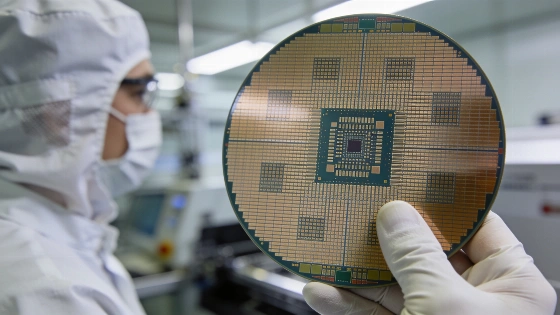
For the first time, a silicon spin-qubit device made on a commercial 300mm semiconductor line has shown single-chip qubit readout, single-qubit gates, and two-qubit gates. Quobly's QSOI architecture uses isotopically enriched silicon-28 and is built with fully depleted silicon-on-insulator (FD-SOI) CMOS technology at STMicroelectronics' Crolles facility. This brings both quantum and classical control elements onto a single chip at industrial scale. Integrating quantum and classical electronics is a key step for scaling up quantum hardware, as highlighted by research centers like MIT and Stanford.
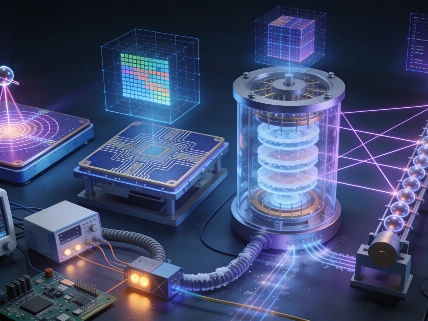
The QSOI quantum processing unit (QPU) applies very large-scale integration (VLSI) to combine quantum dot arrays with cryogenic control electronics. The device is made on 300mm wafers using enriched 28Si substrates, which help reduce nuclear spin noise and support longer qubit coherence. Using FD-SOI CMOS processes, standard in advanced chip manufacturing, makes the device compatible with existing foundry infrastructure and improves yield and reproducibility compared to lab-scale methods. This approach matches recommendations from the Max Planck Society, which has stressed the need for industrial-grade processes in quantum device manufacturing.
Quobly focuses on integrating quantum and classical circuitry within the same chip, which is necessary for scaling to larger numbers of qubits. The company has developed a proprietary cryogenic process design kit (PDK) to support complex circuit layouts, addressing the challenge of designing quantum-classical systems that work reliably at millikelvin temperatures. Integrating FD-SOI transistors with silicon spin qubits on a single chip is a notable step, as confirmed by official press releases and independent industry analysis.
The milestone includes three basic quantum operations on a single chip: initializing and reading out spin qubits, controlling single-qubit logic gates, and running two-qubit entangling gates. These are essential for universal quantum computation and set a minimum bar for moving beyond isolated device demonstrations. The demonstration took place on QSOI devices produced at the commercial 300mm FD-SOI line of STMicroelectronics in Crolles, as confirmed by SEALSQ and industry observers.
No specific numbers for qubit count, gate fidelity, or coherence time have been released. Integrating on-chip cryogenic control electronics is important, since external wiring and control have limited the scalability of spin-based quantum processors. Quobly's roadmap aims for million-qubit systems by 2032, but the current demonstration is at the level of basic quantum operations on a prototype. Similar progress has been reported in recent Nature publications on silicon-based quantum computing.
Quobly's single-chip demonstration supports its Alloy product roadmap, with plans to offer the Alloy Pioneer system via cloud access by late 2026 for high-performance computing and academic research. The company recently raised €115 million in Series A funding and has formed partnerships with Air Liquide, Soitec, and Orano to secure a European supply chain for enriched silicon-28. These steps reflect the move from lab prototypes to manufacturable systems with reliable material sourcing and process control. Quobly is also working with Absolut System to develop cryogenic infrastructure, including the QCube 100-Class 3 platform with 100 mW cooling power at 500 mK, supporting the integration of cryo-electronics needed for scalable quantum computing.
Scaling quantum processors beyond a few qubits has exposed the limits of custom fabrication and manual calibration. By using commercial foundry processes and integrating classical control at the chip level, Quobly aims to address wiring, thermal, and reproducibility challenges that have slowed progress elsewhere. Other developments in quantum hardware, such as those reported for neutral-atom platforms, show the range of approaches competing to achieve scalable, reliable quantum computation. CERN and other international groups have also pointed to the importance of strong supply chains and industrial partnerships for the future of quantum technologies.
Quobly has confirmed the use of 300mm FD-SOI CMOS foundry processes and enriched 28Si substrates, with demonstrated single-qubit and two-qubit gate operations and on-chip readout. However, the company has not released detailed performance metrics such as gate fidelity, error rates, or device yield, so the practical utility and reproducibility of the platform have not been independently verified. The proprietary cryogenic PDK and integration of control electronics are promising engineering steps, but moving from prototype to large-scale, fault-tolerant quantum computing will require further progress in device uniformity, error correction, and system integration. Peer-reviewed journals such as Science have emphasized the need for transparent benchmarking and independent validation in quantum hardware announcements.
Quobly's announcement is a credible step toward manufacturable silicon spin-qubit processors, but there is still a large gap between lab demonstrations and operational quantum advantage. The company's industrial partnerships and foundry-based fabrication address key issues in material supply and process control, but without public performance data and independent validation, claims of scalability and commercial readiness remain unproven. As the field moves beyond proof-of-concept devices, the ability to deliver reproducible, high-fidelity quantum operations at scale will determine which architectures move from technical promise to practical use.
Understanding the difference between physical and logical qubits is important for tracking progress in quantum hardware. A physical qubit is a controllable quantum system-such as an electron spin in a silicon quantum dot-that can be initialized, manipulated, and measured. Physical qubits are prone to errors from noise, decoherence, and imperfect control. Logical qubits encode information across several physical qubits using error-correcting codes, allowing errors to be detected and corrected. Demonstrating high-fidelity operations on physical qubits is necessary, but achieving fault-tolerant logical qubits remains a major engineering challenge. Moving from prototype devices to useful quantum computers will depend on both the quality of individual qubits and the ability to implement robust error correction at scale.