Shannon Lucid spent 188 days aboard Russia's Mir, tending life-science experiments and helping NASA understand the operational, psychological, and cultural demands of long-duration spaceflight.
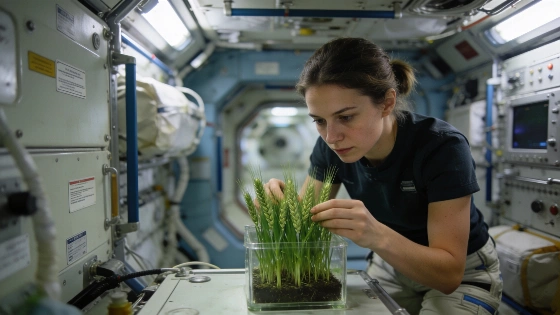
Shannon W. Lucid was still working when her record-setting stay aboard Mir entered its final days. On Sept. 23, 1996, three days before returning to Earth, she checked wheat growing inside the station's Svet greenhouse. The small crop represented a practical part of a much larger challenge: learning how people and living systems function during months in microgravity.
Lucid flew to Mir aboard space shuttle Atlantis on STS-76 on March 22, 1996. Her planned stay became longer when the launch of STS-79 was delayed, rather than because the original mission design called for 188 days in orbit. NASA's oral-history record describes the resulting 188-day mission as an American long-duration spaceflight record and, at the time, a world record for a woman; the NASA oral history also documents how the extended mission unfolded.
Lucid joined NASA in 1978 as one of the agency's first six female astronauts. She ultimately returned aboard Atlantis on Sept. 26, 1996, after the STS-79 Mir crew-exchange mission. Atlantis docked with Mir on Sept. 19, marking the first U.S. astronaut exchange on the Russian station and bringing a new phase of international operations into the mission's final days.
The mission was not defined by a single discovery or instrument. Its significance came from duration and routine. Lucid and her crewmates conducted life-science studies and other experiments while maintaining a working spacecraft far from Earth. The greenhouse photograph captures that operational reality more clearly than any abstract milestone: long-duration spaceflight depended on tending systems and experiments day after day.
Plants provided a direct way to study how living organisms respond to microgravity. In the Svet greenhouse, Lucid monitored wheat rather than merely observing an inert test object. The available record does not provide measurements of plant growth, a defined biological endpoint, sample sizes, statistical tests, or a specific experimental result. The evidence therefore supports a narrower conclusion: the mission included hands-on life-science work in orbit and demonstrated that such work could be sustained during an extended stay.
That distinction matters. A photograph of wheat growing aboard Mir is evidence of an experiment in progress, not proof that space agriculture had been solved. The image does not establish a complete food-production system, quantify crop yield, or explain every biological response to microgravity. What it does show is the close connection between human endurance and experimental care on a mission lasting more than six months.
The same operational thread runs through NASA's later work with the International Space Station, including a recent classroom event that connects students with astronauts in orbit. The activities differ, but both depend on a station functioning as a sustained workplace rather than a brief destination. In that sense, Mir served as an engineering and human-factors precursor to the multinational ISS environment.
Lucid's stay helped NASA prepare for the psychological and cultural demands of long-duration missions on the International Space Station. The historical record does not assign a single measured outcome to that preparation, but the practical lesson is clear: future crews would need to share confined living and working conditions across national and cultural boundaries while conducting experiments and maintaining station operations.
Mir also made the human element of mission design impossible to separate from the science. Six months in orbit requires more than launch and return. It requires reliable routines, communication, cooperation, experiment management, and the ability to keep attention on small biological systems while living in an extreme environment. Those concerns remain relevant to NASA's planning for longer missions, where crew health, habitat reliability, and scientific productivity must be managed together.
Lucid's stay ended during the STS-79 crew exchange, a mission whose docking sequence was an important operational milestone in U.S.-Russian cooperation. The STS-79 mission history places the Sept. 19 docking in that broader context: Atlantis not only delivered a replacement astronaut but also completed the first U.S. astronaut swap at Mir.
Lucid's contribution did not end when Atlantis brought her home. In December 1996, President Bill Clinton awarded her the Congressional Space Medal of Honor for the achievement. She became the tenth person and the first woman to receive the award.
She later worked as a CAPCOM in Mission Control, serving as the primary voice communicating with astronauts in orbit. She also became NASA's Chief Scientist, helping guide the agency's science priorities, before retiring in 2012 after more than three decades with NASA.
Microgravity is not simply a place where gravity disappears; it is an environment in which familiar biological processes operate under altered physical conditions. A greenhouse on Mir could not by itself answer every question about plant growth or human health, but it turned those questions into sustained orbital experiments. Lucid's record therefore matters for more than its number: it marked a disciplined test of whether people could live, work, and conduct life science over the timescales that later space stations would require.