
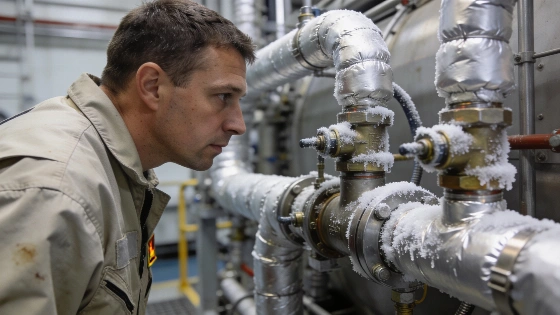
NASA's technical guidance warns that repeated freeze-thaw exposure can rupture hydrazine plumbing, create slush blockages and reduce the service life of propulsion and auxiliary systems.
A hydrazine system can appear intact after cold exposure and still be unsafe to operate. NASA's Technical Bulletin 26-06 warns that freezing and thawing can damage confined plumbing, distort seals and valves, obstruct propellant flow and leave flight hardware with a reduced service life.
The most serious failure path involves what the bulletin describes as superpacking. As hydrazine freezes, contraction can create room for additional propellant inside a confined line. When the material thaws and expands, the resulting pressure can rupture plumbing or fittings. The hazard is therefore not limited to the moment of freezing; thawing can be the point at which hidden damage becomes a structural failure.
Historical NASA experience gives the warning operational weight. Space Shuttle auxiliary power unit hydrazine lines were considered vulnerable to freeze-induced contraction followed by thaw-induced overexpansion, and Shuttle flight rules allowed no more than two freeze-thaw cycles before the system was treated as degraded or failed.
Valves, seals and diaphragms face a separate problem. Differential expansion can crack elastomeric parts, deform sealing surfaces or damage precision valve seats. Long stainless-steel runs can also develop asymmetric temperature profiles, a concern identified during thermal assessments of the Voyager propulsion system.
Voyager operations showed why bulk temperatures are an inadequate readiness test. As hydrazine approached the freezing and slush-formation range of approximately 0.1-1.6°C, engineers relied on detailed thermal modeling to assess the risk of blocked lines and malfunctioning thrusters rather than treating a single tank or surrounding-structure reading as proof that the full propellant path was warm enough.
If freezing cannot be ruled out, the system should not be operated until an engineering review is complete. Engineers should establish how many freeze-thaw cycles may have occurred and treat each cycle as life-limiting. That assessment should include static and fatigue analysis based on conservative estimates of line pressure during and after the transition, with additional margin for uncertainty in the model and its assumptions.
Recovery also requires evidence rather than visual confidence. NASA recommends pressure-decay testing, nondestructive evaluation where the design permits it and checks of valve health. Hardware should be thawed slowly and uniformly to limit thaw-induced overpressure, while catalyst beds and valves must reach their required thermal operating conditions before flow is commanded. A pre-start stabilization period is particularly important when temperatures are close to the operational limit.
The guidance is an engineering bulletin rather than a report of a newly documented accident, regulator decision or peer-reviewed Nature study. In the materials reviewed for this article, no independent Reuters, AP or Financial Times report was found concerning a specific hydrazine freeze-thaw incident. Separate hydrazine-related news reports therefore should not be treated as confirmation of this particular technical warning.
The bulletin also calls for every freeze exposure to be recorded as a reportable anomaly. Hardware should receive an engineering disposition, and any resulting reduction in life should be tracked rather than absorbed into an informal operating assumption.
The operational importance of careful propellant management is visible beyond this specific warning. NASA mission details reported for the Nancy Grace Roman Space Telescope indicate that its initial maneuver used 18 kilograms of hydrazine against a planned 200-kilogram allocation for the first burn, illustrating why thermal control, inventory and precise flow management matter during long-duration missions; the broader mission fuel context does not independently verify the freeze-thaw bulletin.
A Defense Logistics Agency ASSIST-QuickSearch record also shows documentation updated on 21 September 2026, but the available listing does not reveal the standard's text and therefore cannot establish any specific hydrazine freeze-thaw requirement. It is best treated as a lead for further standards research, not as technical confirmation; the DLA document record provides only that limited context.
Hydrazine systems combine a toxic and reactive propellant with narrow thermal margins and hardware that may be damaged without immediately announcing the failure. NASA's historical record shows why a freeze-thaw event cannot be dismissed as a temporary cold soak: prevention is the strongest control, and suspected exposure demands testing, conservative analysis and a formal adjustment to hardware life. The physics is straightforward but unforgiving: freezing changes the propellant's state, thawing can release the stored mechanical consequence, and a temperature reading alone cannot certify safety.