A UK-led demonstration has tested a robotic surface vessel that autonomously launches and recovers a tethered drone at sea, aiming to extend maritime surveillance without direct human intervention
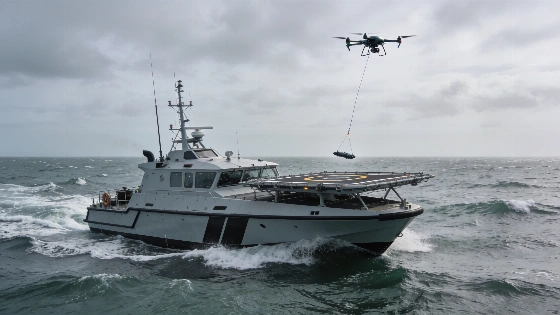
The Royal Navy has conducted a demonstration of a robotic surface vessel capable of autonomously launching and recovering a tethered drone at sea, marking a step toward persistent maritime surveillance with reduced human risk. The trial, organized by British robotics firm ACUA Ocean and US-based Teledyne FLIR Defense, was carried out over two days for the UK Ministry of Defence and industry partners. The system integrates ACUA Ocean's Pioneer uncrewed surface vessel (USV) with Teledyne FLIR Defense's SkyCarrier launch-and-recovery platform and SkyRanger R70 drone, aiming to automate aerial sensor deployment in open water environments.
The demonstration focused on the ability of the Pioneer USV to serve as a stable platform for the SkyCarrier, which houses and operates the SkyRanger R70 drone. The SkyCarrier system is designed to autonomously unfold into a landing pad, enabling the drone to take off and return without human intervention, even as the vessel moves through challenging sea conditions. During the trial, the SkyRanger R70 remained connected to the USV via a managed power and data tether, allowing it to receive continuous power from the vessel and maintain a persistent aerial view of the surrounding area. This approach extends the drone's operational duration beyond the limits of its onboard battery and keeps the aircraft positioned above the vessel for continuous surveillance.
The SkyRanger R70 is equipped with multiple embedded NVIDIA processors for onboard artificial intelligence, supporting real-time object detection and classification. Its sensor suite includes four computer-vision cameras and a stabilized electro-optical and infrared system, providing high-resolution imagery for surveillance tasks. The demonstration was supported by UK Defence Innovation, which funds emerging technologies with potential military applications, but the system remains at the prototype and field-testing stage rather than full operational deployment.
Stability and Environmental Testing
One of the central technical challenges addressed in the demonstration was the stability of the Pioneer USV in open water. According to ACUA Ocean, the vessel was tested in January 2026 in waves up to 4.25 meters, reporting a 60% reduction in roll and a fourfold reduction in peak roll rates compared to conventional monohull vessels. This stability is critical for reliable autonomous drone launch and recovery, as excessive movement can disrupt tethered flight and landing operations. The company states that the Pioneer has previously completed Royal Navy demonstration contracts focused on intelligence, surveillance, reconnaissance (ISR), and anti-submarine warfare, with the latest trial combining persistent aerial and surface surveillance in a single system.
The demonstration did not include independent verification of performance or long-term operational reliability. The system's ability to maintain stable drone operations in rough seas is a notable technical achievement, but further testing will be required to establish reliability, safety, and suitability for routine deployment. Human oversight remains necessary for system monitoring, emergency intervention, and mission planning, particularly in unpredictable maritime environments.
Potential Applications and Limitations
Developers suggest that the combined USV and tethered drone system could support a range of maritime security tasks, including anti-submarine warfare, mine countermeasures, intelligence gathering, and protection of critical infrastructure such as undersea cables and offshore energy facilities. However, the demonstration did not address regulatory, legal, or ethical questions related to autonomous maritime surveillance, nor did it provide evidence of performance in contested or adversarial environments. The technology remains in the experimental phase, with further evaluation needed to determine its operational limits and integration requirements.
Persistent maritime surveillance using uncrewed systems is an area of active research and development, with similar challenges seen in other domains of robotics. For example, recent advances in robotic locomotion, such as those described in a study on humanoid robots adapting to real-world terrain, highlight the importance of robust control and environmental adaptation for autonomous systems. In the maritime context, maintaining reliable operation in variable sea states, ensuring secure communication, and managing human oversight are ongoing concerns.
Autonomous maritime systems raise questions about meaningful human control, safety certification, and accountability in complex environments. While the Royal Navy demonstration shows technical progress, the evidence to date is limited to controlled trials, and the transition to routine operational use will require further validation, regulatory review, and public scrutiny.
Understanding the distinction between automation and autonomy is essential in evaluating robotic systems. Automation refers to the execution of predefined tasks without continuous human input, while autonomy involves the system's ability to make context-dependent decisions and adapt to changing conditions. In the case of the Pioneer USV and SkyCarrier-SkyRanger R70 system, the demonstration showcased automated launch and recovery of a tethered drone, but human operators remain responsible for mission oversight and intervention. The degree of autonomy in such systems is shaped by technical capability, regulatory requirements, and the need for safety assurance in unpredictable real-world environments.