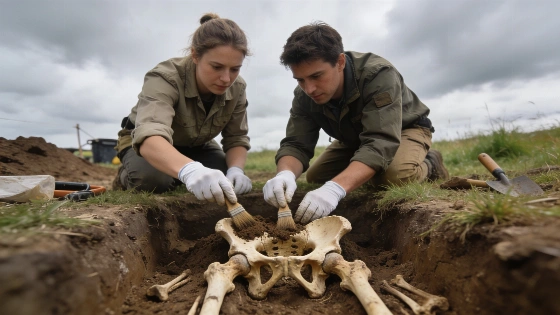
Bioarchaeologists have analyzed over 120 skeletons from a Roman-period mass grave in Vienna, uncovering a high frequency of perimortem trauma-especially to the pelvis-raising new questions about conflict and identity in the region
A recently excavated mass grave beneath a soccer field in Hasenleitengasse, on the outskirts of Vienna, has yielded the remains of at least 129 individuals dating to the first and second centuries CE. The burial, characterized by its disorganized arrangement and lack of typical grave goods, has been interpreted as evidence of a violent event involving young adult males from diverse backgrounds during the Roman period.
Excavation and Context
The site, located in what was once the Roman frontier settlement of Vindobona, was uncovered in 2024 during construction work. Archaeologists documented a minimum of 129 skeletons, all estimated to be males between 18 and 35 years old, based on osteological analysis. The absence of personal items and the presence of a few weapons suggest a rapid, utilitarian burial rather than a formal cemetery. Radiocarbon dating and contextual evidence place the grave within the Roman occupation of the region, though no direct historical record describes a battle at this location.
At least two-thirds of the individuals exhibited signs of perimortem trauma, with injuries distributed across the skeletons. Notably, sharp-force trauma consistent with bladed weapons was observed on various bones, while blunt-force injuries were concentrated on the skulls. Projectile injuries, however, were disproportionately found in the pelvic region, with one skeleton still containing a lance head embedded in the pelvis at the time of excavation.
Trauma Patterns and Interpretation
The pattern of injuries suggests targeted violence, possibly during a military engagement or campaign. The concentration of projectile trauma in the groin and lower limbs may reflect vulnerabilities in armor or deliberate attempts to incapacitate opponents. The scenario is consistent with attackers aiming at exposed areas as individuals rode on horseback, though the precise circumstances remain uncertain. The lack of corroborating archaeological or historical evidence for a specific battle at Hasenleitengasse complicates efforts to reconstruct the event.
Preliminary ancient DNA analysis of 25 individuals confirmed chromosomal male sex and revealed diverse genetic ancestry, including origins from the Italian peninsula, mainland Europe, and the eastern Mediterranean. This diversity aligns with the known composition of Roman military forces but does not exclude the possibility of a mixed group, potentially including local or opposing populations. The absence of clear cultural markers in the burial further limits secure identification of the combatants.
Uncertainty and Ongoing Research
While the evidence supports the interpretation of the grave as the result of mass violence, key questions remain unresolved. It is unclear whether the individuals were Roman soldiers, members of Germanic groups such as the Marcomanni, or a combination of both. The lack of grave goods, the hurried burial, and the trauma patterns all point to a violent episode, but without additional archaeological or textual evidence, the broader context is difficult to establish.
Further analysis of the skeletal remains is underway, including studies of health, diet, and disease, which may provide additional insight into the lives and origins of those buried. The site adds to a growing body of evidence for conflict and rapid burial practices in Roman frontier regions, comparable to discoveries elsewhere in Europe. For example, research at Aspendos in Turkey has also highlighted the complexity of ancient mass burials and the challenges of interpreting identity and cause of death in such contexts, as seen in this analysis of a Classical-period grave with human remains and coins.
Understanding Perimortem Trauma
Perimortem trauma refers to injuries that occurred at or around the time of death, often distinguishable from postmortem damage by the absence of healing and the nature of bone breakage. In archaeological contexts, identifying perimortem trauma requires careful examination of fracture patterns, bone color, and the relationship between injuries and burial conditions. Such analysis can help differentiate between violence, accidental injury, and post-depositional processes, but interpretation is limited by preservation, sample size, and the absence of direct historical records. In mass graves, the combination of demographic profile, trauma distribution, and burial context is critical for reconstructing past events, though uncertainty often remains regarding the precise circumstances and identities involved.