RoboScience has released the REX G1, a wheeled humanoid robot designed to perform object handling and manipulation in logistics, manufacturing, and retail settings, with a focus on adapting to existing environments and variable tasks
RoboScience, a robotics company based in Beijing, has announced the REX G1, a wheeled humanoid robot intended for deployment in logistics, manufacturing, retail, and domestic environments. The REX G1 is designed to move and manipulate objects simultaneously, aiming to address tasks that require both mobility and dexterity in spaces not originally built for robots. The system was introduced on August 17, with the company positioning it as a flexible alternative to fixed industrial arms and stationary automation.
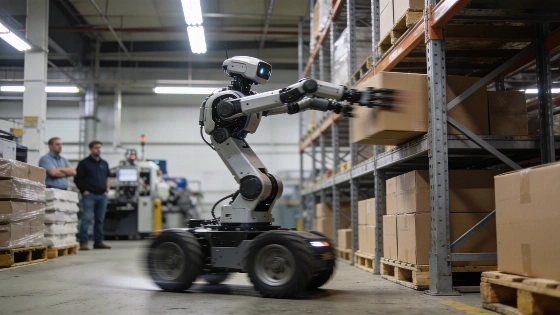
The REX G1 features 22 degrees of freedom, including two in the head and neck, seven in each arm, two in the waist, one lifting axis, and three in the wheeled chassis. Its dual-arm configuration supports a combined payload of up to 10 kilograms. Unlike traditional industrial robots that remain anchored to a single workstation, the REX G1 can travel between locations, performing actions such as lifting and grasping while in motion. The robot's chassis, lifting mechanism, and arms are coordinated to maintain end-effector stability in confined spaces, reducing the need for frequent repositioning. For tasks requiring high precision, the company reports a repeatability of ±0.1 millimeters. The vision system is capable of verifying storage-location codes after grasping, supporting repeated pick-and-place operations.
Integration and Adaptation
One of the central claims of RoboScience is that the REX G1 can be integrated into existing facilities without major modifications. The robot's width is 540 millimeters, with an adjustable length between 540 and 640 millimeters, and a height range from 1,100 to 1,700 millimeters. It is designed to operate at working heights from 0.1 to 2 meters. The REX G1 uses 360-degree stereo vision for environmental perception, and adaptive lighting to function in low-light conditions, reflective shelving, and packaging films. The exterior is matte with rounded edges, and an e-ink information screen is included for human-robot interaction in close quarters. Quick-release access points are intended to simplify maintenance without full disassembly.
Many warehouse robots require changes to aisle width, turning space, or shelving layout. By contrast, RoboScience claims the REX G1 can operate in standard environments, potentially reducing the cost and disruption of deployment. However, the company has not yet released independent field trial data or third-party evaluations of integration performance.
Visics Model and Onboard Processing
At the core of the REX G1 is the Visics model, a proprietary embodied intelligence system based on a Vision-Language-Object-Action (VLOA) architecture. This model is designed to connect visual input and language instructions to physical actions, simulating three-dimensional object trajectories and translating them into control signals. The robot is equipped with onboard computing reportedly capable of 2,070 teraFLOPS, allowing perception, decision-making, and control to be processed locally rather than relying on continuous cloud connectivity. This edge processing is intended to enable the robot to adapt to changing conditions in real time, though the extent of its autonomy and the frequency of required human intervention have not been independently verified.
The REX G1 is powered by a hot-swappable battery, supporting up to four hours of operation per charge. The battery can be replaced without shutting down the system, with work resuming in as little as five seconds. RoboScience describes the robot as a "next-generation embodied intelligent productivity partner," but has not disclosed detailed safety certification status or compliance with international robotics standards.
Deployment Context and Limitations
RoboScience is targeting applications in warehouse handling, flexible manufacturing, retail fulfillment, and future domestic services. The company's approach reflects a broader trend toward mobile, multi-purpose robots that can operate in unstructured or semi-structured environments. However, as with other recent robotics announcements, the evidence for reliable, unsupervised operation in complex real-world settings remains limited. The company has not published systematic data on failure rates, human interventions, or long-term maintenance requirements. For comparison, other research efforts, such as the Fi0 model for cross-body robot task transfer, have explored the challenges of adapting robotic manipulation across different hardware platforms, as discussed in recent coverage of task transfer in soft robot arms.
While the REX G1's specifications suggest potential for flexible deployment, the absence of independent testing and the lack of detailed operational data mean that claims of general-purpose utility should be interpreted with caution. The robot's ability to handle unexpected obstacles, interact safely with humans, and recover from errors in dynamic environments will require further evaluation before large-scale adoption can be assessed.
Understanding the distinction between automation and autonomy is essential when evaluating new robotics systems. Automation refers to the execution of predefined tasks with minimal human input, often within structured environments. Autonomy, by contrast, involves the capacity to make independent decisions and adapt to changing conditions without direct human oversight. Many robots marketed as autonomous still require significant human supervision, especially in unstructured or unpredictable settings. The degree of autonomy achieved by a system like the REX G1 depends not only on its onboard intelligence and sensing but also on the reliability of its control software, the robustness of its perception in real-world conditions, and the procedures in place for human intervention when failures occur.