

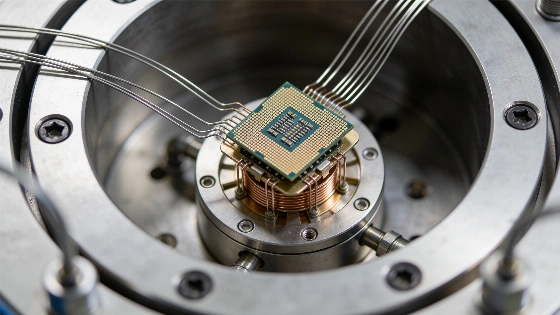
A Riverlane pipeline mines syndrome measurements for correlated noise missing from baseline detector error models. It cut the distance-15 simulated logical error rate by 75% and the rate on Google's distance-7 hardware data by 14%
On Google's below-threshold superconducting experimental dataset, Riverlane's augmented priors produced an error-suppression factor of Λ = 2.02 ± 0.06 across surface-code distances 5 to 7. At distance 7, the logical error rate fell by 14%.
The same approach produced a larger reduction in simulations: at distance 15, the logical error rate was 75% lower than with the baseline model. Across simulated code distances 7 to 15, the augmented detector error model (DEM) raised the error-suppression factor Λ by 20%: from 1.71 ± 0.01 for the unaugmented baseline to 2.06 ± 0.01. The results test whether syndrome data can reveal physical noise correlations that standard theoretical models leave out.
Mining Syndrome Data
Graph-based decoders use a Detector Error Model to describe likely error mechanisms and their relationships to measured syndromes. If the model misses correlated physical noise, including two-qubit crosstalk, its priors may not accurately represent the errors the decoder must handle.
Riverlane's pipeline searches for candidate higher-order mechanisms by combining pairs of mechanisms already present in the baseline DEM, rather than only recalibrating probabilities assigned to known mechanisms. It filters candidates using pairwise and higher-order detector correlations. Each discovered mechanism receives a logical effect derived from its constituent mechanisms, allowing it to be represented as a decomposed hyperedge and used by correlated-matching decoders.
The method screens candidates for pairwise correlations. It then validates higher-order probabilities using joint detection inversion. A separate recurrence-edge step pools identical physical mechanisms across operational rounds without increasing parameter overhead.
The work is described in the preprint "Discovering correlated error mechanisms", by Zohar Schwartzman-Nowik, Matthew P. Stafford, Boris M. Varbanov, and Joan Camps. The paper was submitted to arXiv on 4 November 2026, and an updated version was recorded on 5 November.
Simulation Results
In planar surface-code simulations, the team combined standard SI1000 circuit noise with correlated two-qubit XX crosstalk, set at pcorr = 3 × 10⁻⁴. Across code distances 7 to 15, the augmented DEM achieved an error-suppression factor of Λ = 2.06 ± 0.01. The unaugmented baseline reached Λ = 1.71 ± 0.01.
The distance-15 reduction is the largest reported improvement in this simulation set. It is tied to the specified simulated noise and crosstalk setting; the paper reports it as a benchmark under correlated-matching decoding.
Hardware Benchmark
On Google's experimental dataset, the augmented priors improved the error-suppression factor by 9% over baseline priors optimised with reinforcement learning. The distance-7 logical error rate was 14% lower. This is a benchmark on an existing superconducting-hardware dataset, rather than a claim that Riverlane built or operated the processor.
The hardware result is distinct from the 75% simulated reduction: it measures performance on Google device data across code distances 5 to 7, with the 14% logical-error reduction reported at distance 7. The study's benchmarks cover simulations and this experimental dataset. Full algorithmic derivations and benchmark comparisons are detailed in the arXiv research paper and Riverlane's technical announcement.







