Rigetti Computing has reported a sharp increase in revenue, new U.S. government funding under the CHIPS Act, and a partnership with Hewlett Packard Enterprise to deploy superconducting quantum processors in hybrid supercomputing environments
Rigetti Computing, a developer of superconducting quantum processors, has released its financial and technical results for the second quarter of 2026. The company reported $5.14 million in revenue for the quarter ending June 30, representing a 16.8% increase over the previous quarter and a 185% rise compared to the same period in 2025. This growth was attributed to on-premises system shipments, sales of Novera quantum processing units (QPUs), and international deliveries. Rigetti also announced a Letter of Intent with the U.S. Department of Commerce for up to $100 million in potential funding over three years under the CHIPS Act, aimed at supporting research and development in modular superconducting quantum processors and domestic quantum manufacturing.
Superconducting Quantum Hardware
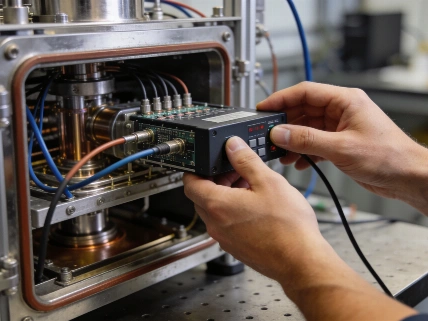
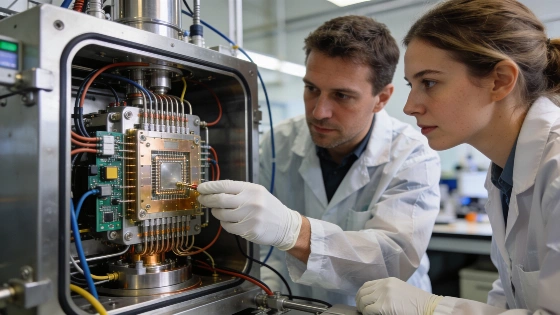
The company's hardware platform is based on superconducting qubits, which require cryogenic operation to maintain quantum coherence. In Q2 2026, Rigetti highlighted the deployment of its 9-qubit Novera system at the Pittsburgh Supercomputing Center's TangleLab testbed, a project funded by the National Science Foundation. The company is also fulfilling international orders, including a 108-qubit system for the Centre for Development of Advanced Computing (C-DAC) in India, and supplying systems to academic and government research institutions worldwide. The Cepheus-1-108Q system, composed of twelve tiled 9-qubit chiplets, was reported to achieve a median single-qubit gate fidelity of approximately 99.9%, a median two-qubit gate fidelity of 99.1%, and gate speeds of 60 nanoseconds. Smaller systems demonstrated two-qubit gate fidelities of 99.6% (36-qubit) and 99.8% (9-qubit) in recent benchmarks.
Financial Position and CHIPS Act Funding
Rigetti's operating expenses for the quarter reached $30.25 million, reflecting continued investment in chiplet-based research and development and infrastructure. The company reported an operating loss of $28.06 million and a net loss of $52.61 million, which included a $29.6 million non-cash charge related to the fair value of derivative warrant liabilities. On a non-GAAP basis, the net loss was $15.98 million. As of June 30, Rigetti held $541.3 million in cash, cash equivalents, and available-for-sale investments, with no debt reported. The Letter of Intent with the Department of Commerce, if finalized, would involve an equity stake for the government and is intended to accelerate R&D on modular superconducting processors, improve coherence times, and expand U.S.-based quantum manufacturing capacity.
Hybrid Supercomputing and International Deployments
Rigetti's partnership with Hewlett Packard Enterprise (HPE) and the Pittsburgh Supercomputing Center is part of a broader trend toward integrating quantum processors with high-performance classical computing infrastructure. The TangleLab testbed will allow researchers to explore hybrid quantum-classical algorithms and benchmarking in a controlled environment. Internationally, Rigetti is delivering systems to research programs in India and other countries, reflecting growing demand for on-premises quantum hardware. The company's roadmap targets the development of ~1,000-qubit systems with two-qubit gate fidelities near 99.9% and sub-50 nanosecond gate speeds within three years, supported by ongoing investment in dilution refrigeration and fabrication infrastructure. Plans are also underway to invest up to $100 million in the United Kingdom to expand research facilities and deploy physical systems.
Technical Benchmarks and Roadmap
While Rigetti's reported gate fidelities and system sizes are consistent with current industry standards for superconducting qubits, the company has not yet demonstrated logical qubits or fault-tolerant operation. The reported fidelities are median values, and system-level performance may vary due to calibration drift, crosstalk, and device variability. The company's roadmap remains ambitious, with targets for larger systems and higher fidelities, but achieving practical quantum advantage will require further improvements in error rates, control electronics, and system integration. For context, recent industry efforts to deploy hybrid quantum-classical testbeds, such as those described in coverage of the Pittsburgh Supercomputing Center's quantum-classical integration, highlight the experimental and engineering challenges that remain before quantum processors can deliver practical computational benefits.
Gate fidelity is a key metric for evaluating the performance of quantum processors. It measures how closely a physical quantum gate operation matches the ideal mathematical transformation, averaged over many repetitions. High gate fidelity is necessary for running deep quantum circuits and for implementing quantum error correction, which encodes logical qubits across multiple physical qubits to detect and correct errors. However, even with fidelities above 99%, noise and calibration drift can limit the depth and reliability of computations on current devices. Achieving fault-tolerant quantum computing will require not only high-fidelity gates but also robust error correction, stable control electronics, and scalable system architectures.