

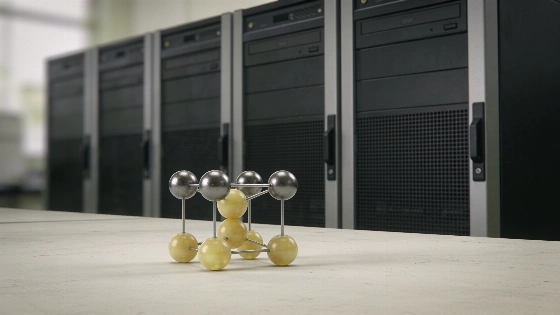
Qunova's HI-VQE combined quantum sampling on IBM Quantum System Two with classical subspace diagonalization on Fugaku to estimate the [4Fe-4S] cluster's ground-state energy at chemical accuracy
Iron-sulfur clusters help drive nitrogen fixation and hydrogen production in enzymes, but their interacting electrons are difficult to model exactly. On November 12, 2026, Qunova Computing reported an 80-qubit simulation of the [4Fe-4S] cubane, with an extrapolated ground-state energy within the commonly used chemical-accuracy benchmark of about 1 kilocalorie per mole.
Sampling and diagonalization
The South Korean developer ran its Handover Iterative Variational Quantum Eigensolver (HI-VQE) across an IBM Quantum System Two processor at RIKEN and the Fugaku supercomputer. The hybrid workflow uses quantum hardware to generate samples, then applies classical subspace diagonalization and extrapolation to estimate the energy; it is not a fully quantum solution of the molecular eigenvalue problem.
That approach has a methodological parallel in an earlier IBM sampling study of iron oxides, which also paired hardware sampling with classical diagonalization. The molecular system and target in that work were different. The [4Fe-4S] cubane is a strongly correlated electronic-structure problem relevant to catalytic systems including nitrogenase and hydrogenase.
The energy benchmark
Qunova reported an extrapolated energy of -327.2482 ± 0.0007 Hartree, compared with a classical density-matrix renormalization group (DMRG) reference of -327.2471 Hartree. The central values differ by about 0.0011 Hartree, or 1.1 milliHartree; the company described the result as within 1.6 milliHartree, approximately 1 kilocalorie per mole. Qunova chief executive Kevin Rhee said the result put the method "on equal footing, in terms of accuracy" with the classical benchmark.
The workflow used 2,518 Fugaku node-hours and reached -326.9821 Hartree by its second iteration. Qunova compared this classical-computing cost with a previously published sample-based quantum diagonalization (SQD) result, claiming an approximately 300-fold reduction in the classical compute burden for that comparison. The figure concerns the classical supercomputing component, rather than a general cost advantage over classical electronic-structure methods.
The company presented the result as its most accurate quantum computation of the molecule to date. Coverage of the announcement described the supporting work as a preprint-level claim. The reported energy is an extrapolated estimate compared with a DMRG reference, not an exact, directly measured eigenvalue.
What the result shows
This is a computational energy benchmark, not a measurement of enzyme activity or a demonstrated prediction of nitrogen fixation or hydrogen production. The result does not itself establish a chemical reaction prediction or practical advantage for broader workloads. The source describes exact classical solutions for this system as intractable.
HI-VQE is designed to avoid assumptions of linearity or spatial locality, according to the supplied description. The company also said its result was more accurate than recent extrapolated trimmed configuration-interaction results. Qunova plans to add orbital-rotation and optimization routines aimed at processing between 500 million and 3 billion unique electronic configurations.







