Terra Quantum and Apex.AI have demonstrated the integration of NIST-standardized post-quantum cryptography into cloud-connected robotic platforms, enabling quantum-resistant communication without altering core software architecture
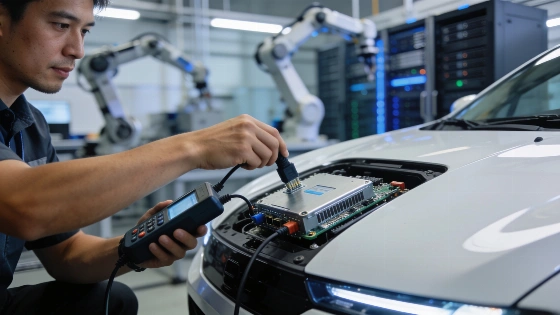
Terra Quantum and Apex.AI have reported a technical demonstration of post-quantum cryptography (PQC) integrated into edge-to-cloud communication for autonomous and robotic systems. The companies implemented NIST-standardized PQC algorithms within Apex.OS, a safety-certified middleware platform used in software-defined vehicles and industrial robots. This approach aims to provide quantum-resistant security for long-lived, cloud-connected assets without requiring changes to existing application logic or real-time communication pipelines.
Long-Lived Autonomous Systems Face Quantum Security Risks
Many autonomous vehicles, industrial robots, and aerospace platforms are designed for operational lifespans extending beyond 2030. These systems depend on persistent cloud connectivity for telemetry, diagnostics, over-the-air software updates, and remote control. Current public-key cryptography methods, such as RSA and elliptic-curve cryptography (ECC), are expected to become vulnerable to attacks from large-scale quantum computers capable of running Shor's algorithm. As a result, the migration to quantum-resistant cryptographic standards is becoming a critical requirement for infrastructure intended to remain secure over decades of service.
The demonstration involved embedding Terra Quantum's PQC libraries directly into the Apex.OS middleware layer. This integration allows developers to adopt quantum-safe encryption for edge-to-cloud messaging while preserving existing software control loops and communication interfaces. The companies state that this method avoids the need for costly and disruptive refactoring of core software architectures, which is a significant barrier for organizations managing fleets of mission-critical connected devices.
Middleware Integration Enables a Drop-In Security Upgrade
While the demonstration focused on commercial mobility and industrial automation, the architecture is also designed to support complex, interconnected Systems-of-Systems, including defense and aerospace applications. The platform aligns with NATO's Multi-Domain Operations (MDO) framework, which requires secure, interoperable communication across land, air, maritime, cyber, and defense domains. The companies claim that their approach offers a scalable blueprint for securing communication networks that must remain resilient against future quantum-enabled threats.
According to the developers, the PQC integration was achieved without modifying the underlying application programming interfaces (APIs) or message-passing architectures. This drop-in approach is intended to facilitate crypto-agility, allowing organizations to update cryptographic algorithms as standards evolve, without incurring major capital expenditures or operational downtime.
Performance and Independent Validation Remain Open Questions
The demonstration did not report specific performance metrics such as encryption latency, throughput, or resource overhead, and independent verification of system-level security and performance under real-world conditions has not yet been published.
For context, the challenge of preparing critical infrastructure for quantum-era threats is being addressed across multiple sectors. For example, efforts to secure blockchain protocols against quantum attacks have been highlighted in recent industry initiatives, such as a program supporting research into post-quantum security for Bitcoin. The transition to PQC standards is a complex process involving not only algorithm selection and software integration, but also hardware compatibility, certification, and ongoing vulnerability assessment.
Post-Quantum Cryptography Is Only One Part of Future-Proof Security
Post-quantum cryptography refers to cryptographic algorithms designed to resist attacks from both classical and quantum computers. Unlike quantum key distribution, which relies on quantum communication channels, PQC algorithms are implemented on conventional digital hardware and are intended as drop-in replacements for existing public-key systems.
The security of PQC depends on mathematical problems believed to be hard for both classical and quantum computers, such as lattice-based constructions. However, the long-term resilience of any cryptographic standard depends on continued cryptanalysis, implementation security, and the pace of quantum hardware development. Migration to PQC is a necessary but not sufficient step toward future-proofing digital infrastructure against quantum-enabled threats.