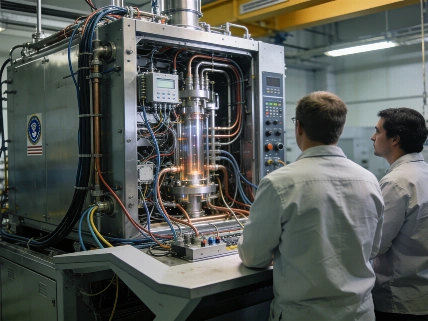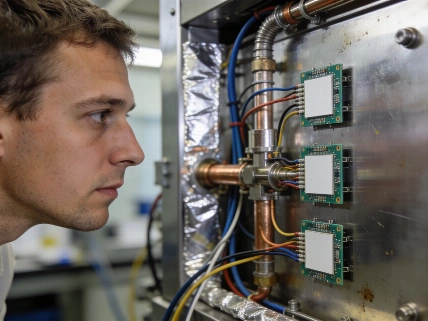
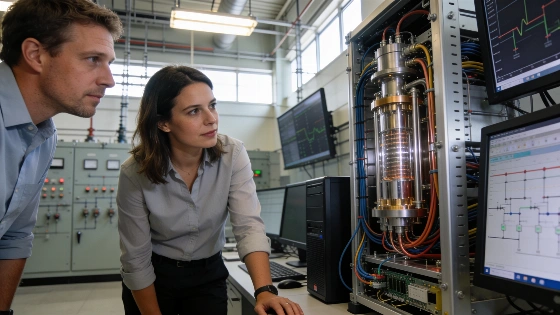
Eaton, Infleqtion, and Penn State will develop and test hybrid quantum-classical algorithms on specialized quantum hardware to analyze and respond to complex threats facing electrical grids under a $7 million U.S. Air Force Research Laboratory contract
The U.S. Air Force Research Laboratory (AFRL) has awarded a $7 million, 24-month contract to Eaton, in partnership with Infleqtion and Pennsylvania State University, to develop and evaluate quantum-enabled analytics for electrical grid resilience. The project aims to address the growing challenge of detecting and mitigating simultaneous physical and cyber threats to critical energy infrastructure, a problem that exceeds the scope of current regulatory standards and classical contingency planning.
Hybrid Quantum-Classical Algorithms
The initiative focuses on designing hybrid quantum-classical algorithms capable of analyzing the vast combinatorial space of grid failure scenarios. While North American Electric Reliability Corporation (NERC) standards require transmission networks to withstand two sequential component failures (N-2), real-world grids increasingly face unpredictable, compound threats such as severe weather, wildfires, cyberattacks, and physical sabotage. These scenarios demand real-time evaluation of exponentially larger configuration spaces, which quickly outstrip the capacity of conventional computing methods.
Specialized Quantum Hardware and Testing
Infleqtion will provide specialized quantum hardware platforms for the project, while Penn State will contribute expertise in artificial intelligence and machine learning. The program will develop and optimize quantum circuits for hybrid execution, test protocols across multiple quantum hardware systems, and evaluate error mitigation strategies. The goal is to determine whether near-term quantum processors can deliver actionable situational awareness and automated contingency responses for defense and commercial power grids. The project will culminate in a proof-of-concept demonstration, but the technical details of the hardware, qubit count, and error rates have not been disclosed.
Benchmarking and Engineering Challenges
One of the central engineering challenges is the integration of quantum hardware with classical grid analytics in a way that delivers measurable improvement over existing methods. The project will benchmark quantum-classical algorithms against current classical approaches, focusing on the ability to detect and visualize multi-threat contingencies in real time. Hardware error mitigation and circuit optimization will be critical, as current quantum processors remain limited by noise, decoherence, and device variability. The program will also test the algorithms on different quantum hardware platforms to assess reproducibility and hardware-specific performance.
Context in Quantum Grid Research
This contract reflects a broader trend of applying quantum computing to complex infrastructure problems, where the combinatorial explosion of possible states challenges classical simulation. Similar efforts have explored benchmarking hybrid quantum-classical algorithms on various hardware platforms, as seen in recent developments involving integration with Quantinuum's trapped-ion systems (see coverage of quantum software benchmarking efforts). However, the practical utility of quantum processors for real-time grid security remains unproven, and the current project is best understood as an experimental testbed rather than a deployable solution.
Quantum error mitigation is a set of techniques used to reduce the impact of noise and hardware imperfections in near-term quantum processors. Unlike full quantum error correction, which encodes logical qubits across many physical qubits to detect and correct errors, error mitigation seeks to improve the reliability of results from noisy intermediate-scale quantum (NISQ) devices without the overhead of large-scale error-correcting codes. In the context of grid security analytics, effective error mitigation is essential for extracting useful information from quantum circuits that are otherwise limited by short coherence times, gate infidelity, and device variability. The success of hybrid quantum-classical approaches in this domain will depend on the ability to manage these errors while integrating quantum outputs into classical decision frameworks.