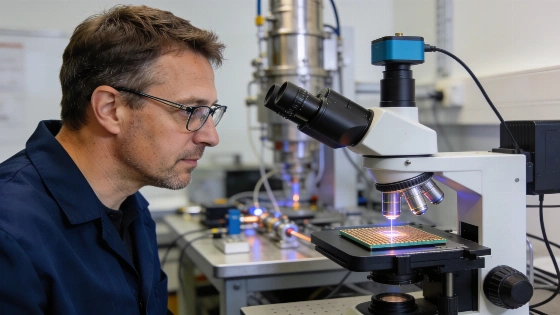
Senior hires at Q.ANT, Qtonic Quantum, QuantrolOx, and Leiden Cryogenics reflect a push to solve the practical challenges of building and scaling quantum hardware, photonic processors, and cryogenic systems.
Quantum hardware firms are reshuffling their leadership as they move from experimental prototypes toward manufacturable systems. Q.ANT recently hired Joerg Behrend, who spent over two decades at IBM's quantum hardware division, to lead the shift of its Thin-Film Lithium Niobate (TFLN) photonic Native Processing Units from lab prototypes to production. Behrend's appointment as Vice President Hardware was confirmed by Q.ANT on September 9, 2026. He will oversee the development of next-generation photonic processors, including chip technology, processor architecture, and preparing NPUs for manufacturing, with teams in Stuttgart and Austin. This is Q.ANT's fifth senior leadership hire in a year, part of a broader management overhaul as the company aims for serial production and industrial rollout of its technology.
Engineering for manufacturability
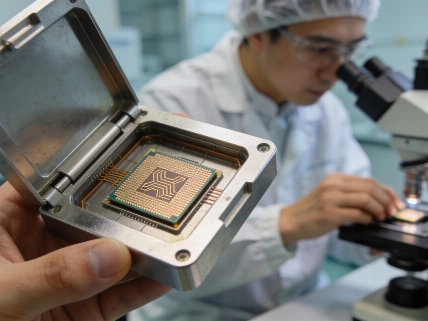
Behrend brings experience in processor development and high-performance computing, having held a senior management role at IBM Quantum in Böblingen. At Q.ANT, he will lead hardware engineering and processor architecture across the company's sites. The TFLN photonic NPUs are designed to take advantage of lithium niobate's low-loss, high-bandwidth properties, but scaling up production with consistent performance remains a challenge. Moving from single-device demonstrations to wafer-scale manufacturing will test both the maturity of the TFLN platform and Q.ANT's process controls. The company describes its photonic processors as energy-efficient and suitable for high-performance computing and AI, a direction that matches research priorities at places like MIT and the Max Planck Society, where photonic and quantum hardware are active research areas.
Meanwhile, Leiden Cryogenics has named Eric Kievit as its new CEO, taking over from founder Giorgio Frossati, who will stay on as a senior scientist. Leiden Cryogenics builds ultralow-temperature cooling systems used in many quantum computing experiments. As of now, Kievit's appointment has not been independently confirmed by outside sources, and further verification is needed. The company's systems have reached record-low base temperatures, but the next step will require not just technical advances but also reliable supply chains and better integration with quantum device makers. Cryogenic infrastructure is still essential for quantum processors, as recent Nature publications have shown in studies of scalable quantum device operation at millikelvin temperatures.
Strategic roles in quantum control and AI
Qtonic Quantum has brought in Gina Fratarcangeli, formerly a managing director at Google, as Senior Advisor for AI Transformation and Global Alliances. With executive experience at Google, Accenture, IBM, and Genpact, she will focus on commercial strategy and post-quantum adoption, especially in building partnerships with systems integrators and cloud providers. The company aims to support post-quantum risk remediation, though technical details of its approach have not yet been made public. The need for strong post-quantum cryptography is highlighted by ongoing research at CERN and Stanford, where integrating quantum-safe protocols is a focus for both academic and enterprise use.
QuantrolOx has appointed Srishti Mahhajan as Global Head of Strategy & Corporate Development. Mahhajan's background in corporate strategy at Barclays, GlobalLogic, and Westpac Group will help drive global growth and partnerships for QuantrolOx's automated quantum control software. The company's platform targets the automation of calibration and control for quantum devices, a bottleneck that has limited reproducibility and scalability in both academic and industrial settings. Automated calibration is a key research area at labs such as Harvard and in projects funded by the European Research Council.
Technical and operational benchmarks
These leadership changes come as technical demands grow. Q.ANT's TFLN photonic NPUs need to show not just low optical loss and high integration density, but also consistent performance across multiple wafers and production runs. According to Q.ANT, Behrend's job is to bridge the gap between R&D and manufacturing, making sure the company's photonic processors are ready for large-scale production and use in energy-efficient AI and high-performance computing. Leiden Cryogenics faces the challenge of delivering cooling systems that keep temperatures below 10 millikelvin with high reliability and minimal downtime, as quantum processors become more complex and require more wiring and thermal management. QuantrolOx's software must automate device calibration across different hardware platforms, reducing manual work and increasing device yield. Qtonic Quantum's commercial strategy will be tested by how quickly post-quantum cryptography is adopted and by the technical demands of adding quantum-safe protocols to existing enterprise systems.
These moves are part of a wider trend in the quantum sector, as seen in recent coverage of leadership changes at other quantum hardware and software companies. The industry is shifting focus from proof-of-concept demonstrations to the engineering realities of device yield, system integration, and operational reliability.
Limits of current quantum hardware
Even with experienced leaders in place, the technical barriers to scalable quantum computing are still significant. Photonic processors based on TFLN must solve issues with loss, crosstalk, and packaging before they can support large-scale quantum circuits. Cryogenic systems need to provide stable, low-vibration environments for increasingly complex wiring and control electronics, while staying serviceable and reliable for commercial users. Automated control software must handle device variability and drift, offering robust calibration without introducing new errors. Progress will depend not just on technical breakthroughs, but also on coordinating engineering, manufacturing, and supply chains across international teams. These challenges are the focus of ongoing studies in journals like Science and PNAS, where reproducibility and scalability are seen as central hurdles for the field.
Leadership changes alone will not solve these problems, but they show that companies recognize the next phase of quantum hardware development will depend on engineering discipline, not just lab innovation. The firms making these hires are betting that operational expertise and cross-sector experience will help move from prototype to product. The real test will be whether these teams can deliver quantum systems that are reproducible, manufacturable, and maintainable for both researchers and commercial users.
To put these developments in context, it's important to distinguish between lab demonstrations and scalable quantum hardware. A device that works well in a controlled experiment may not perform consistently when manufactured at scale, due to variability in fabrication, calibration, and environmental conditions. Device yield-the share of manufactured devices that meet performance standards-remains a major bottleneck for quantum processors, photonic chips, and cryogenic systems. Achieving high yield and reproducibility is essential for any claim of scalability or commercial readiness in quantum technology.